Arum italicum
Mill.
Italian Arum, Portland arrowroot, Large cuckoo pint
iNaturalist· cc-by-nc-sa
(c) Stefano, some rights reserved (CC BY-NC-SA)
iNaturalist· cc-by-nc
(c) Christine Ridgway, some rights reserved (CC BY-NC), uploaded by Christine Ridgway
iNaturalist· cc-by-nc
(c) al3xdr, some rights reserved (CC BY-NC), uploaded by al3xdr
Summary
Source: WikipediaArum italicum is a species of flowering herbaceous perennial plant in the family Araceae, also known as Italian arum and Italian lords-and-ladies. It is native to the British Isles and much of the Mediterranean region, the Caucasus, Canary Islands, Madeira and northern Africa. It is also naturalized in Belgium, the Netherlands, Austria, Argentina, North Island New Zealand and scattered locations in North America.
Description
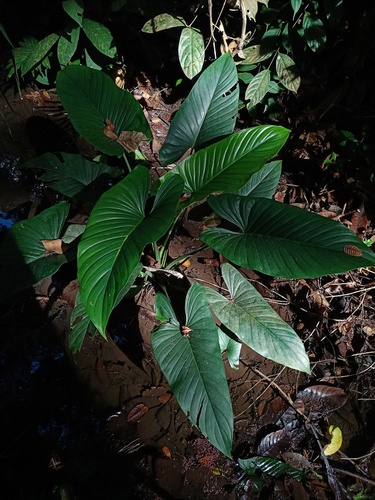
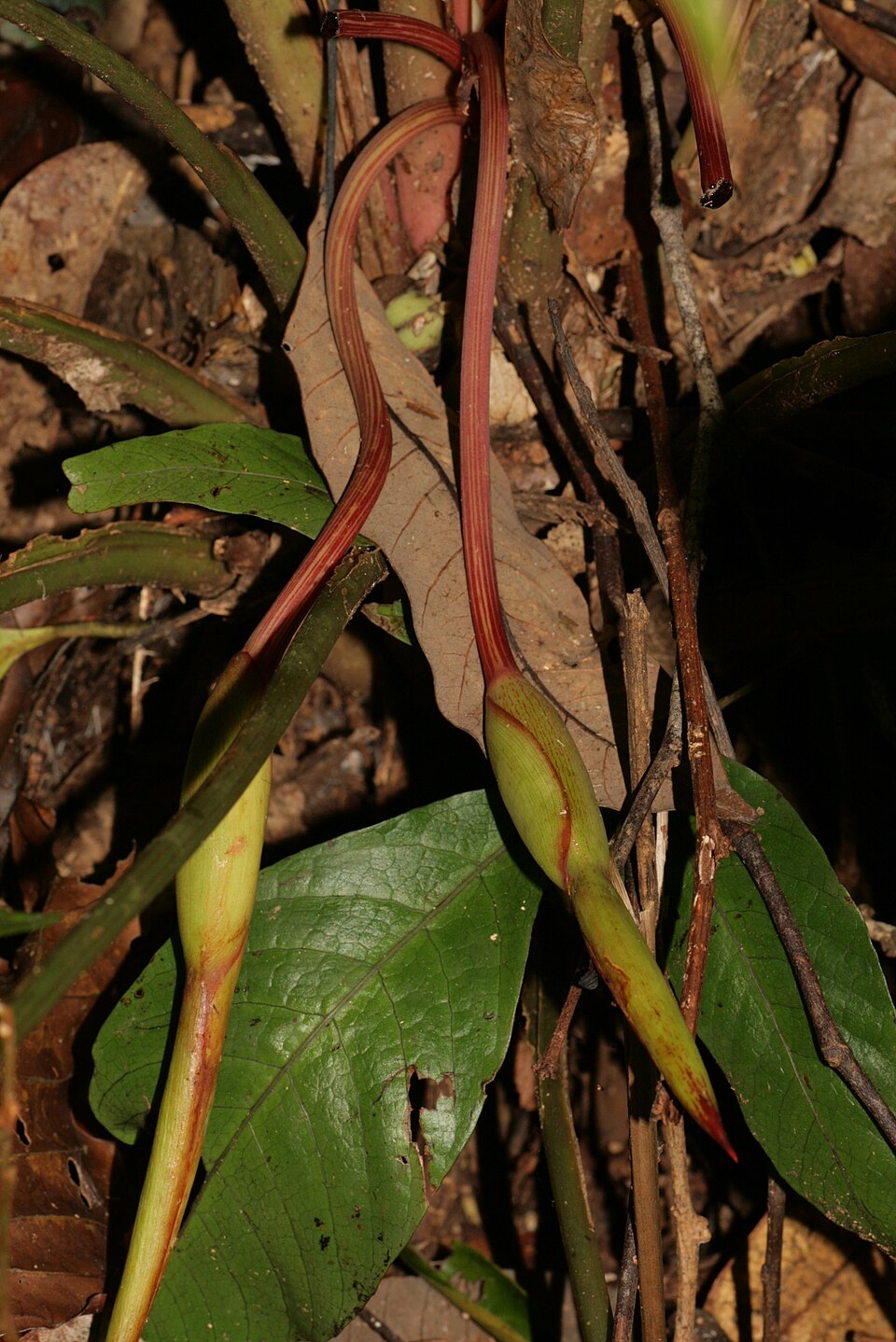
A bulb plant. It grows 25-30 cm high and spreads 15-20 cm wide. The leaves are glossy and with white veins. They have wavy edges and are shaped like a spear head. The flower has a hood like spathe around a central column. The spathe is 15-30 cm long. It droops at the pointed tip. The fruit are bright orange berries. They are in a fruiting spike 10-15 cm long.
Edible Uses
Edible Parts: Root Edible Uses: Tuber - cooked and used as a vegetable. An arrowroot can be extracted from the dried root. The root must be thoroughly dried or cooked before being eaten, see the notes above on toxicity.
Traditional Uses
The running rootstock is gathered, dried and ground to a powder then mixed with the flour of barley or wheat. The root is cooked and eaten. It is cooked for a long time in several changes of water. The leaves are chopped and mixed with egg to prepare an omelette. CAUTION: This plant is poisonous.
Medicinal Uses
None known
Known Hazards
Leaves, fruits and rhizomes contain compounds that make them poisonous. Notably, the plants are rich in oxalates. The ingestion of the tuber may be fatal, as it affects the kidneys, digestive tract, and brain. Additionally, the sap of the plant can cause skin irritation, so it is recommended that gloves should be worn when removing it from an area.
Distribution
It is a temperate plant. It suits moist shaded places. It suits hardiness zones 6-10.
Where It Grows
Africa, Albania, Argentina, Australia, Balkans, Bosnia, Britain, Canada, Croatia, Egypt, Europe, France, Greece, Iraq, Italy, Mediterranean, Middle East, North Africa, North America, Portugal, Slovenia, South America, Spain, Tunisia, Turkey, Türkiye, Uruguay,
Cultivation
Prefers a humus rich soil and abundant water in the growing season. Succeeds in sun or dry shade, preferring a shady position and growing well in woodland conditions. A polymorphic species, the British form has been separated off by some botanists as A. neglectum. The leaves appear in the autumn, the plant staying green all winter. The inflorescence has the remarkable ability to heat itself above the ambient air temperature to such a degree that it is quite noticeable to the touch. This probably protects the flowers from damage by frost, or allows it to penetrate frozen ground. Members of this genus are rarely if ever troubled by browsing deer.
Propagation
Seed - best sown in a greenhouse or cold frame as soon as it is ripe. The seed usually germinates in 1 - 6 months at 15°c. Stored seed should be sown in the spring in a greenhouse and can be slow to germinate, sometimes taking a year or more. A period of cold stratification might help to speed up the process. Sow the seed thinly, and allow the seedlings to grow on without disturbance for their first year, giving occasional liquid feeds to ensure that they do not become mineral deficient. When the plants are dormant in the autumn, divide up the small corms, planting 2 - 3 in each pot, and grow them on in light shade in the greenhouse for a further year, planting out when dormant in the autumn. Division of the corms in summer after flowering. Larger corms can be planted out direct into their permanent positions, though it is best to pot up the smaller corms and grow them on for a year in a cold frame before planting them out.
Other Uses
None known Special Uses
Notes
It should not be eaten in large quantities. There are 12-26 Arum species.
Nutrition
| Part | Moisture | kJ | kcal | Protein | Vit A | Vit C | Iron | Zinc |
|---|---|---|---|---|---|---|---|---|
| Root | — | — | — | — | — | — | — | — |
| Leaves dry | — | — | 33.2 | — | — | — | — | — |
Synonyms
Also Known As
Aro, Karduw, Konjska blitva, Laški kačnik, Nivik
References (26)
- Ahmad, S. A. & Askari, A. A., 2015, Ethnobotany of the Hawraman Region of Kurdistan Iraq. Harvard Papers in Botany, Vol. 20, No. 1, 2015, pp. 85–89.
- Bircher, A. G. & Bircher, W. H., 2000, Encyclopedia of Fruit Trees and Edible Flowering Plants in Egypt and the Subtropics. AUC Press. p 44
- Blamey, M and Grey-Wilson, C., 2005, Wild flowers of the Mediterranean. A & C Black London. p 503
- Blanco-Salas, J., et al, 2019, Wild Plants Potentially Used in Human Food in the Protected Area “Sierra Grande de Hornachos” of Extremadura (Spain). Sustainability 2019, 11, 456
- Bodkin, F., 1991, Encyclopedia Botanica. Cornstalk publishing, p 105
Show all 26 references Hide references
- BOUQUET
- Brown, D., 2000, Aroids. Plants of the Arum family. Timber Press. (Second edition) p 271
- Brickell, C. (Ed.), 1999, The Royal Horticultural Society A-Z Encyclopedia of Garden Plants. Convent Garden Books. p 142
- Burnie, G.(Ed.), 2003, Annuals and Bulbs. The Gardener's Handbooks. Fog City Press. p 246
- Cundall, P., (ed.), 2004, Gardening Australia: flora: the gardener's bible. ABC Books. p 192
- Demir, E., et al, 2020, Nutrient and bioactive substance contents of edible plants grown naturally in Salıpazarı (Samsun). Acta Sci. Pol. Hortorum Cultus, 19(1), 151–160
- Ertug, F, Yenen Bitkiler. Resimli Türkiye Florası -I- Flora of Turkey - Ethnobotany supplement
- Gard. dict. ed. 8: Arum no. 2. 1768
- Hedrick, U.P., 1919, (Ed.), Sturtevant's edible plants of the world. p 78
- Joyce, D., 1998, The Garden Plant Selector. Ryland, Peters and Small. p 282
- Kizilarslan, C. & Ozhatay, N., 2012, An ethnobotanical study of the useful and edible plants of İzmit. Marmara Pharmaceutical Journal 16: 134-140, 2012.
- Lazarides, M. & Hince, B., 1993, Handbook of Economic Plants of Australia, CSIRO. p 26
- Lim, T. K., 2015, Edible Medicinal and Non Medicinal Plants. Volume 9, Modified Stems, Roots, Bulbs. Springer p 12
- Luczaj et al, 2013, Wild vegetable mixes sold in the markets of Dalmatia (southern Croatia). Journal of Ethnobiology and Ethnomedicine. 8:2
- Luczaj, L. et al, 2014, Wild Food Plants of Dalmatia (Croatia). in A. Pieroni, C. L. Quave (eds.), Ethnobotany and Biocultural Diversities in the Balkans, p 138
- Plants for a Future database, The Field, Penpol, Lostwithiel, Cornwall, PL22 0NG, UK. http://www.scs.leeds.ac.uk/pfaf/
- Redzic, S. J., 2006, Wild Edible Plants and their Traditional Use in the Human Nutrition in Bosnia-Herzegovina. Ecology of Food and Nutrition, 45:189-232
- Ryan, S., 2008, Dicksonia. Rare Plants Manual. Hyland House. p 121
- Slocum, P.D. & Robinson, P., 1999, Water Gardening. Water Lilies and Lotuses. Timber Press. p 109
- Turner, N. J. et al, 2011, Edible and Tended Wild Plants, Traditional Ecological Knowledge and Agroecology. Critical Reviews in Plant Sciences, 30:198-225
- Wilson, S., 1997, Some Plants are Poisonous. Reed. p 25