Disphyma crassifolium
(L.) L. Bolus
Rounded noon-flower, Round-leaved Pig Face
iNaturalist· cc-by-nc
(c) Kaitlyn, some rights reserved (CC BY-NC), uploaded by Kaitlyn
iNaturalist· cc-by-nc
(c) Jordi López-Pujol, some rights reserved (CC BY-NC), uploaded by Jordi López-Pujol
iNaturalist· cc-by-sa
(c) Tony Rebelo, some rights reserved (CC BY-SA), uploaded by Tony Rebelo
Summary
Source: WikipediaDisphyma crassifolium, commonly known as round-leaved pigface or salty fingers is a species of flowering plant in the family Aizoaceae native to Australia and the Cape Provinces of South Africa. It is a prostrate, succulent annual shrub or short-lived perennial plant with stems up to 2 m (6 ft 7 in) long, leaves that are three-sided in cross-section with a rounded lower angle, and purple daisy-like flowers with staminodes up to 30 mm (1.2 in) long.
Description
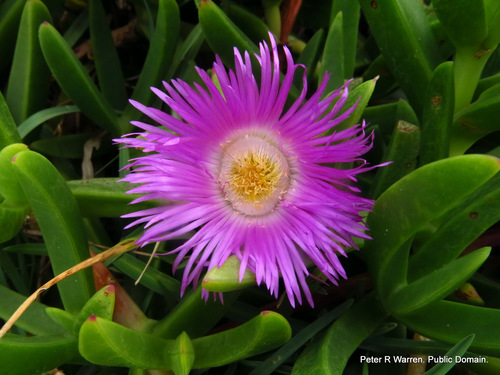
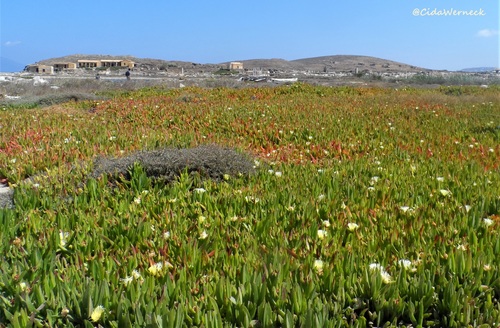
A herb which lies along the ground. It is soft and succulent. It can spread 1-2 m wide. It can form dense mats over the ground. The branches root at the nodes. The leaves are sausage shaped. They are fleshy. They are 2-3 cm long and rounded in cross section. They can be red. The flowers are 1-5 cm across. They are light purple with some white colour. The fruit is a capsule which becomes dry and hard at maturity.
Edible Uses
The leaves, flowers, and fruit are edible.
Distribution
It is a temperate plant. It grows in drier sandy parts of salt marshes and on cliffs. It grows in coastal locations and up to 500 km inland. It can tolerate drought and frost. It does well on salty soils. It needs good drainage.
Where It Grows
Africa, Australia*, New Zealand, Pacific, South Africa, Southern Africa, Tasmania*,
Cultivation
Plants can be grown from stem or leaf cuttings. It can also be grown from seed. Cuttings form roots quickly.
Notes
There are 3 Disphyma species.
Synonyms
References (13)
- Bodkin, F., 1991, Encyclopedia Botanica. Cornstalk publishing, p 350
- Breidahl H., 1997, Australian Southern Shores. Lothian. p 122
- Cameron, M., (Ed.) 1981, A Guide to Flowers & Plants of Tasmania. Reed p 100
- Dashorst, G.R.M., and Jessop, J.P., 1998, Plants of the Adelaide Plains & Hills. Botanic Gardens of Adelaide and State Herbarium. p 54
- Flora of Australia, Volume 4, Phytolaccaceae to Chenopodiaceae, Australian Government Publishing Service, Canberra (1984) p 36
Show all 13 references Hide references
- Fl. Pl. South Africa 7: t. 276. 1927
- Harris, S., Buchanan, A., Connolly, A., 2001, One Hundred Islands: The Flora of the Outer Furneaux. Tas Govt. p 150
- Hibbert, M., 2002, The Aussie Plant Finder 2002, Florilegium. p 88
- Howells, C & Gulline, H., 2003, Coastal Plants of Tasmania. Plant Identikit. Australian Plant Society, Tasmania. p 24
- Low, T., 1991, Wild Food Plants of Australia. Australian Nature FieldGuide, Angus & Robertson. p 30
- Low, T., 1992, Bush Tucker. Australia’s Wild Food Harvest. Angus & Robertson. p 59
- Paczkowska, G. & Chapman, A.R., 2000, The Western Australian Flora. A Descriptive Catalogue. Western Australian Herbarium. p 134
- Woolmore, E et al, 2002, King Island Flora: A Field Guide. p 21
More from Aizoaceae
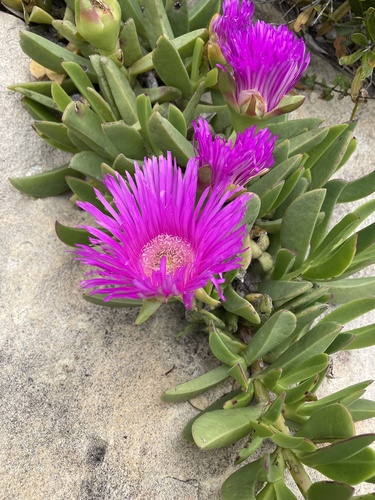
Carpobrotus acinaciformis
Red Hottentot fig, Giant pigface
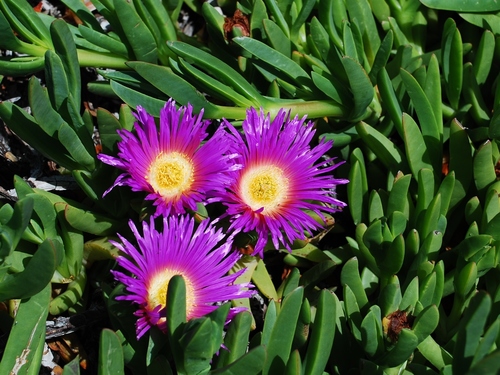
Carpobrotus aequilaterus
Noonflower, Angular pigface, Chilean pigface
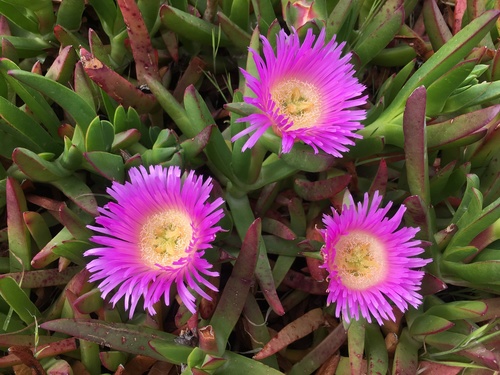
Carpobrotus chilensis
Sea fig
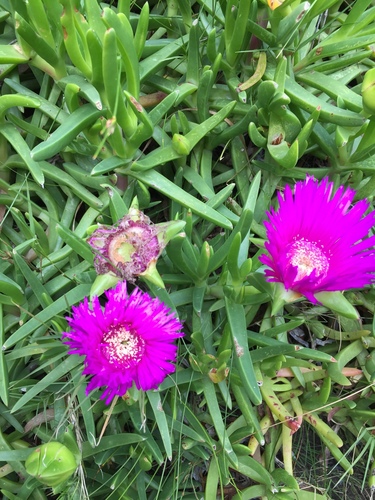
Carpobrotus deliciosus
Sweet hottentot fig, Ice-plant, Sour-fig
Carpobrotus dimidiatus
Natal sourfig
Carpobrotus edulis
Hottentot Fig, Ice-plant