Carpobrotus rossii
(Haw.) Schwantes
Karkalla, Pigface
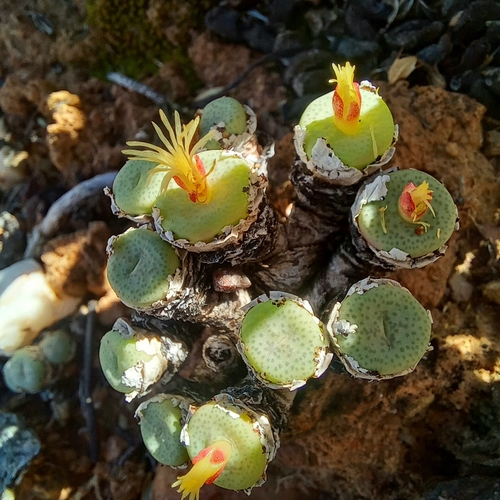
iNaturalist· cc-by
(c) Rolf Lawrenz, some rights reserved (CC BY), uploaded by Rolf Lawrenz
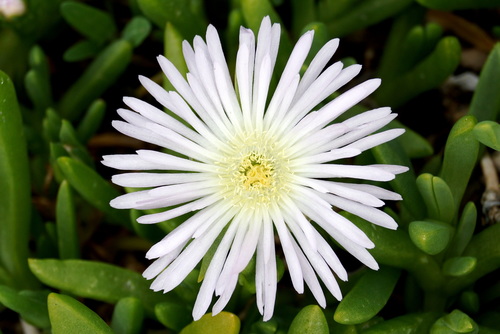
iNaturalist· cc-by-nc
(c) Ryan Shofner, some rights reserved (CC BY-NC), uploaded by Ryan Shofner
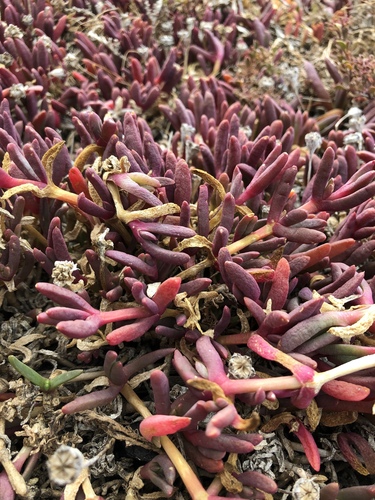
iNaturalist· cc-by-nc
(c) Ellura Sanctuary, some rights reserved (CC BY-NC), uploaded by Ellura Sanctuary
Summary
Source: WikipediaCarpobrotus rossii (formerly Mesembryanthemum rossii) is a succulent coastal groundcover plant of the family Aizoaceae. Native to southern Australia, it is known by various common names, including karkalla, pig face, sea fig and beach bananas. C. rossii can be confused with rounded noon-flower Disphyma crassifolium subsp. clavellatum, which has also been erroneously called "karkalla" and "beach bananas" in the Australian native food trade.
Description
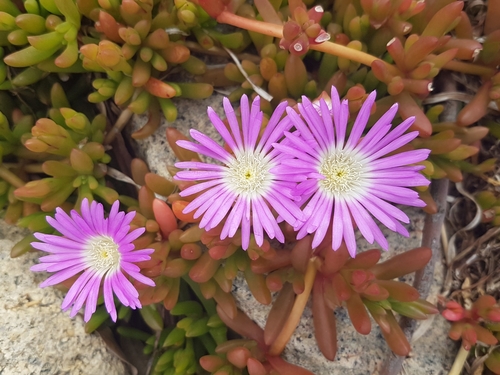
A plant which forms a carpet over the ground. It spreads 2-4 m wide. The stems are slender. The leaves are succulent or soft and fleshy. They are triangle shaped in cross section. The leaves are up to 6-10 cm long and 5-8 mm broad. They are curved inwards and taper from the base. The flowering branches curve upwards. The flowers are large and purple or pink. They are 3.5-5.5 cm across. The flower stalks are 3 cm long. The fruit are 2 cm long by 1.5 cm wide and almost round. They are purplish-red.
Edible Uses
None known.
Traditional Uses
The fruit are eaten both fresh and dried. The leaves are eaten with meat. They are salty. They can be eaten raw or cooked.
This uses section is brief — help expand it
Medicinal Uses
None known.
Distribution
Temperate. It can grow in the subtropics and in semiarid places. It needs well drained soil. It can grow in dry soil and in full sun. It cannot stand frost. It can grow near coasts. It grows on sand dunes and the edges of salt marshes. Melbourne Botanical Gardens. Hobart Botanical Gardens. Tasmania Herbarium. Arboretum Tasmania.
Where It Grows
Australia*, Tasmania*,
Cultivation
Plants can be grown from seed, cuttings or divisions of the stems which have rooted. Cuttings form roots quickly.
Other Uses
None known.
Other Information
It is produced commercially.
Notes
It is good for binding loose soil. There are about 25 Carpobrotus species. Also put in the family Mesembryanthemaceae.
Synonyms
Also Known As
Gadwud, Katwort, Keeng-a, Puuyuupkil, Wenddar
References (27)
- Alice, L. & O'Quinn, T., Australian Bush Superfoods. Explore Australia p 78
- Bodkin, F., 1991, Encyclopedia Botanica. Cornstalk publishing, p 217
- Bonney, N., 1997, Economic Native Trees and Shrubs for South Australia. Greening Australia (SA) inc. Campbelltown SA 5074 p 56
- Bonney, N., 2012, Edible Wild Native Plants for Southern Australia. p 28
- Breidahl H., 1997, Australian Southern Shores. Lothian. p 122
Show all 27 references Hide references
- Cameron, M., (Ed.) 1981, A Guide to Flowers & Plants of Tasmania. Reed p 100
- Clarke, P. A., 2013, The Aboriginal Ethnobotany of the Adelaide Region, South Australia. Transactions of the Royal Society of South Australia. (2013), 137(1): 97-126
- Cribb, A.B. & J.W., 1976, Wild Food in Australia, Fontana. p 71
- Curtis, W.M., 1963, The Students Flora of Tasmania Vol 2 p 238
- Dashorst, G.R.M., and Jessop, J.P., 1998, Plants of the Adelaide Plains & Hills. Botanic Gardens of Adelaide and State Herbarium. p 54
- De Angelis, D., 2005, Aboriginal Plant Use of the Greater Melbourne Area. La Trobe University Environment Collective
- Elliot, W.R., & Jones, D.L., 1982, Encyclopedia of Australian Plants suitable for cultivation. Vol 2. Lothian. p 466
- Flora of Australia, Volume 4, Phytolaccaceae to Chenopodiaceae, Australian Government Publishing Service, Canberra (1984) p 27
- Greig, D., 1996, Flowering Natives for Home Gardens. Angus & Robertson. p 108
- Harris, S., Buchanan, A., Connolly, A., 2001, One Hundred Islands: The Flora of the Outer Furneaux. Tas Govt. p 129
- Hibbert, M., 2002, The Aussie Plant Finder 2002, Florilegium. p 60
- Hastings Advance Community College, 2017, Uses for Native Plants of the Mornington Peninsula. 86pp. p 30
- King Island Natural Resource Management Group, 2002, King Island Flora: A Field Guide. p 21
- Lazarides, M. & Hince, B., 1993, Handbook of Economic Plants of Australia, CSIRO. p 49
- Low, T., 1991, Wild Food Plants of Australia. Australian Nature FieldGuide, Angus & Robertson. p 30
- Low, T., 1992, Bush Tucker. Australia’s Wild Food Harvest. Angus & Robertson. p 58
- Molyneux, B & Forrester, S., 1997, The Austraflora A-Z of Australian Plants. Reed. p 64
- Paczkowska, G. & Chapman, A.R., 2000, The Western Australian Flora. A Descriptive Catalogue. Western Australian Herbarium. p 133
- Smith, K & I., 1999, Grow your own bushfoods. New Holland. Australia. p 68
- Whiting, J. et al, 2004, Tasmania's Natural Flora. Tasmania's Natural Flora Editorial Committee PO Box 194, Ulverstone, Tasmania, Australia 7315 p 14
- Woolmore, E et al, 2002, King Island Flora: A Field Guide. p 21
- www.ceres.org.au/bushfoodcatalogue