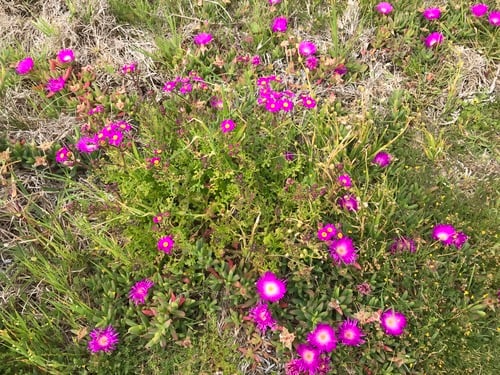
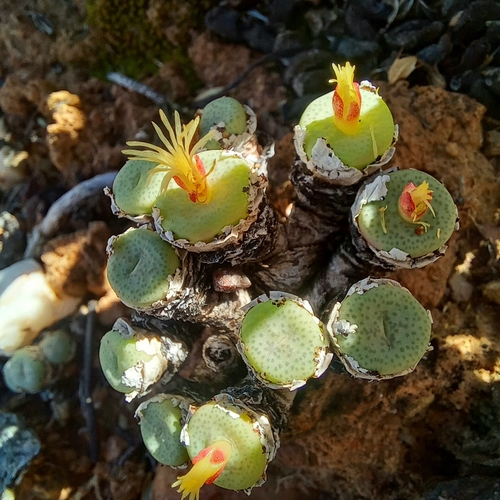
Conicosia pugioniformis
(L.) N. E. Br.
Narrow-leaved iceplant, Giant clockplant
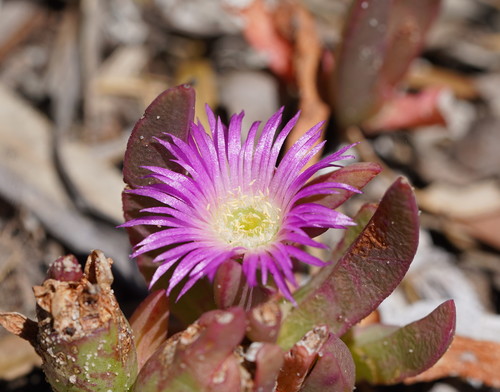
iNaturalist· cc-by-nc
(c) James Bailey, some rights reserved (CC BY-NC), uploaded by James Bailey
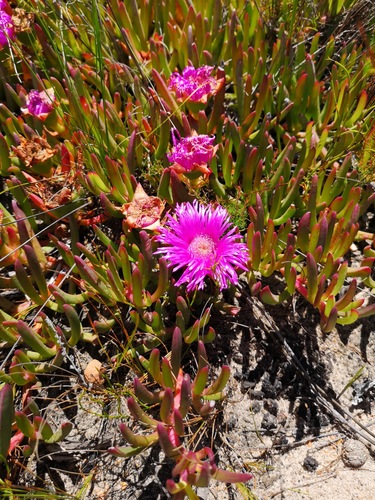
iNaturalist· cc-by-nc
(c) mariepanossian, some rights reserved (CC BY-NC)
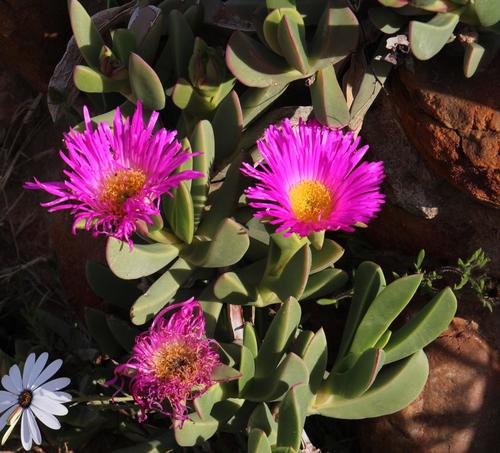
iNaturalist· cc-by-nc
(c) mariepanossian, some rights reserved (CC BY-NC)
Summary
Source: WikipediaConicosia pugioniformis is a species of succulent plant in the ice plant family known by the common names narrow-leaved iceplant and pigroot. It is native to South Africa and it is known on other continents as an introduced species and sometimes a noxious weed. It is an invasive species on the Central Coast of California, where it is a minor threat to native coastal vegetation, although not as harmful as other species of invasive iceplant. This is a short-lived perennial herb growing from an underground caudex. It can sprout vegetatively from the caudex if its aboveground parts are destroyed. The fingerlike leaves are fleshy, gray-green, hairless, and up to 20 centimeters long. The inflorescence is a solitary, malodorous flower up to 8 centimeters wide. It has rings of up to 250 thin petals.
Description
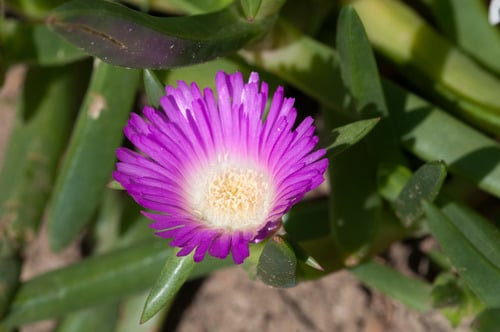
A plant that keeps growing from year to year. It grows 30 cm high and spreads 1 m wide. The stems are thick and erect. The branches lie flat but turn up at the tips. The leaves are narrow and 3 angled. They are greyish-green and taper to the tip. The flowers are yellow and 7 cm across.
Edible Uses
The slimy roots are eaten as a snack. Young fruit capsules are used in stews.
Traditional Uses
The roots are slimy and edible. They are eaten as a snack. The young fruit capsules are used in stews.
This uses section is brief — help expand it
Distribution
It is a subtropical plant. It is best in light, sandy, well-drained soils. It suits an open sunny position. It is resistant to drought and frost.
Where It Grows
Africa, Australia, South Africa*, Southern Africa,
Cultivation
Plants are grown from seeds.
Notes
Also put in the family Mesembryanthemaceae.
Nutrition
| Part | Moisture | kJ | kcal | Protein | Vit A | Vit C | Iron | Zinc |
|---|---|---|---|---|---|---|---|---|
| Roots | 73.2 | 397 | 95 | 0.6 | — | 3.6 | 8.8 | 0.3 |
Synonyms
Also Known As
Duikerwortel, Snotwortel
References (9)
- Bodkin, F., 1991, Encyclopedia Botanica. Cornstalk publishing, p 275
- Brickell, C. (Ed.), 1999, The Royal Horticultural Society A-Z Encyclopedia of Garden Plants. Convent Garden Books. p 291
- Gard. Chron. ser. 3, 84:253. 1928 (E. Phillips, Gen. S. Afr. fl. pl. 247. 1926, nom. nud.)
- Jardin, C., 1970, List of Foods Used In Africa, FAO Nutrition Information Document Series No 2.p 130
- Ruiters-Welcome, A. K., 2019, Food plants of southern Africa. Ph.D. thesis. Univ. of Johannesburg p 7
Show all 9 references Hide references
- van Wyk, Be., & Gericke, N., 2007, People's plants. A Guide to Useful Plants of Southern Africa. Briza. p 68
- van Wyk, B-E., 2011, The potential of South African plants in the development of new food and beverage products. South African Journal of Botany 77 (2011) 857–868
- Wehmeyer, A. S, 1986, Edible Wild Plants of Southern Africa. Data on the Nutrient Contents of over 300 species
- Welcome, A. K. & Van Wyk, B.-E., 2019, An inventory and analysis of the food plants of southern Africa. South African Journal of Botany 122 (2019) 136–179