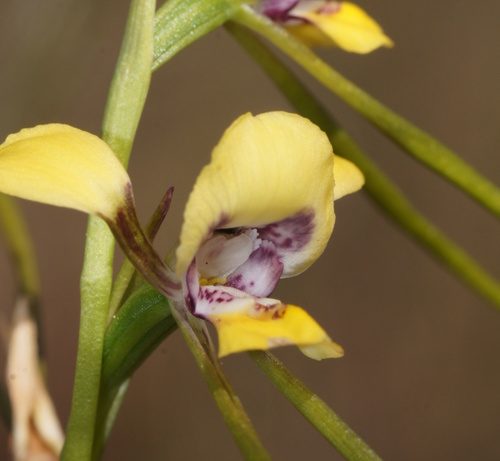
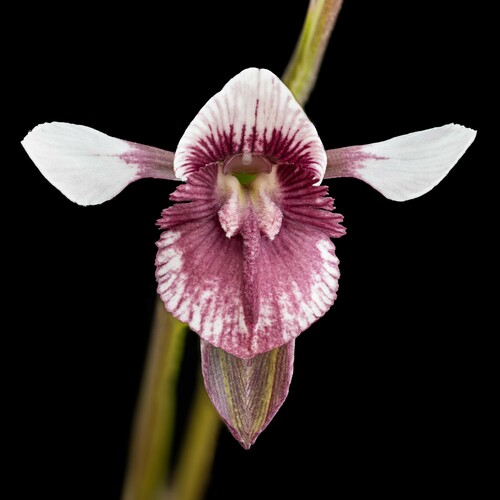
Dipodium roseum
D. L. Jones and M. A. Clem.
Pink hyacinth orchid
iNaturalist· cc-by-nc
(c) izakschoon, some rights reserved (CC BY-NC), uploaded by izakschoon
iNaturalist· cc-by-nc
(c) Karen Retra, some rights reserved (CC BY-NC)
Summary
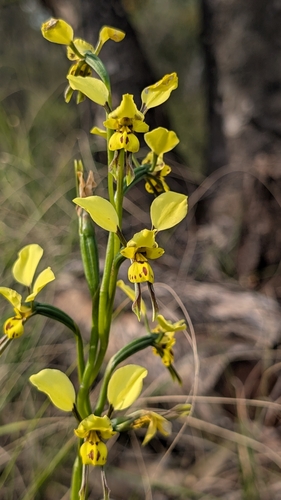
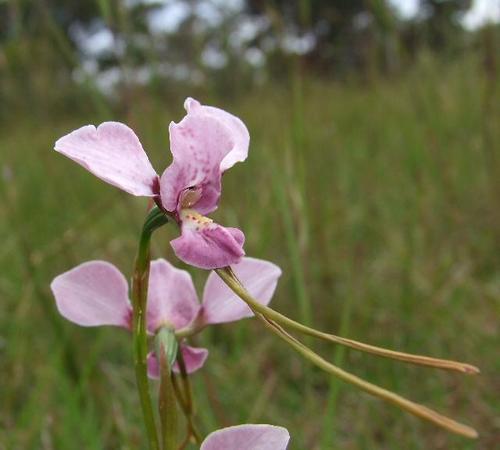
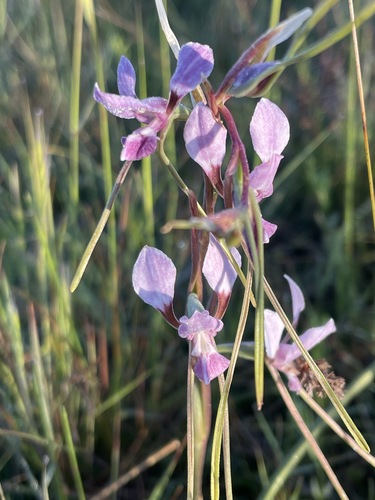
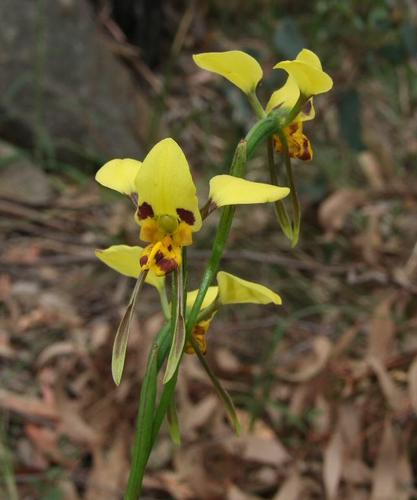
Source: WikipediaDipodium roseum, commonly known as rosy hyacinth-orchid or pink hyacinth-orchid, is a leafless saprophytic orchid found in east and south-eastern Australia. In summer it produces a tall flowering stem with up to fifty pale pink flowers with small, dark red spots. A widespread and common species it is often confused with D. punctatum but has darker, less heavily spotted flowers.
Description
A robust orchid. A herb which is without leaves and grows on rotting plant material. It grows to 1 m high. The flowers are along a stalk 60 cm long. They are pale pink with darker spots. The flowers are 2 cm across. The sepals and petals are free, spreading and equal. The rhizome is light brown with white flesh and 1.5 cm across.
Edible Uses
The tuber, root, and rhizome are edible portions.
Distribution
It is a temperate plant. It grows from the coast to the hills. It occurs in dry open forest.
Where It Grows
Australia*, Tasmania,
Cultivation
It is almost impossible to grow this species at present. It may be possible to grow it from seed in lots of sawdust near Eucalypt trees.
Notes
There are 22 Dipodium species. Dipodium roseum has now been separated off from Dipodium punctatum.
Synonyms
References (16)
- Bodkin, F., 1991, Encyclopedia Botanica. Cornstalk publishing, p 348
- Cameron, M., (Ed.) 1981, A Guide to Flowers & Plants of Tasmania. Reed p 96
- Caton, J.M. & Hardwick, R. J., 2016, Field Guide to Useful Native Plants from Temperate Australia. Harbour Publishing House. p 340
- Cherikoff V. & Isaacs, J., The Bush Food Handbook. How to gather, grow, process and cook Australian Wild Foods. Ti Tree Press, Australia p 195
- Clarke, P. A., 2013, The Aboriginal Ethnobotany of the Adelaide Region, South Australia. Transactions of the Royal Society of South Australia. (2013), 137(1): 97-126
Show all 16 references Hide references
- Cronin, L., 1989, The Concise Australian Flora. Reed. p 74
- Dashorst, G.R.M., and Jessop, J.P., 1998, Plants of the Adelaide Plains & Hills. Botanic Gardens of Adelaide and State Herbarium. p 204
- Elliot, W.R., & Jones, D.L., 1984, Encyclopedia of Australian Plants suitable for cultivation. Vol 3. Lothian. p 298
- Grieg, D., 2002, A photographic guide to Wildflowers of South-eastern Australia. New Holland. p 92
- Jones, D., Wapstra, H., Tonelli, P., and Harris S., 1999, The Orchids of Tasmania. Miegunyah Press, MUP, Victoria, Australia. p 131 (Dipodium roseum)
- Lim, T. K., 2015, Edible Medicinal and Non Medicinal Plants. Volume 9, Modified Stems, Roots, Bulbs. Springer p 39
- Low, T., 1992, Bush Tucker. Australia’s Wild Food Harvest. Angus & Robertson. p 122
- Minchin, R.F., Tasmanian Wildflowers. A Field Guide. Volume one. Regal Publications, Launceston p 36
- Scarth-Johnson, V., 2000, National Treasures. Flowering Plants of Cooktown and Northern Australia. Vera Scarth-Johnson Gallery Association. Cooktown, Australia. p 157
- Tasmanian Herbarium Vascular Plants list p 73
- Zola, N., & Gott, B., 1992, Koorie Plants Koorie People. Koorie Heritage Trust. p 34 (As Dipodium punctatum)