Dioscorea oppositifolia
L.
Chinese yam, Cinnamon yam
iNaturalist· cc-by-nc
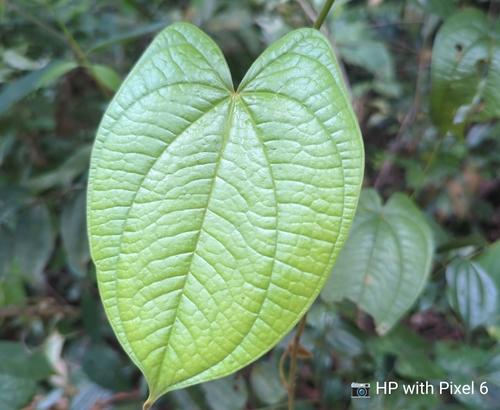
(c) Aniruddha Singhamahapatra, some rights reserved (CC BY-NC), uploaded by Aniruddha Singhamahapatra
iNaturalist· cc-by-nc-nd
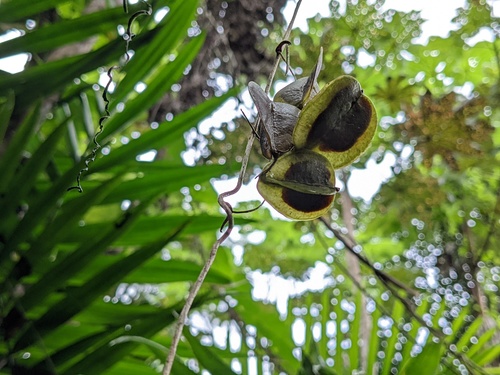
(c) Dinesh Valke, some rights reserved (CC BY-NC-ND)
iNaturalist· cc-by-sa
(c) Dinesh Valke, some rights reserved (CC BY-SA)
Summary
Source: WikipediaDioscorea oppositifolia is a type of yam (Dioscorea) native to Myanmar (Burma) and to the Indian subcontinent (India, Sri Lanka, Bangladesh).
Description
A yam. It is a large climber that keeps growing from year to year. The tuber is cylinder shaped and 50-90 cm long. The stem twines clockwise. It produces bulbils in the axils of leaves. The leaves are opposite and have 3-5 leaflets like fingers on a hand. They are 5-20 cm long by 3-8 cm wide.
Edible Uses
The tubers are cut and washed with salt and fresh water to remove the alkaloid dioscorine, then cooked and eaten. They can be boiled, mashed, fried, or added to soups. Bulbils are also edible. Starch is extracted from the roots.
Traditional Uses
The tubers are cut and washed with successively with salt and fresh water to remove an alkaloid dioscorine then cooked and eaten. The tubers are cooked and eaten. They are not glutinous so have little binding strength. They can be boiled, mashed, fried, or added to soups. A starch is extracted from the roots.
Known Hazards
Raw tubers contain the alkaloid dioscorine, which must be removed through washing with salt and fresh water before cooking and consumption.
Distribution
A tropical plant. It grows on the Deccan in India. It grows in open forest or along the edge of the forest. It is a cold hardy species. It grows on hillsides and steep valleys between 500-1,500 m altitude. In Sichuan.
Where It Grows
Asia, Bangladesh, Brazil, Canada, China, Cuba, Himalayas, India, Japan, Korea, Nepal, North America, Northeastern India, Sikkim, South America, Sri Lanka, USA, West Indies,
Production
In Sikkim tubers are available December to March.
Other Information
It is available dried in Chinese stores in Australia. It is cultivated.
Notes
There are about 650 species of Dioscorea. Dioscorea opposita is an illegitimate, superfluous name (ICBN Art. 52) for D. oppositifolia L.; non D. opposita auct. (= D. batatas Decne.)