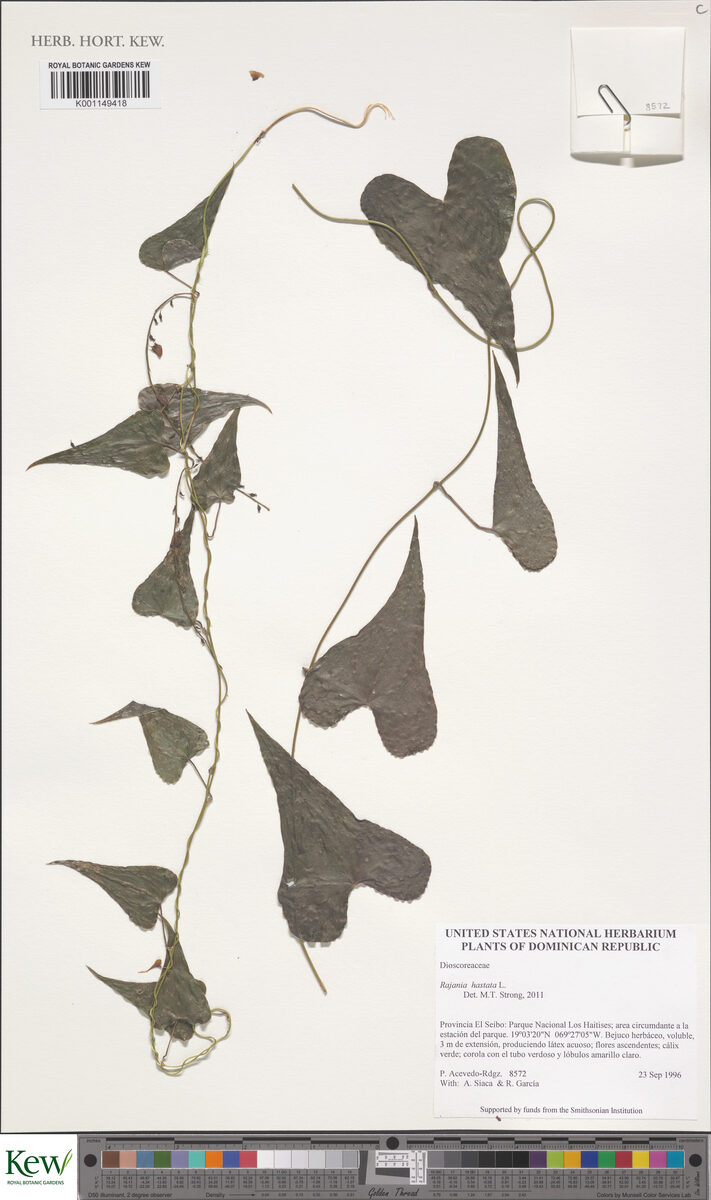
Dioscorea piscatorum
Prain & Burkill
Fish-poison yam
gbif· cc0
President and Fellows of Harvard College
gbif· cc-by-sa
GBIF
Description
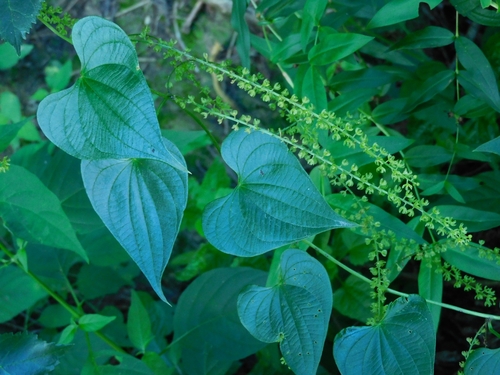
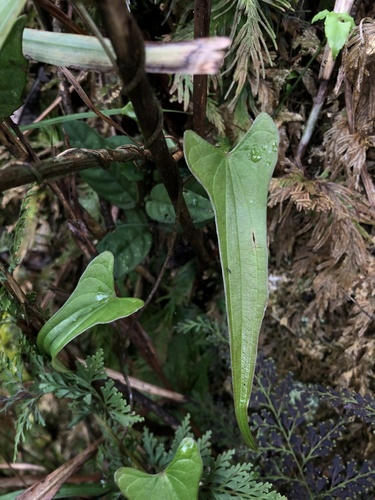
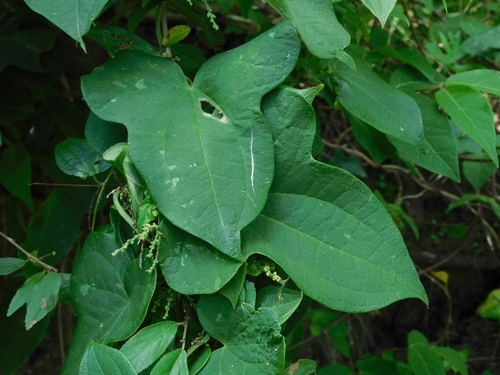
A yam. It keeps growing from year to year by sprouting from the tubers. The stems are woody and have prickles. They twine to the left. The tubers develop in the axils where the base of the stem touches the ground. The short roots can have thorns. The skin of the tubers is red-brown and the flesh is dark red. The leaves are simple and like paper. The leaf stalk is shorter than the leaf blade. It has small prickles. The leaf blade is heart shaped and 18 cm long by 14 cm wide. The veins are easy to see.
Edible Uses
The tubers are roasted and eaten; they remain bitter if boiled.
Traditional Uses
Tubers are roasted and eaten. (They remain bitter if boiled.)
This uses section is brief — help expand it
Distribution
A tropical plant.
Where It Grows
Asia, Indonesia, Malaysia, SE Asia, Thailand,
Notes
There are about 650 species of Dioscorea.
Synonyms
Also Known As
Cheriok, Cheroh, Kiyak, Tuba gunjo, Tuba podeh gantung, Tuba ubi, Uni cherok
References (5)
- Burkill, I.H., 1966, A Dictionary of the Economic Products of the Malay Peninsula. Ministry of Agriculture and Cooperatives, Kuala Lumpur, Malaysia. Vol 1 (A-H) p 836
- Ibrahim, N., 1994, Trace metals in tropical yam species: Dioscorea spp. Food Chemistry 51:5-6
- Lim, T. K., 2015, Edible Medicinal and Non Medicinal Plants. Volume 9, Modified Stems, Roots, Bulbs. Springer p 37
- PROSEA handbook Volume 9 Plants yielding non-seed carbohydrates. p 173
- World Checklist of Useful Plant Species 2020. Royal Botanic Gardens, Kew