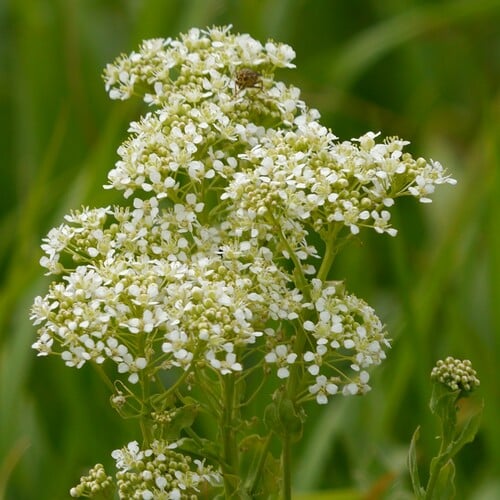
Descurainia sophia
(L.) Webb. ex Prantl
Fixweed, Herb-Sophia, Tansy mustard
iNaturalist· cc-by-nc
(c) faluke, some rights reserved (CC BY-NC), uploaded by faluke
iNaturalist· cc-by-nc
(c) h_i, some rights reserved (CC BY-NC)
iNaturalist· cc-by-nc-sa
(c) Shuangqi Liu, some rights reserved (CC BY-NC-SA), uploaded by Shuangqi Liu
Summary
Source: WikipediaDescurainia sophia is a member of the family Brassicaceae. Common names include flixweed, herb-Sophia and tansy mustard. It reproduces by seeds. It is a dominant weed in dark brown prairie and black prairie soils of southern Alberta. Its stem is erect, branched, and 4–30 in (10–76 cm) high. It was once given to patients with dysentery and called by ancient herbalists Sophia Chirurgorum, "The Wisdom of Surgeons". It is the type species of the genus Descurainia (named for French botanist and herbalist François Descurain (1658–1749)) and of the rejected genus Sophia Adans.
Description
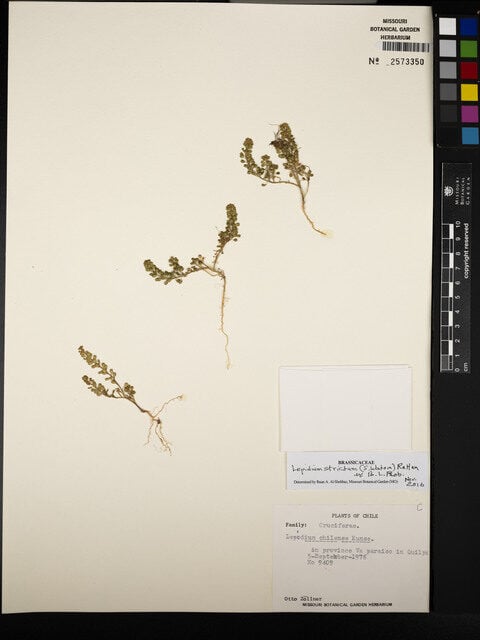
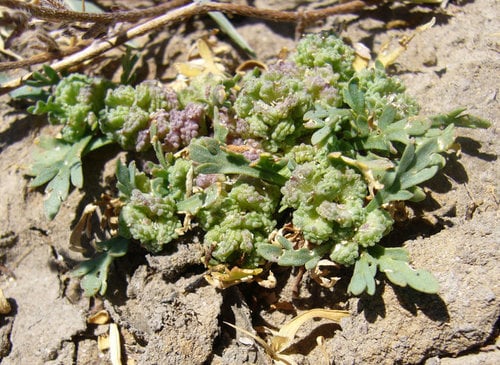
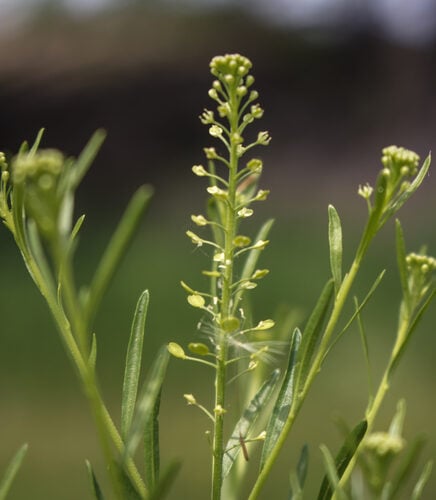
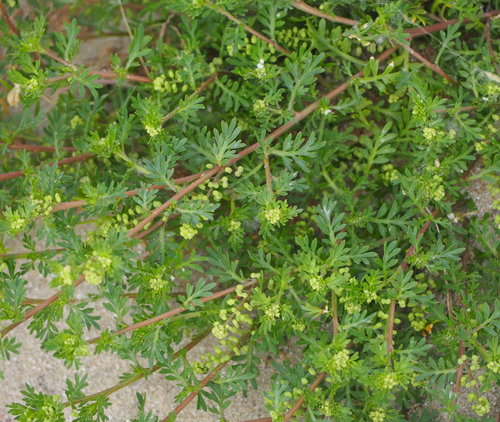
A cabbage family herb. It is an annual or biennial plant. It is almost 0.4-1 m high. The leaves do not have stalks. They are narrow, oblong and taper towards the tip. The flowers are yellow. The fruit is a pod. It is narrow. The seeds are 1 mm long by 0.5 mm wide.
Edible Uses
Young leaves and shoots are cooked and used as a potherb, though they have a bitter flavour. The seed can be eaten raw or cooked and has a pungent taste, making it a useful mustard substitute. Ground seed can be mixed with cornmeal to make bread or used to thicken soups, and it can also be sprouted and added to salads. A nourishing and cooling beverage is made by mixing ground seeds with water to form a thin batter. On a zero-moisture basis, the seed contains 25.5–29.9% protein, 26.9–39.7% fat, and 3.6–3.9% ash. Per 100 g dry weight, median figures are approximately 27.5 g protein, 33 g fat, and 3.7 g ash.
Traditional Uses
The young leaves are eaten cooked. They have a bitter flavour. The seeds are eaten raw or roasted. They are a mustard substitute. The seeds can be sprouted and eaten in salads and sandwiches. They are also used to make a drink.
Medicinal Uses
A poultice of the plant has been used to ease toothache. The plant's juice has been used to treat chronic coughs, hoarseness, and ulcerated sore throats. A strong decoction has proven effective in treating asthma. The flowers and leaves are antiscorbutic and astringent. The seed is considered cardiotonic, demulcent, diuretic, expectorant, febrifuge, laxative, restorative, and tonic. It is used to treat asthma, fevers, bronchitis, oedema, dysentery, worms, and calculus complaints, and is decocted with other herbs for various ailments. The seeds have also been used specifically as a remedy for sciatica. Ground seeds made into a poultice have been applied to burns and sores.
Distribution
It is a temperate plant. It occurs in waste ground and along roadsides. Plants will grow in most soil types. It grows on roadsides, waste places, disturbed sites, fields, pastures, deserts from near sea level to 4200 m altitude in China. In Nepal it grows between 2000-4000 m altitude. It can grow in arid places and salty soils.
Where It Grows
Afghanistan, Africa, Albania, Algeria, Argentina, Armenia, Asia, Australia, Austria, Azerbaijan, Balkans, Belarus, Belgium, Bhutan, Britain, Bulgaria, Canada, Caucasus, Central Asia, Chile, China, Czech Republic, Denmark, Egypt, England, Estonia, Europe, Finland, France, Georgia, Germany, Greece, Hawaii, Himalayas, Hungary, India, Iran, Iraq, Israel, Italy, Japan, Jordan, Kazakhstan, Korea, Kyrgyzstan, Latvia, Lebanon, Lithuania, Mediterranean, Middle East, Moldova, Mongolia, Morocco, Nepal, Netherlands, New Zealand, North Africa, North America, Norway, Pacific, Pakistan, Poland, Portugal, Romania, Russia, Scandinavia, Siberia, Sicily, Slovakia, South America, Spain, Sweden, Switzerland, Syria, Tajikistan, Turkey, Türkiye, Turkmenistan, USA, Uzbekistan, Yugoslavia,
Cultivation
It grows from seed.
Propagation
Sow seed in spring directly in situ.
Other Uses
A semi-drying oil is obtained from the seed, though yields are not recorded. The leaves have been stored with corn to prevent spoilage. Descurainia sophia is a tertiary genetic relative of rape (Brassica napus). The species has moderate palatability to livestock and is considered likely to have limited economic value for animal husbandry.
Synonyms
Also Known As
Aca, Flaxweed, Khubkallana, Lassinu di sceccu, Masino tori jhar, Mihao, Roosh, Thale cress, Yinchen
References (26)
- Ambasta, S.P. (Ed.), 2000, The Useful Plants of India. CSIR India. p 167
- Anderson, M. K., 2012, Edible Seeds and Grains of California Tribes and the Klamath Tribe of Oregon in the Phoebe Apperson Hearst Museum of Anthropology Collections, University of California, Berkeley. USDA p 41
- Beckstrom-Sternberg, Stephen M., and James A. Duke. "The Foodplant Database." http://probe.nalusda.gov:8300/cgi-bin/browse/foodplantdb.(ACEDB version 4.0 - data version July 1994) (As Sophia parviflora)
- Centofanti, T. & Banuelos, G., 2019, Practical uses of Halophytic Plants as Sources of Food and Fodder. CAB International. p 334
- Cormack, R. G. H., 1967, Wild Flowers of Alberta. Commercial Printers Edmonton, Canada. p 126
Show all 26 references Hide references
- Couture, M. D., 1978, Recent and Contemporary Foraging Practices of the Harney Valley Paiute. Thesis, Portland State University (As Sisymbrium sophia)
- H. G. A. Engler & K. A. E. Prantl, Nat. Pflanzenfam. 3(2):192. 1891
- Facciola, S., 1998, Cornucopia 2: a Source Book of Edible Plants. Kampong Publications, p 58
- Flora of China @ efloras.org Volume 8
- Geraci, A., et al, 2018, The wild taxa utilized as vegetables in Sicily (Italy): a traditional component of the Mediterranean diet. Journal of Ethnobiology and Ethnomedicine (2018) 14:14
- Kang, Y., et al, 2012, Wild food plants and wild edible fungi in two valleys on the Qinling Mountains (Shaanxi, central China) Journal of Ethnobiology and Ethnomedicine; 9:26
- Kang, Y., et al, 2012, Wild food plants and wild edible fungi of Heihe valley (Qinling Mountains, Shaanxi, central China): Herbophilia and indifference to fruits and mushrooms. Acta Societas Botanicorum Poloniae 81(4):4-5-413
- Kermath, B. M., et al, 2014, Food Plants in the Americas: A survey of the domesticated, cultivated and wild plants used for Human food in North, Central and South America and the Caribbean. On line draft. p 302
- Lazarides, M. & Hince, B., 1993, Handbook of Economic Plants of Australia, CSIRO. p 78
- Manandhar, N.P., 2002, Plants and People of Nepal. Timber Press. Portland, Oregon. p 194
- Plants for a Future database, The Field, Penpol, Lostwithiel, Cornwall, PL22 0NG, UK. http://www.scs.leeds.ac.uk/pfaf/
- READ, (As Sisymbrium sophia)
- Royal Botanic Gardens, Kew (1999). Survey of Economic Plants for Arid and Semi-Arid Lands (SEPASAL) database. Published on the Internet; http://www.rbgkew.org.uk/ceb/sepasal/internet [Accessed 15th April 2011]
- Tanaka,
- Tareen, N. M., et al, 2016, Ethnomedicinal Utilization of Wild Edible Vegetables in District Harnai of Balochistan Province - Pakistan. Pakistan Journal of Botany 48(3): 1159-1171
- Uphof,
- Urgamal, M., Oyuntsetseg, B., Nyambayar, D. & Dulamsuren, Ch. 2014. Conspectus of the vascular plants of Mongolia. (Editors: Sanchir, Ch. & Jamsran, Ts.). Ulaanbaatar, Mongolia. “Admon“ Press. 334pp. (p. 79-90).
- USDA, ARS, National Genetic Resources Program. Germplasm Resources Information Network - (GRIN). [Online Database] National Germplasm Resources Laboratory, Beltsville, Maryland. Available: www.ars-grin.gov/cgi-bin/npgs/html/econ.pl (10 April 2000)
- Wiersema, J. H. & Leon, B., 2013, World Economic Plants. A Standard Reference CRC Press. 2nd Ed. p 239
- World Checklist of Useful Plant Species 2020. Royal Botanic Gardens, Kew
- Zhou Taiyan, Lu Lianli, Yang Guang; Ihsan A. Al-Shehbaz, BRASSICACEAE (CRUCIFERAE), Flora of China.