Diplotaxis tenuifolia
(L.) DC.
Perennial wall rocket, Sand mustard
iNaturalist· cc-by-nc
(c) Ron Vanderhoff, some rights reserved (CC BY-NC), uploaded by Ron Vanderhoff
iNaturalist· cc-by-nc
(c) Fabienne Herregodts, some rights reserved (CC BY-NC), uploaded by Fabienne Herregodts
iNaturalist· cc-by-nc
(c) Tom JAMONNEAU, some rights reserved (CC BY-NC), uploaded by Tom JAMONNEAU
Summary
Source: WikipediaDiplotaxis tenuifolia is a species of flowering plant in the mustard family known by the common name perennial wall-rocket. It is native to Europe and western Asia, where it grows on disturbed ground and roadsides, and it can now be found throughout much of the temperate world where it has naturalized. In recent years it has increasingly been cultivated to produce salad leaves, which are marketed as wild rocket in Britain or arugula in the US. It is easily confused with garden rocket, which has similar uses.
Description
A cabbage family herb. It is a plant which keeps growing from year to year. It grows 0.2-1.2 m high. The leaves near the base are slightly lobed but the leaves on the stem are narrow and entire or with teeth. The leaves have an unpleasant smell when crushed. The flowers have sepals which spread out. The petals are bright yellow. The fruit stalks are also spreading. The pods are flattened and with a short beak. Seed are arranged in two rows.
Edible Uses
The leaves are eaten raw and work well in salads, where they contribute a very strong cress-like, hot flavour similar to rocket (Eruca vesicaria sativa) but more intense. They make an excellent addition to a mixed salad but are too pungent to eat in large quantities on their own. The plant is highly productive, yielding leaves from early spring through to autumn.
Traditional Uses
The leaves are eaten raw in salads and boiled in soups. They have a peppery taste.
This uses section is brief — help expand it
Medicinal Uses
None known.
Distribution
It is a temperate plant. It grows well in sandy soils. It can grow on beach sand and limestone. In Argentina it grows between sea level and 1,000 m above sea level. It can grow in salty conditions. Tasmania Herbarium. It suits hardiness zone 7.
Where It Grows
Africa, Argentina, Australia, Balkans, Bosnia, Britain, Croatia, Europe*, Finland, France, Ireland, Italy, Luxembourg, Mediterranean, New Zealand, North Africa, North America, Scandinavia, Sicily, Slovenia, South America, Spain, Tasmania, Turkey, Türkiye, Uruguay,
Cultivation
Plants are grown from seeds. They can be transplanted.
Propagation
Sow seed in situ as soon as it is ripe for best results, though spring sowing in situ is also possible. Germination typically occurs in autumn.
Other Uses
None known.
Other Information
It is commonly cultivated. It is sold in local markets.
Synonyms
Also Known As
Aruca sarvaggia, Divlja rikula, Flor amarilla, Lincoln weed, Napor, Ruca, Ruchetta, Rucoletta, Rucola selvatica, Ruqueta, Sand rocket, Tankolistni dvoredec, Turpenk
References (33)
- Biscotti, N. & Pieroni, A., 2015, The hidden Mediterranean diet: wild vegetables traditionally gathered and consumed in the Gargano area, Apulia, SE Italy. Acta Societatis Botanicorum Poloniae 84 (3): 327-338
- Biscotti, N. et al, 2018, The traditional food use of wild vegetables in Apulia (Italy) in the light of Italian ethnobotanical literature. Italian Botanist 5:1-24
- Cakir, E. A., 2017, Traditional knowledge of wild edible plants of Iğdır Province (East Anatolia, Turkey). Acta Soc Bot Pol. 2017;86(4):3568.
- Centofanti, T. & Banuelos, G., 2019, Practical uses of Halophytic Plants as Sources of Food and Fodder. CAB International. p 330
- Cerne, M., 1992, Wild Plants from Slovenia used as Vegetables. Acta Horticulturae 318
Show all 33 references Hide references
- Crawford, M., 2012, How to grow Perennial Vegetables. Green Books. p 147
- Dolina, K. & Luczaj, L., 2014, Wild food plants used on the Dubrovnik coast (south-eastern Croatia) Acta Soc Bot Pol 83(3):175–181
- Ertug, F, Yenen Bitkiler. Resimli Türkiye Florası -I- Flora of Turkey - Ethnobotany supplement
- Facciola, S., 1998, Cornucopia 2: a Source Book of Edible Plants. Kampong Publications, p 58
- Geraci, A., et al, 2018, The wild taxa utilized as vegetables in Sicily (Italy): a traditional component of the Mediterranean diet. Journal of Ethnobiology and Ethnomedicine (2018) 14:14
- Hammer, K. & Spahillari, M., 1999, Crops of European origin. in Report of a networking group on minor crops. IPGRI p 44
- Hibbert, M., 2002, The Aussie Plant Finder 2002, Florilegium. p 88
- Hussey, B.M.J., Keighery, G.J., Cousens, R.D., Dodd, J., Lloyd, S.G., 1997, Western Weeds. A guide to the weeds of Western Australia. Plant Protection Society of Western Australia. p 118
- INFOODSUpdatedFGU-list.xls
- Irving, M., 2009, The Forager Handbook, A Guide to the Edible Plants of Britain. Ebury Press p 91
- Jackes, D. A., Edible Forest Gardens
- Ladio, A. H. & Lozada, M., 2000, Edible Plant Use in a Mapuche Community of North-western Patagonia, Human Ecology. Vol. 28, No. 1. pp. 53-71
- Ladio, A. H., 2001, The Maintenance of Wild Edible Plant Gatherings in a Mapuche Community of Patagonia. Economic Botany, Vol. 55, No. 2, pp. 243-254
- Lamp, C & Collet F., 1989, Field Guide to Weeds in Australia. Inkata Press. p 104
- Luczaj et al, 2013, Wild vegetable mixes sold in the markets of Dalmatia (southern Croatia). Journal of Ethnobiology and Ethnomedicine. 8:2
- Luczaj, L. et al, 2014, Wild Food Plants of Dalmatia (Croatia). in A. Pieroni, C. L. Quave (eds.), Ethnobotany and Biocultural Diversities in the Balkans, p 138
- Motti, R. et al, 2009, Traditional Plant Use in the Phlegraean Fields Regional Park (Campania, Southern Italy). Human Ecology 37:775-782
- Paczkowska, G. & Chapman, A.R., 2000, The Western Australian Flora. A Descriptive Catalogue. Western Australian Herbarium. p 185
- Pasta, S., et al, 2020, An Updated Checklist of the Sicilian Native Edible Plants: Preserving the Traditional Ecological Knowledge of Century-Old Agro-Pastoral Landscapes. Frontiers in Plant Science. Volume 11|Article 388
- Pieroni, A., 1999, Gathered wild food plants in the Upper Valley of the Serchio River (Garfagnana), Central Italy. Economic Botany 53(3) pp 327-341
- Plants for a Future database, The Field, Penpol, Lostwithiel, Cornwall, PL22 0NG, UK. http://www.scs.leeds.ac.uk/pfaf/
- Rivera, D. et al, 2006, Gathered Mediterranean Food Plants - Ethnobotanical Investigations and Historical Development, in Heinrich M, Müller WE, Galli C (eds): Local Mediterranean Food Plants and Nutraceuticals. Forum Nutr. Basel, Karger, 2006, vol 59, pp 18–74
- Sansanelli, S., et al, 2014, Wild food plants traditionall consumed in the area of Bologna (Emilia Romagna region, Italy). Journal of Ethnobiology and Ethnomedicine 10:69
- Sansanelli, S., et al, 2017, Ethnobotanical survey of wild food plants traditionally collected and consumed in the Middle Agri Valley (Basilicata region, southern Italy). Journal of Ethnobiology and Ethnomedicine (2017) 13:50
- Seidemann J., 2005, World Spice Plants. Economic Usage, Botany, Taxonomy. Springer. p 137
- Syst. nat. 2:632. 1821
- Tasmanian Herbarium Vascular Plants list p 17
- Turner, N. J. et al, 2011, Edible and Tended Wild Plants, Traditional Ecological Knowledge and Agroecology. Critical Reviews in Plant Sciences, 30:198-225
More from Brassicaceae
Raphanus sativus caudatus - (L.)L.H.Bailey.
Rat-Tail Radish
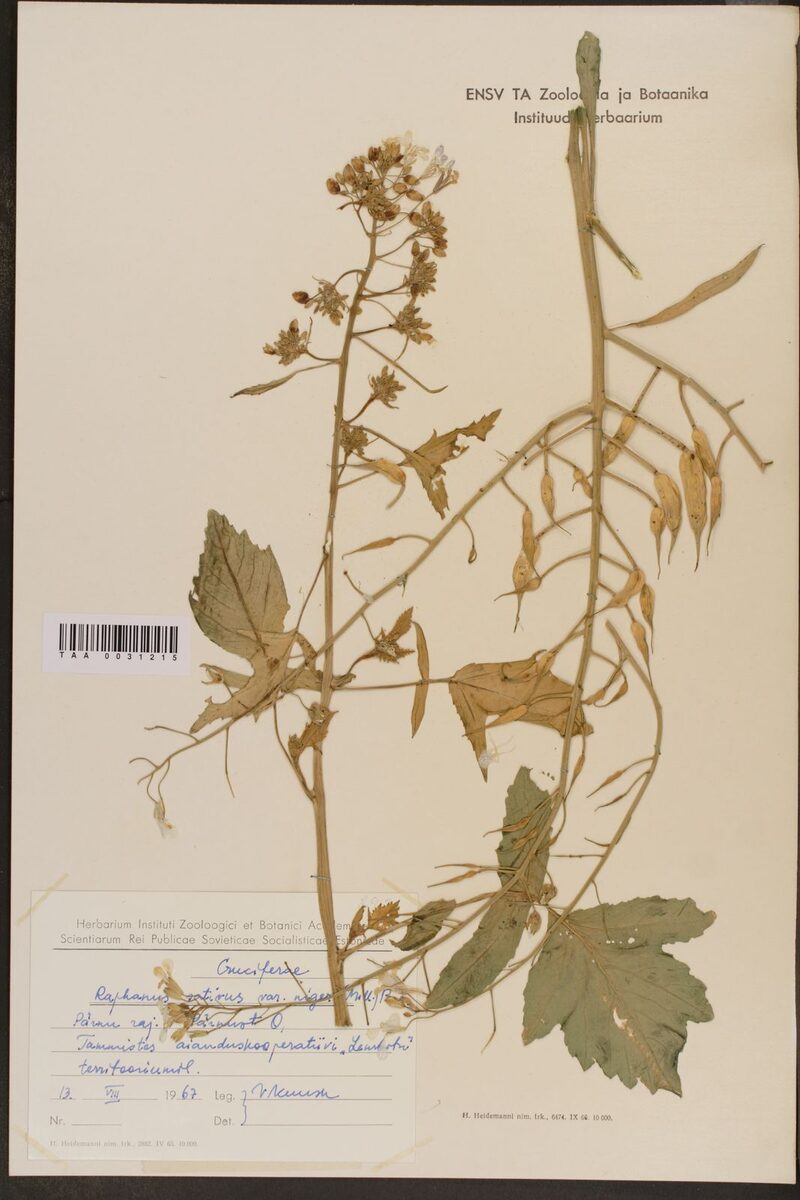
Raphanus sativus niger
Oriental Radish
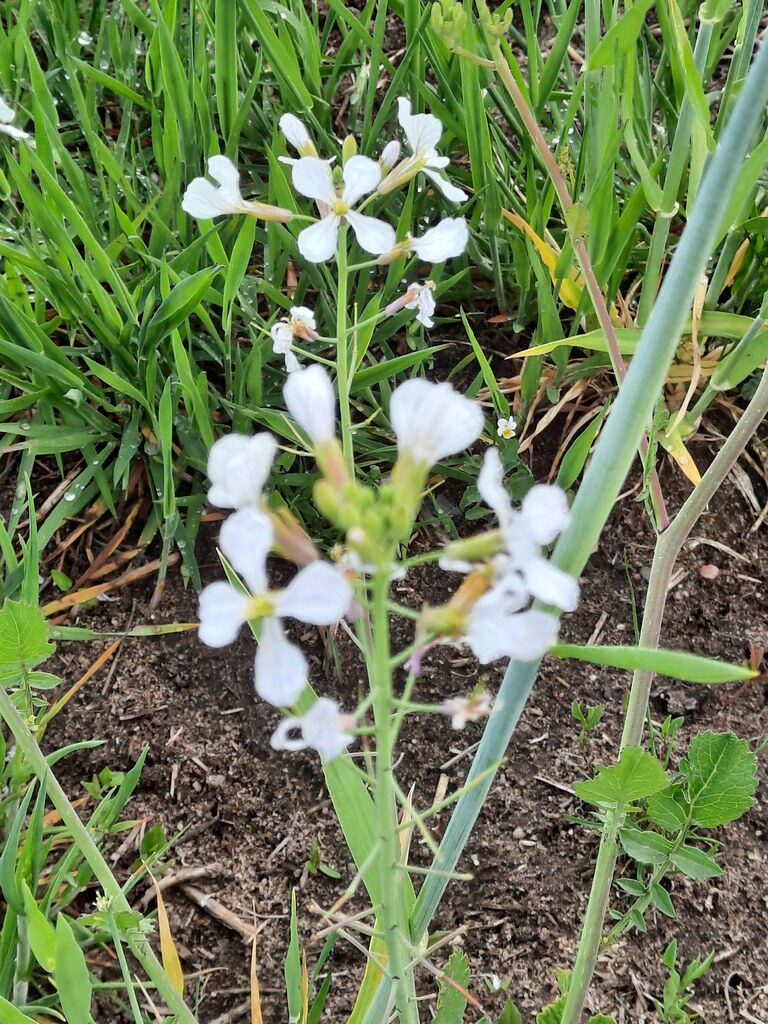
Raphanus sativus oleiformis
Fodder Radish
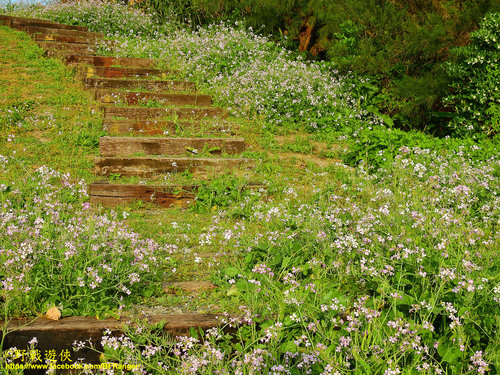
Raphanus sativus var. caudatus
Rat-tail radish, Potting radish
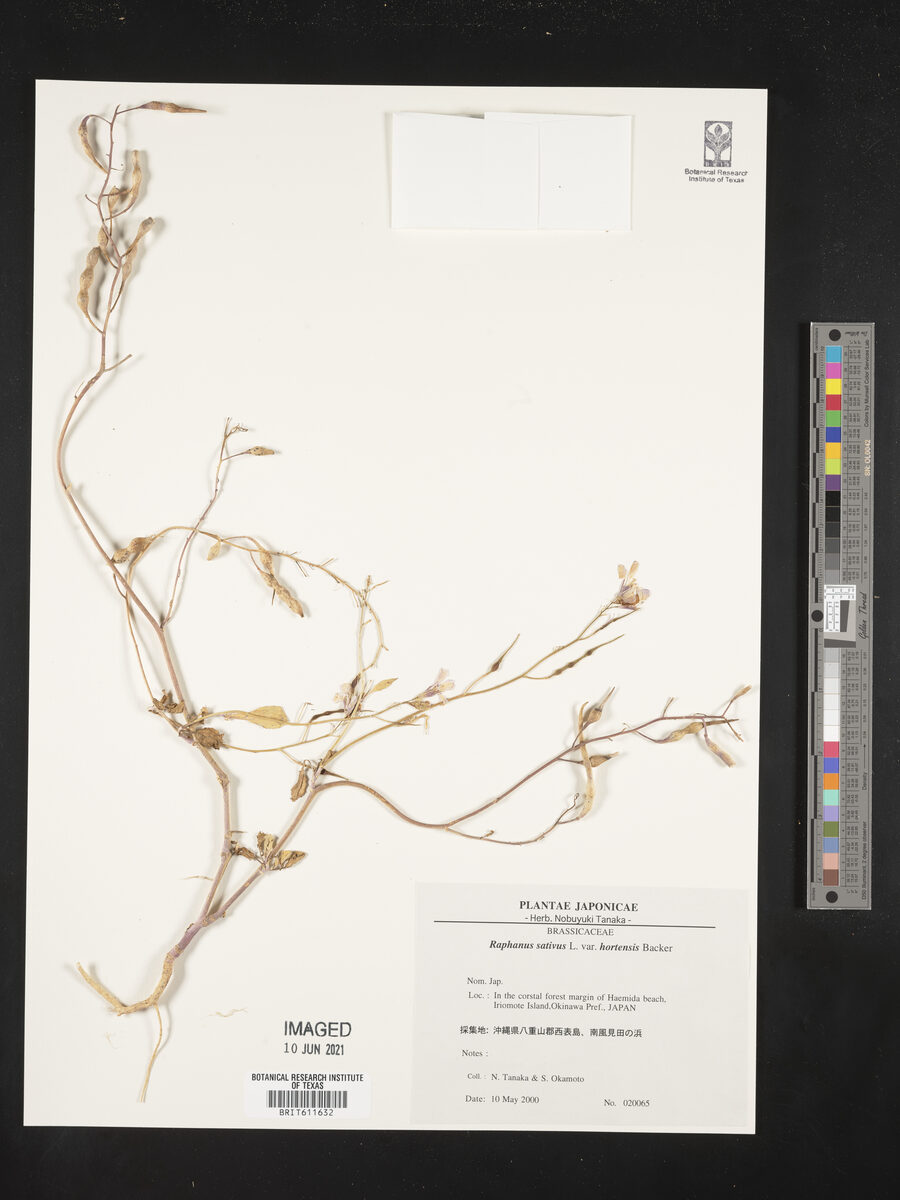
Raphanus sativus var. hortensis
Japanese winter radishes
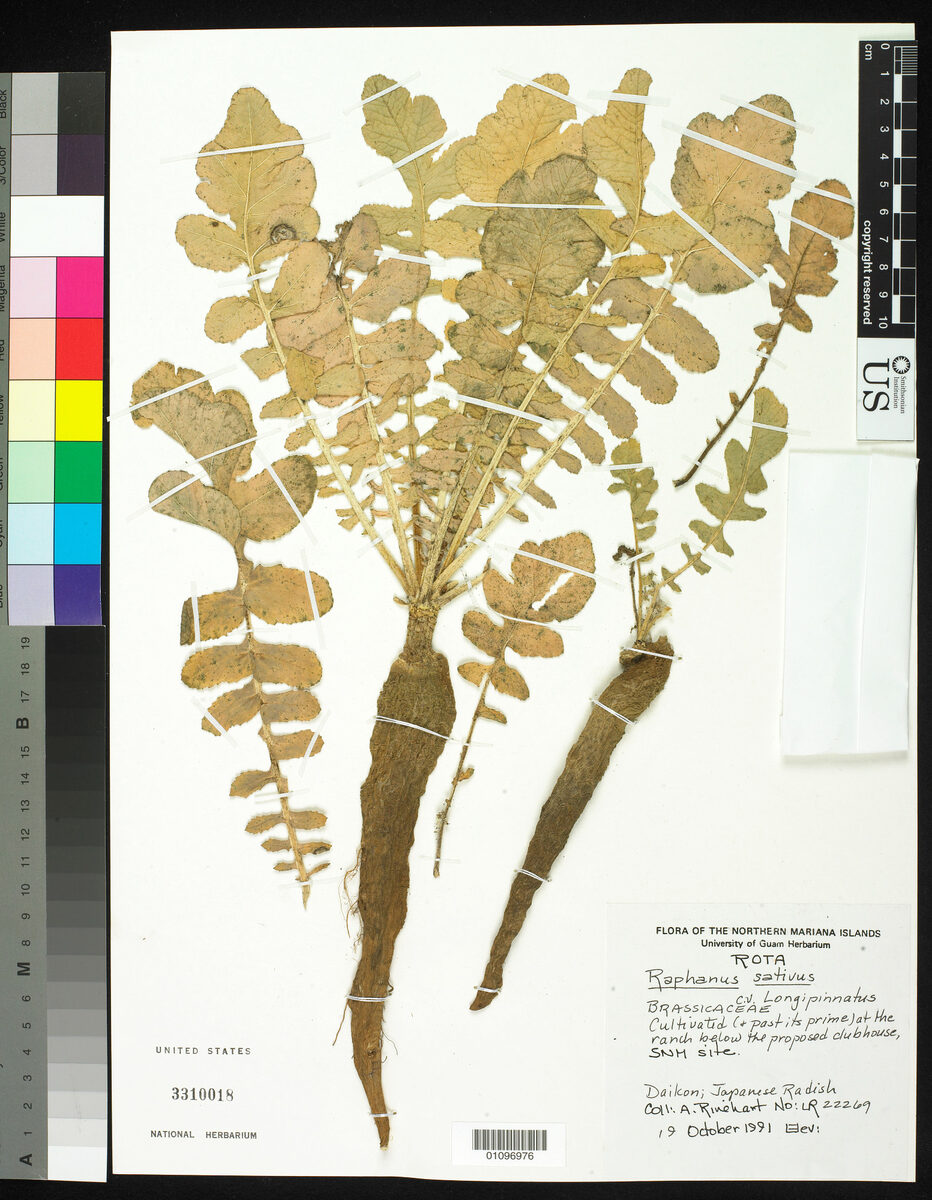
Raphanus sativus var. longipinnatus
Chinese radish, Daikon, Oriental radish