Dendrocalamus giganteus
Munro
Giant bamboo, Dragon bamboo
iNaturalist· cc-by-nc-sa
(c) Reuben C. J. Lim, some rights reserved (CC BY-NC-SA)
iNaturalist· cc-by-nc
(c) James Bailey, some rights reserved (CC BY-NC)
iNaturalist· cc0
no rights reserved, uploaded by 葉子
Summary
Source: WikipediaDendrocalamus giganteus, commonly known as giant bamboo, is a giant tropical and subtropical, dense-clumping species native to Southeast Asia. It is one of the largest bamboo species in the world.
Description
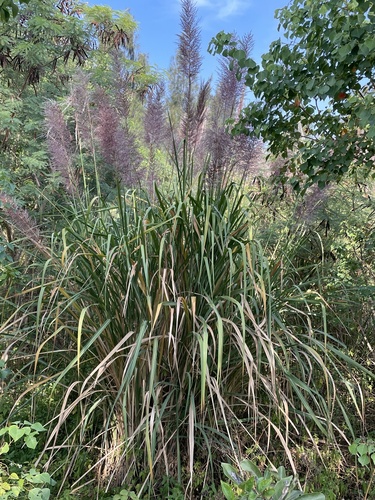
A clump forming bamboo. It can be 25-30-50 m tall. It has rhizomes which spread. The clumps can be 10-15 m wide. The canes can be 35 cm across. They are erect and jointed. The nodes are hairy. The leaf blades are sword shaped and smooth with fine teeth along the edge. The leaves can be 55 cm long. These clasp the canes at their base. The flower is a long panicle which droops.
Edible Uses
The young shoots are edible. When cooked they are creamy and tender, though not widely consumed. They have a fair canning quality.
Traditional Uses
Young shoots are cooked and eaten as a vegetable. They are cooked with meat or fish.
This uses section is brief — help expand it
Medicinal Uses
The siliceous secretion of the culm is considered aphrodisiac and tonic.
Distribution
It is a tropical plant. It often grows in high mountains. It must have temperatures above 5°C. They are frost tender. It cannot tolerate drought. It prefers rich moist soil. In Nepal it grows between 200-1300 m altitude. In Yunnan it grows between 380-1,900 m above sea level. In Cairns Botanical garden. In XTBG Yunnan.
Where It Grows
Africa, Asia, Australia, Bangladesh, Benin, Cambodia, China, East Africa, Ghana, Himalayas, India, Indochina, Indonesia, Kenya, Laos, Madagascar, Malaysia, Myanmar, Nepal, Northeastern India, Pacific, Papua New Guinea, PNG, Philippines, Reunion, SE Asia, Sri Lanka, St Helena, Taiwan, Thailand, Vietnam, West Africa, Zimbabwe,
Cultivation
It grows best in areas where annual daytime temperatures are within the range 20 - 27°c, but can tolerate 15 - 34°c. It prefers a mean annual rainfall in the range 1,800 - 3,600mm, but tolerates 1,200 - 4,500mm. Succeeds in full sun or in light shade. Prefers a rich, alluvial soil. Succeeds in most soils of at lest moderate fertility. Prefers a pH in the range 5.5 - 6.5, tolerating 4.5 - 7.5. Offsets consisting of young shoots with small portions of attached rhizome produce small culms in the first year. Subsequent culms increase in size each consecutive year until, after 7 years, they have attained a girth of about 25 cm and a height of about 12 metres. They are then harvested. However, culms only attain full size ultimately at an age of 15 - 16 years. Bamboos have an interesting method of growth. Each plant produces a number of new stems annually - these stems grow to their maximum height in their first year of growth, subsequent growth in the stem being limited to the production of new side branches and leaves. In the case of some mature tropical species the new stem could be as much as 30 metres tall, with daily increases in height of 30cm or more during their peak growth time. This makes them some of the fastest-growing species in the world. At first, the growth of an individual young shoot is very slow, quickening gradually during a period of 4 - 6 weeks until the culm is about 4 metres tall. Then maximum growth is attained and maintained for several weeks (e.g. On average, 32 cm per day), after which growth gradually decreases until it stops when full height is attained at the age of 3.5 months. Rapid growth seems to be induced by high relative humidity, irrespective of light and temperature, causing a high turgescence in the culm. Competition between culms in a clump may cause 'abortive shoots', affecting about 50% of all new shoots. Young abortion-prone shoots usually grow within 20 cm from a culm, attaining about 13 cm height before dying. Such young shoots are suitable for vegetable use Bamboos in general are usually monocarpic, living for many years before flowering, then flowering and seeding profusely for a period of 1 - 3 years before usually dying. This species is reputed to have a cycle of around 40 years between major flowerings.
Propagation
Seed is seldom available because the plant only flowers at intervals of many years. When seed is available, sow in containers and barely cover; germination usually takes place readily. Prick out into individual pots as soon as plants are large enough to handle. Plant out into permanent positions when 20cm tall. Plants may remain in a low-growing juvenile state for several years — cutting culms to ground level can stimulate taller adult growth. Normally propagated by clump division. Culm and branch cuttings are possible though difficult; artificial induction of roots before taking cuttings is possible and reasonably successful.
Other Uses
Large culm sheaths are used to make hats. Strips of cane are woven into mats and baskets. The large culms serve many purposes including construction, scaffolding, rural housing, water pipes, buckets, boat masts, matting, woven wares, and paper production. The thick-walled culms are particularly well suited to making bamboo boards for room decoration and interior applications such as walls, ceilings, floors, doors, shelves, and similar fittings. The plant can also be used to protect soil against erosion.
Production
Young shoots can grow at the rate of 30 cm a day.
Other Information
It is widely used for building, water pipes and other uses. The shoots are sold in local markets.
Notes
There are about 29 Dendrocalamus species.
Synonyms
Also Known As
Ae hatee, Bambu ater, Bambu sembilang, Bhalu bans, Buloh semilang, Kyo-Chiku, Lao bu bie, Long zhu, Mai sang, Phai phama, Phai po, Phai pok, Phai yak, Rusey prey, Russei prei, Surung, Vai-mau, Wabo, Wabo-gyi, Wo pu, Worra
References (31)
- Anderson, E. F., 1993, Plants and people of the Golden Triangle. Dioscorides Press. p 209
- Balkrishna, A., et al, 2022, Indigenous Uses of Plants among Forest-dependent Communities of Seijosa, Arunachal Pradesh. International Journal of Economic Plants 2022, 9(1):064-080
- Bodkin, F., 1991, Encyclopedia Botanica. Cornstalk publishing, p 334
- Borrell, O.W., 1989, An Annotated Checklist of the Flora of Kairiru Island, New Guinea. Marcellin College, Victoria Australia. p 23
- Brickell, C. (Ed.), 1999, The Royal Horticultural Society A-Z Encyclopedia of Garden Plants. Convent Garden Books. p 354
Show all 31 references Hide references
- Brink, M., 2008. Dendrocalamus giganteus Munro. [Internet] Record from Protabase. Louppe, D., Oteng-Amoako, A.A. & Brink, M. (Editors). PROTA (Plant Resources of Tropical Africa), Wageningen, Netherlands. < http://database.prota.org/search.htm>. Accessed 15 October 2009.
- Burkill, I.H., 1966, A Dictionary of the Economic Products of the Malay Peninsula. Ministry of Agriculture and Cooperatives, Kuala Lumpur, Malaysia. Vol 1 (A-H) p 793
- Cao, Y., et al, 2020, Ethnobotanical study on wild edible plants used by three trans-boundary ethnic groups in Jiangcheng County, Pu’er, Southwest China. Journal of Ethnobiology and Ethnomedicine (2020) 16:66
- Cengel, D. J. & Dany, C., (Eds), 2016, Integrating Forest Biodiversity Resource Management and Sustainable Community Livelihood Development in the Preah Vihear Protected Forest. International Tropical Timber Organization p 125
- Dobriyal, M. J. R. & Dobriyal, R., 2014, Non Wood Forest Produce an Option for Ethnic Food and Nutritional Security in India. Int. J. of Usuf. Mngt. 15(1):17-37
- Dransfield, S. & Widjaja, EA., 1995, Plant Resources of South East Asia. PROSEA No. 7 Bamboos. Leiden. p 85
- Guite, C., 2016, A study of wild edible plants associated with the Paite tribe of Manipur, India, International Journal of Current Research. Vol. 8, Issue, 11, pp. 40927-40932
- Hibbert, M., 2002, The Aussie Plant Finder 2002, Florilegium. p 84
- http://www.plantnames.unimelb.edu.au/sorting/Bamboos_Edible.html
- Kar, A., et al, 2013, Wild Edible Plant Resources used by the Mizos of Mizoram, India. Kathmandu University Journal of Science, Engineering and Technology. Vol. 9, No. 1, July, 2013, 106-126
- Lord, E.E., & Willis, J.H., 1999, Shrubs and Trees for Australian gardens. Lothian. p 95
- Manandhar, N.P., 2002, Plants and People of Nepal. Timber Press. Portland, Oregon. p 193
- Murtem, G. & Chaudhrey, P., 2016, An ethnobotanical note on wild edible plants of Upper Eastern Himalaya, India. Brazilian Journal of Biological Sciences, 2016, v. 3, no. 5, p. 63-81
- Norrington, L., & Campbell, C., 2001, Tropical Food Gardens. Bloomings Books. p 25
- Phon, P., 2000, Plants used in Cambodia. © Pauline Dy Phon, Phnom Penh, Cambodia. p 225
- Sahni, K.C., 2000, The Book of Indian Trees. Bombay Natural History Society. Oxford. p 191
- Sukarya, D. G., (Ed.) 2013, 3,500 Plant Species of the Botanic Gardens of Indonesia. LIPI p 840
- Trans. Linn. Soc. London 26:150. 1868
- Upreti, T.C. and Sundriyal, R. C., 2001, Bamboo and cane resources of Arunachal Pradesh: Utilization pattern and implications for management. Bamboo Science and Culture: The Journal of the American Bamboo Society 15(1):20-34
- van Wyk, B., 2005, Food Plants of the World. An illustrated guide. Timber press. p 174
- Waikhom, S. D., et al, 2013, Grappling the High Altitude for Safe Edible Bamboo Shoots with Rich Nutritional Attributes and Escaping Cyanogenic Toxicity. BioMed Reserch International. Voluyme 2013 Article ID 289285, 11 pages
- Wiersema, J. H. & Leon, B., 2013, World Economic Plants. A Standard Reference CRC Press. 2nd Ed. p 238
- World Checklist of Useful Plant Species 2020. Royal Botanic Gardens, Kew
- Xu, You-Kai, et al, 2004, Wild Vegetable Resources and Market Survey in Xishuangbanna, Southwest China. Economic Botany. 58(4): 647-667.
- Yang Yuming, Wang Kanglin, Pei Shengji, and Hao Jiming, 2004, Bamboo Diversity and Traditional Uses in Yunnan, China Mountain Research and Development, 24(2):157-165. 2004.
- Yang, Y., et al, A review of bamboo resources in Yunnan, China www.bioversityinternational.org