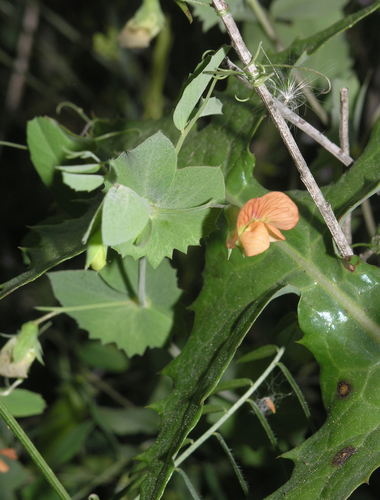
Cynometra cauliflora
L.
Namnam
iNaturalist· cc-by-sa
(c) Ong Jyh Seng, some rights reserved (CC BY-SA)
iNaturalist· cc-by-nc
(c) Sri Srikumar, some rights reserved (CC BY-NC)
iNaturalist· cc-by-nc
(c) HP Lim, some rights reserved (CC BY-NC)
Summary
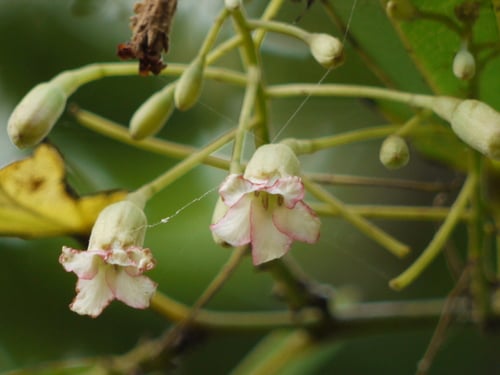
Source: WikipediaCynometra cauliflora is a small, cauliflorous tree with a thick, heavily branched stem, and rather small flowers, about 1.2 cm (0.5 in) across, that appear on the stem in clusters. It is known in Indonesian as namu-namu, after the flattened, crescent shaped pods, which look similar to the Indonesian pastry, namu-namu. In the city of Ternate, it is called namo-namo, and ñam-ñam in the Maldives. It is a species of the genus Cynometra, native to Malaysia, and found mainly in northern peninsular Malaysia.
Description
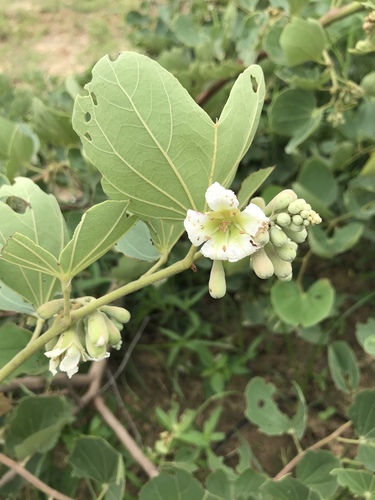
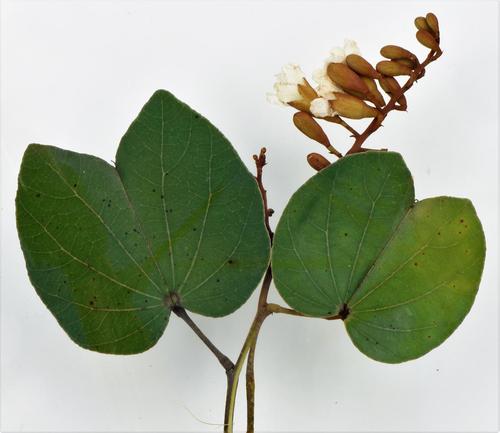
A small tree. It grows up to 15 m high. It has a thick stem which branches many times. Each leaf is made up of two leaflets. The leaf is 5-15 cm long and 2.5-7.5 cm wide and is not the same shape in the two halves of the leaf. The leaves are shiny smooth and dark green on top and paler underneath. The flowers are small. They are 1.2 cm across. They appear on the stem in clusters. The fruit is a fleshy pod 5-10 cm long and 5 cm wide. It is kidney shaped. There is one seed. The fruit has a fleshy pulp. The flesh is yellow. The fruit surface is rough and wrinkled. It is a dull pale green.
Edible Uses
The young fruit (seedpod) - raw or cooked. A pleasant, sharp flavour. It is very sour, but the acid content decreases with maturity. The mature fruit can be eaten fresh or cooked with sugar to make sweets (compote). It can also be made into a fruit salad, pickled, or be used to prepare a special 'sambal' (a condiment based on pounded chilli). The fleshy, brownish-green seedpod is rather kidney-shaped, up to 3cm long by 2cm by 1cm. The pod is 3 - 9cm long.
Traditional Uses
The fruit are eaten raw or cooked and as a flavouring in curry. They are also pickled.
This uses section is brief — help expand it
Medicinal Uses
An oil from the seed is used medicinally.
Distribution
It is a tropical plant. It suits the hot humid tropical lowlands. It needs an annual rainfall of 1,500-2,000 mm. The daily temperature should be 22-35°C. It can resist wind. It is best in full sun but can tolerate shade. It probably yields best in a monsoonal climate with a dry season. In Fiji it is grown near sea level.
Where It Grows
Asia, Fiji, India, Indochina, Indonesia, Malaysia, Myanmar, Pacific, SE Asia, Singapore, Sri Lanka, Thailand, Vietnam,
Cultivation
Plants can be grown by seed. They can also be grown by budding and grafting.
Other Uses
The wood is not valued, not even for firewood.
Other Information
It is a cultivated food plant.
Notes
There are about 20-70 Cynometra species. They grow in the tropics. Also as Caesalpinaceae.
Also Known As
Amphawaa, Iripa, Katak puru, Kapi anjing, Naminan, Nam-nam, Nan-nan, Num-num, Pohon nam-nam, Puki anjing, Salah nama
References (25)
- Ambasta, S.P. (Ed.), 2000, The Useful Plants of India. CSIR India. p 156
- Arora, R. K., 2014, Diversity in Underutilized Plant Species - An Asia-Pacific Perspective. Bioversity International. p 65
- Burkill, I.H., 1966, A Dictionary of the Economic Products of the Malay Peninsula. Ministry of Agriculture and Cooperatives, Kuala Lumpur, Malaysia. Vol 1 (A-H) p 740
- Chin, H.F., & Yong, H.S., 1996, Malaysian Fruits in Colour. Tropical press, Kuala Lumpur p 63
- Dobriyal, M. J. R. & Dobriyal, R., 2014, Non Wood Forest Produce an Option for Ethnic Food and Nutritional Security in India. Int. J. of Usuf. Mngt. 15(1):17-37
Show all 25 references Hide references
- Dodo, 2015, Keanekaragaman dan konservasi Tumbuhan Buah Langka Indonesia. Pusat Konservasi Tumbuhan Kebun Raya – LIPI. Warta Kebun Raya 13(2)
- Facciola, S., 1998, Cornucopia 2: a Source Book of Edible Plants. Kampong Publications, p 68
- Hedrick, U.P., 1919, (Ed.), Sturtevant's edible plants of the world. p 262
- Jacquat, C., 1990, Plants from the Markets of Thailand. D.K. Book House p 45
- Lembaga Biologi Nasional, 1977, Buah-Buahan, Balai Pustaka, Jakarta. p 94
- Macmillan, H.F. (Revised Barlow, H.S., et al) 1991, Tropical Planting and Gardening. Sixth edition. Malayan Nature Society. Kuala Lumpur. p 297
- Martin, F. W., et al, 1987, Perennial Edible Fruits of the Tropics. USDA Handbook 642 p 33
- Ochse, 1931, Fruit and fruit culture in the Dutch Indies. p 59
- Pham-Hoang Ho, 1999, An Illustrated Flora of Vietnam. Nha Xuat Ban Tre. p 864
- PROSEA (Plant Resources of South East Asia) handbook, Volume 2, 1991, Edible fruits and nuts.
- Rajapaksha, U., 1998, Traditional Food Plants in Sri Lanka. HARTI, Sri Lanka. p 232
- Seidemann J., 2005, World Spice Plants. Economic Usage, Botany, Taxonomy. Springer. p 131
- Slik, F., www.asianplant.net
- Smith, A.C., 1985, Flora Vitiensis Nova: A New flora of Fiji, Hawai Botanical Gardens, USA Vol 3 p 123
- Solomon, C., 2001, Encyclopedia of Asian Food. New Holland. p 246
- Soerianegara, I. & Lemmens, R. H. M. L., (Eds.) 1993, Timber trees: Major commercial timbers. Plant Resources of South-East Asia. Wageningen. No. 5(1). p 151
- Sp. pl. 1:382. 1753
- Sukarya, D. G., (Ed.) 2013, 3,500 Plant Species of the Botanic Gardens of Indonesia. LIPI p 220
- Tanaka,
- World Checklist of Useful Plant Species 2020. Royal Botanic Gardens, Kew