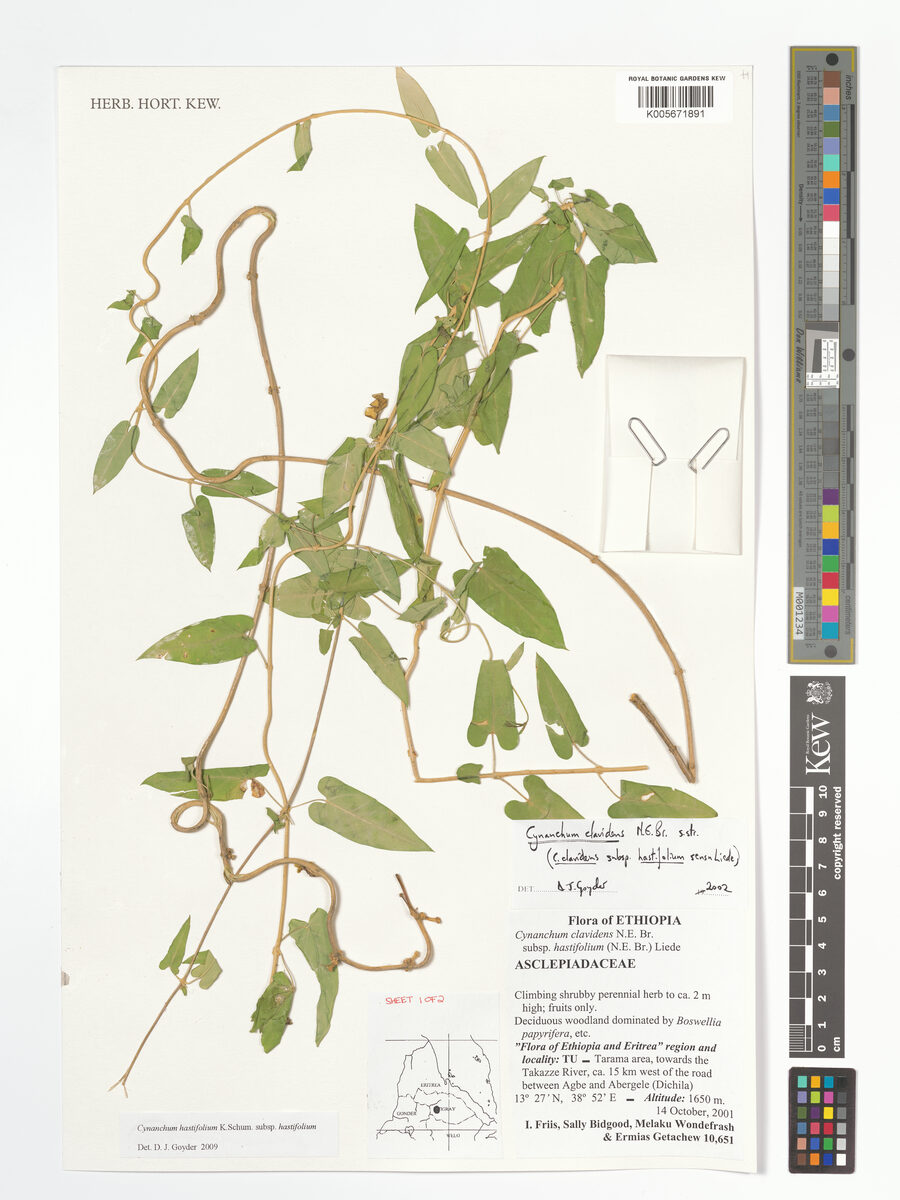
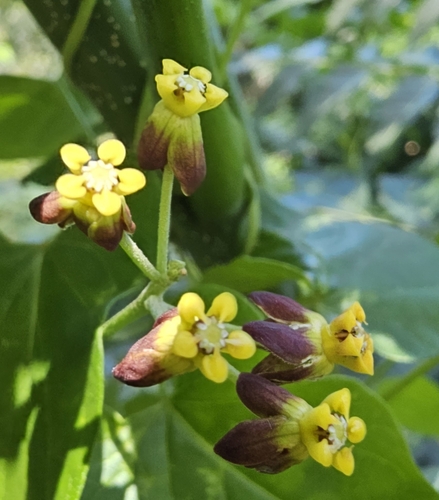
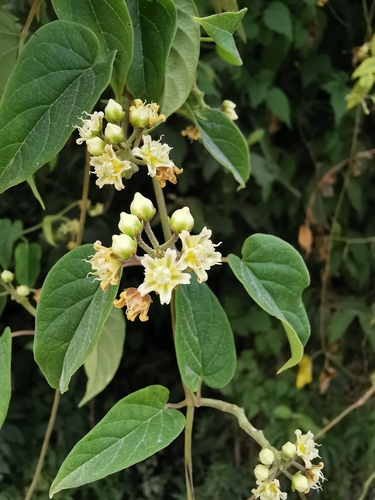
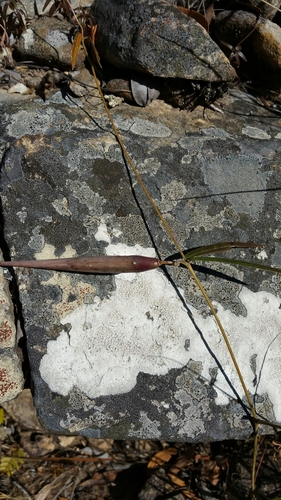
Voacanga africana
Stapf ex Scott Elliot
Small-fruit wild frangipani
iNaturalist· cc-by
(c) i_c_riddell, some rights reserved (CC BY), uploaded by i_c_riddell
iNaturalist· cc-by-nc
(c) Doug Macdonald, some rights reserved (CC BY-NC), uploaded by Doug Macdonald
iNaturalist· cc-by-nc-sa
(c) Bart Wursten, some rights reserved (CC BY-NC-SA)
Summary
Source: WikipediaVoacanga africana is a small tree native to tropical Africa belonging to the family Apocynaceae that grows to 6 m (20 ft) in height and bears leaves that are up to 30 cm (12 in) in length. The yellow or white flowers are succeeded by paired, follicular, dehiscent fruit with a mottled green exocarp and a pulpy, yellow mesocarp surrounding the seeds. The plant contains alkaloids acting as CNS depressants and hypotensives.
Description
A shrub or small tree. It grows 4-10 m tall. The trunk can be 2-30 cm across. The bark is smooth and pale grey. The leaf blade is pale green. The leaves vary in shape. There are many flowers in a loose group 4-16 cm long. The flowers have a bad smell. The fruit has 2 sections but only one develops. They are dark with pale green spots. They are 3-8 cm long by 3-8 cm wide and 3-7 cm thick. There are many dark brown seeds.
Edible Uses
The fruit are eaten in Senegal.
Traditional Uses
The fruit are used in medicine but also eaten in Senegal.
This uses section is brief — help expand it
Medicinal Uses
The fruit and seeds are used in traditional medicine.
Known Hazards
The plant contains a large number of alkaloids related to the anti-addiction medication ibogaine, including some of the only known naturally occurring CB1 receptor antagonists. One of the plant's alkaloids, voacangine, has been used as a precursor in the semi-synthesis of ibogaine. Voacamidine and voacamine cleavage can be used to increase voacangine yield. While small amounts of ibogaine are found in Voacanga africana root bark, they do not occur in sufficient quantity to have medicinal or psychoactive effects. Extracts from the plant are also used in the production of vinpocetine, a medication used to treat Alzheimer's disease, and vinblastine, used to treat leukemia. The 1998 Encyclopedia of Psychoactive Plants by Christian Rätsch included an entry on the Voacanga genus, which claimed that various members of the genus are used in West Africa for their psychoactive effects. Since 2007, more specific, unsubstantiated rumors have circulated that the bark and seeds of the tree are used in Ghana as a poison, stimulant, and ceremonial psychedelic due to an edit made to a Wikipedia article about the plant by a Ghanaian businessman who linked to a website advertising the seeds. A 2009 study by the National Institute of Health Sciences in Tokyo, Japan found that the Voacanga africana seed and bark products were in fact from a few different, but closely related species and contained some alkaloids including ibogaine, voacanga and tabersonine.
Distribution
A tropical plant. It grows along river banks. It grows in open woodland and light forest. In southern Africa it grows from sea level to 1,000 m altitude. In Yunnan.
Where It Grows
Africa, Angola, Asia, Burkina Faso, Central Africa, Central African Republic, CAR, China, Congo DR, Congo R, East Africa, Equatorial Guinea, Gabon, Guinea, Guinée, Guinea-Bissau, Malawi, Mozambique, Nigeria, Sao Tome and Principe, Senegal, Sierra Leone, Southern Africa, Sudan, Tanzania, Togo, West Africa, Zambia, Zimbabwe,
Cultivation
Plants can be grown from seeds. The ripe fruit are opened to release the seeds into water and then the seeds are dried. They can be stored for 12 months.
Propagation
Seed - pre-soaking for 12 hours in warm water can improve germination results. The seed is quite easy to germinate - it can be sown in light shade in nursery seedbeds or individual containers. Germination rates can be quite good, reaching up to 90% after 7 weeks. Dry seeds store well under cool conditions. Seed storage behaviour is orthodox; viability is maintained for more than 3 years in airtight storage at ambient temperature with 11 - 15% humidity. Cuttings are possible but success rates are generally low.
Other Uses
There is an abundant white latex in the bark and other parts of the tree. It does not coagulate and has been used to adulterate better rubbers. Children use it to make balls to play with The bark contains a fibre which is used to make a yarn, and which may also be admixed with cotton or other fibres for making mats. A seed oil is obtained as a by-product of the pharmaceutical industry obtaining medicinal compounds. It has cosmetic and nutritional value. The wood is soft and the bole often hollow. Considered to be of low quality, it is sometimes used locally as poles for building purposes and to make musical instruments. Arrows and knife sheaths are made from the branches. The wood is also used for fuel.
Production
In Central African Republic in flowers in March.
Notes
There are 12 Voacanga species. The seeds are used in medicine.
Synonyms
Also Known As
Blacahai, Bu lefukal, Cinimbwe, Epopoque, M'pumbu, Mukodi kodi, Munkodi nkodi, Pau-de-bor-racha
References (9)
- Djihounouck, Y., et al, 2018, Diversité Et Importance Socio-Economique Des Espèces Fruitières Sauvages Comestibles En Zone Kasa (Sud-Ouest Du Sénégal). European Scientific Journal December 2018 edition Vol.14, No.36 ISSN: 1857 – 7881
- Djihounouck, Y., et al, 2021, Ethnobotanical Uses of Non-cultivated Edible Fruit Species in the Department of Oussouye (South Senegal). Journal of Food Research; Vol. 10, No. 4 p 20
- Flora Zambesiaca. http://apps.kew.org/efloras
- Fowler, D. G., 2007, Zambian Plants: Their Vernacular Names and Uses. Kew. p 11
- Harris, D. J., 2002, The vascular plants of the Dzanga-Sangha Reserve, Central African Republic. National Botanic Garden of Belgium, 2002. – 274 pages p 55
Show all 9 references Hide references
- Latham, P., 2004, Useful Plants of Bas-Congo province. Salvation Army & DFID p 293
- Maroyi, A., 2006. Voacanga africana Stapf. [Internet] Record from Protabase. Schmelzer, G.H. & Gurib-Fakim, A. (Editors). PROTA (Plant Resources of Tropical Africa), Wageningen, Netherlands. < http://database.prota.org/search.htm>. Accessed 23 October 2009
- White, F., Dowsett-Lemaire, F. and Chapman, J. D., 2001, Evergreen Forest Flora of Malawi. Kew. p 150
- World Checklist of Useful Plant Species 2020. Royal Botanic Gardens, Kew