Voacanga thouarsii
Roem. & Schult.
Wild frangipani, Voacanga
iNaturalist· cc-by-nc
(c) Solofo Eric Rakotoarisoa, some rights reserved (CC BY-NC), uploaded by Solofo Eric Rakotoarisoa
iNaturalist· cc-by-nc
(c) Dewald du Plessis, some rights reserved (CC BY-NC)
iNaturalist· cc-by-nc
(c) Dewald du Plessis, some rights reserved (CC BY-NC)
Summary
Source: WikipediaVoacanga thouarsii, the wild frangipani, is a species of small tree in the family Apocynaceae.
Description
A small tree. It grows up to 15 m tall. The leaves are crowded towards the ends of branches. Leaves are leathery and opposite. There is one pair at right angles to the next. Leaves are 8-16 cm long and 2.5-5.5 cm wide. They are broadly sword shaped. The tips are usually broadly rounded and the base narrowed. Leaves are shiny green above and duller beneath. The small stipules or leaf like structures are united into a small flap between the leaves. The flowers can be 5 cm across. They have 5 broadly fleshy overlapping twisted petals. The flowers occur in flower heads at the ends of branches. The fruit are usually in pairs and like 2 green cricket balls joined together. Each part is round and 7-9 cm across. The fruit have mottles of white or yellow on them. The seeds are grooved and yellow. The fruit are edible.
Edible Uses
The fruit are eaten raw.
Traditional Uses
The fruit are eaten raw.
This uses section is brief — help expand it
Medicinal Uses
The latex is vesicant on the skin and dangerous to the eyes. It is used as a remedy for toothache; is applied to wounds, boils and sores; used to treat gonorrhoea, eczema, fungal infections and scabies.. Decoctions or infusions of the stem bark, leaves and roots are applied to wounds, boils and sores, and are used to treat gonorrhoea, eczema, fungal infections and scabies. The infusions are also taken to treat heart problems, hypertension and rheumatic afflictions. The roots and bark contain the alkaloids voacamine, vobtusine and voacangine which are hypotensive, cardiotonic and sympatholytic. Tabersonine, an alkaloid extracted from the seed, can be converted into vincamine, a compound widely used in Europe as a depressant of the central nervous system and for the treatment of cerebral vascular disorders in geriatric patients. The seeds are also exported to be used in medicines to treat heart diseases, to lower blood pressure and to treat cancer.
Distribution
A tropical plant. It grows in coastal forests. It is often in marshy soils. It grows on the edge of evergreen forest and in swamp forest. It grows from sea level to 600 m above sea level.
Where It Grows
Africa, Angola, Burkina Faso, Cameroon, Central Africa, Central African Republic, CAR, Congo DR, Congo R, Côte d'Ivoire, East Africa, Gambia, Ghana, Guinea, Guinée, Guinea-Bissau, Ivory Coast, Kenya, Liberia, Madagascar, Malawi, Mali, Mozambique, Nigeria, Sierra Leone, South Africa, Southern Africa, Sudan, Tanzania, Uganda, West Africa, Zambia, Zimbabwe,
Cultivation
Trees can be coppiced or pollarded.
Propagation
Seed - pre-soaking for 12 hours in warm water can improve germination results. The seed is quite easy to germinate - it can be sown in light shade in nursery seedbeds or individual containers.
Other Uses
The bark is said to furnish a fibre which can be used for making hunting nets. A latex is obtained from the tree. That from the branches is recorded as being white, whilst that obtained from the trunk is clear. The latex produces an inferior rubber, it has been used to adulterate rubber from the Hevea tree and is usable when mixed with others as a glue for fastening handles to knife-blades and to repair baskets. The ripe seeds are scattered on the ground of rice-farms in Liberia when the grain is ripening to scare off wild pigs which depredate the rice crop. The reddish-brown wood is fine-grained, tough, difficult to saw, planing unsmoothly, the grain pulling out, and turning indifferently. The wood is of little value., though it is used as poles for hut-posts, tool handles and sheaths for knives. The wood is also used as firewood and for making charcoal. The plant is grown along watercourses for soil and water conservation. The tree easily colonizes disturbed habitats and so could be suitable for use as a pioneer species.
Notes
There are 12 Voacanga species.
Synonyms
References (11)
- Cunningham, 1985,
- Fowler, D. G., 2007, Zambian Plants: Their Vernacular Names and Uses. Kew. p 11
- Fox, F. W. & Young, M. E. N., 1982, Food from the Veld. Delta Books. p 93
- Palgrave, K.C., 1996, Trees of Southern Africa. Struik Publishers. p 791
- Palmer, E and Pitman, N., 1972, Trees of Southern Africa. Vol. 2. A.A. Balkema, Cape Town p1919
Show all 11 references Hide references
- Peters, C. R., O'Brien, E. M., and Drummond, R.B., 1992, Edible Wild plants of Sub-saharan Africa. Kew. p 60
- Ruiters-Welcome, A. K., 2019, Food plants of southern Africa. Ph.D. thesis. Univ. of Johannesburg p 28
- Schatz, G.E., 2001, Generic Tree Flora of Madagascar. Royal Botanical Gardens, Kew and Missouri Botanical Garden. p 57
- Welcome, A. K. & Van Wyk, B.-E., 2019, An inventory and analysis of the food plants of southern Africa. South African Journal of Botany 122 (2019) 136–179
- White, F., Dowsett-Lemaire, F. and Chapman, J. D., 2001, Evergreen Forest Flora of Malawi. Kew. p 150
- World Checklist of Useful Plant Species 2020. Royal Botanic Gardens, Kew
More from Apocynaceae
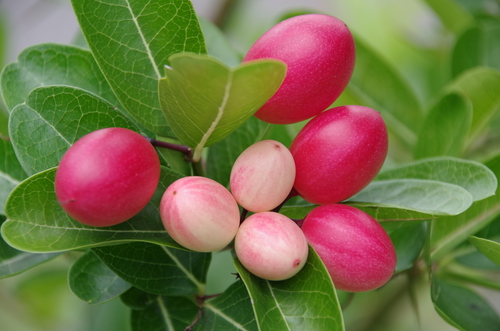
Carissa carandas
Ceylon damson, Sri Lankan damson
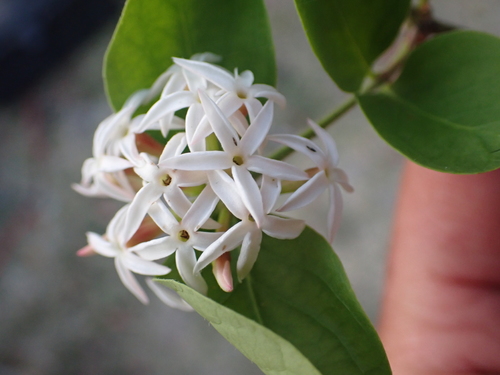
Carissa congesta
Bengal currant
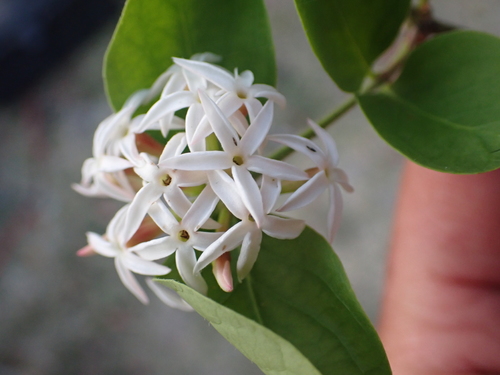
Carissa edulis
Carandas plum, Simple-spined carissa
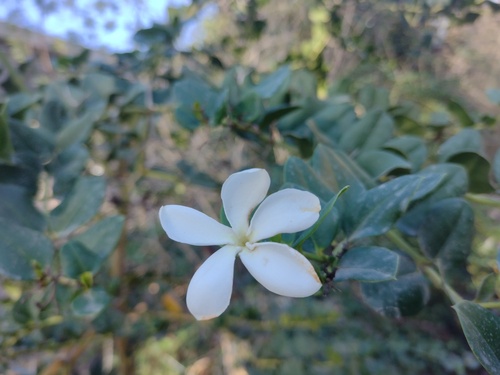
Carissa grandiflora
Carissa, Natal plum, Boxwood beauty
Carissa haematocarpa
Karoo num-num, Black num-num
Carissa lanceolata
Konkleberry, Conkerberry, Currant bush, Kunkerberry, Aperlap, Perlap