Cynanchum floribundum
(R. Br.) Schltr.
Native pear, Dumara bush, Angelth
iNaturalist· cc-by
(c) Kym Nicolson, some rights reserved (CC BY), uploaded by Kym Nicolson
iNaturalist· cc-by-nc
(c) Yandeyarra Remote Community School, some rights reserved (CC BY-NC)
Summary
Source: WikipediaCynanchum floribundum, commonly known as desert cynanchum, is a flowering plant in the family Apocynaceae and grows in Australia. It is a perennial shrub with twining stems and whitish flowers.
Description
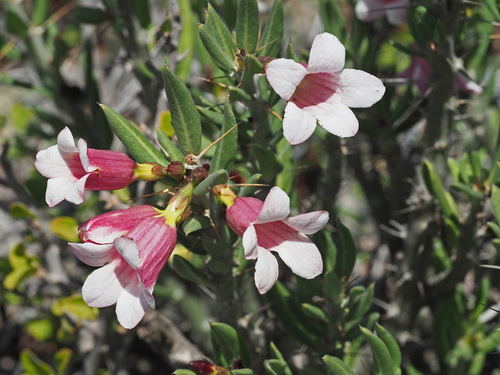
A small shrubby climber. It grows 0.5-1 m tall. Young shoots are hairy. The leaves are 2.5-5 cm long by 2-4 cm wide. They are oval or heart shaped. They are rounded at the base and drawn out into a long point. They are hairy when young but smooth when mature. They are dark green. The flowers are white and o.6 cm long. The follicles are spindle shaped and 3-5 cm long. The seeds are 1-2.5 cm long and have bristles.
Edible Uses
The unripe milky pods are cooked and eaten.
Traditional Uses
CAUTION: The unripe milky pods are eaten. They are cooked.
This uses section is brief — help expand it
Known Hazards
Caution advised with unripe pods.
Distribution
It grows in inland regions and on sand dunes. It is a tropical and subtropical plant. It is damaged by frost or drought. It can grow in arid places.
Where It Grows
Australia*,
Cultivation
Plants can be grown from seed.
Notes
There are about 150 Cynanchum species.
Synonyms
Also Known As
Jupa, Walyuru
References (19)
- Bindon, P., 1996, Useful Bush Plants. Western Australian Museum. p 96
- Bodkin, F., 1991, Encyclopedia Botanica. Cornstalk publishing, p 314
- Cancilla, D., 2018, Ethnobotanical and Ethnozoological Values Desktop Assessment - Eliwana Project. p 11
- Cherikoff V. & Isaacs, J., The Bush Food Handbook. How to gather, grow, process and cook Australian Wild Foods. Ti Tree Press, Australia p 189
- Cribb, A.B. & J.W., 1976, Wild Food in Australia, Fontana. p 65
Show all 19 references Hide references
- Elliot, W.R., & Jones, D.L., 1984, Encyclopedia of Australian Plants suitable for cultivation. Vol 3. Lothian. p 153
- Flora of Australia, Volume 28, Gentiales, Melbourne:CSIRO Australia, 1996. p 225, Map 259 p 302
- Green, J., (Ed.), 2003, Anmatyerr Plant Stories. AID Press. p 6
- Hardwick, G., 2001, Economically Useful Plants for Northern Australia: Master Species List. Crusader eBooks.
- Jones, D.L. & Gray, B., 1977, Australian Climbing Plants. Reed. p 60
- Latz, P.K., 1996, Bushfires and Bushtucker: Aboriginal plant use in Central Australia. IAD Press Alice Springs p 157
- Latz, P & Wightman, G., 1995, Desert Bush Tucker Identikit. Common Native Food Plants of Central Australia. Parks & Wild Commission Northern territory. p 28
- Lazarides, M. & Hince, B., 1993, Handbook of Economic Plants of Australia, CSIRO. p 72
- Low, T., 1991, Wild Food Plants of Australia. Australian Nature FieldGuide, Angus & Robertson. p 165
- Morley, B.D., & Toelken, H.R., (Eds), 1983, Flowering Plants in Australia. Rigby. p 253
- Paczkowska, G. & Chapman, A.R., 2000, The Western Australian Flora. A Descriptive Catalogue. Western Australian Herbarium. p 152
- Urban, A., 1990, Wildflowers of Inland Australia. Portside editions. p 156
- Wheeler, J.R.(ed.), 1992, Flora of the Kimberley Region. CALM, Western Australian Herbarium, p 710
- Williams, K.A.W., 1999, Native Plants of Queensland Volume 4. Keith A.W. Williams North Ipswich, Australia. p 138