Cussonia spicata
Thunb.
Cabbage tree, Spiked cabbage tree
iNaturalist· cc-by-nc-sa
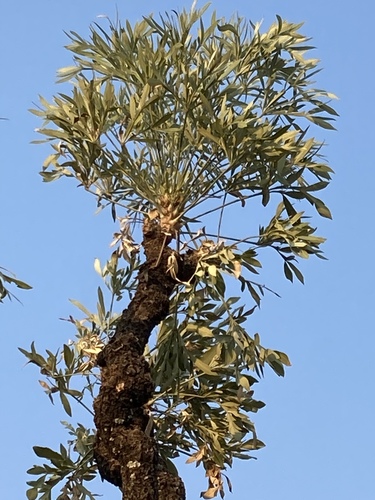
(c) Rob Palmer, some rights reserved (CC BY-NC-SA), uploaded by Rob Palmer
iNaturalist· cc-by-nc
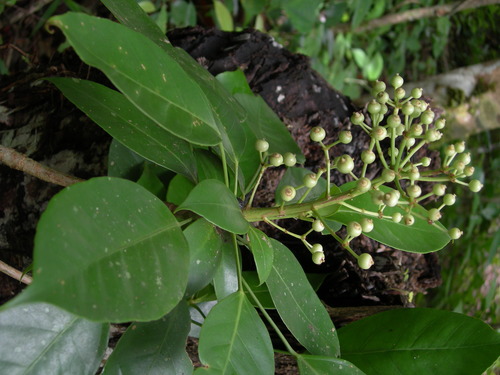
(c) Richard Gill, some rights reserved (CC BY-NC)
iNaturalist· cc-by-nc-sa
(c) manual crank, some rights reserved (CC BY-NC-SA)
Summary
Source: WikipediaCussonia spicata, known as spiked cabbage tree, lowveld cabbage tree or common cabbage tree, is a tree in the family Araliaceae, which is native to the moister regions of Sub-Saharan Africa. It is cultivated as a garden plant in areas without extreme degrees of frost. It is one of the favorite foods of wild elephants.
Description
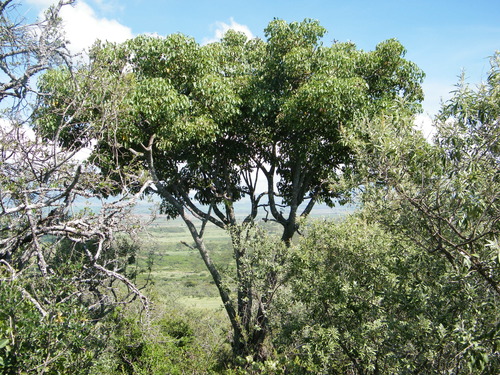
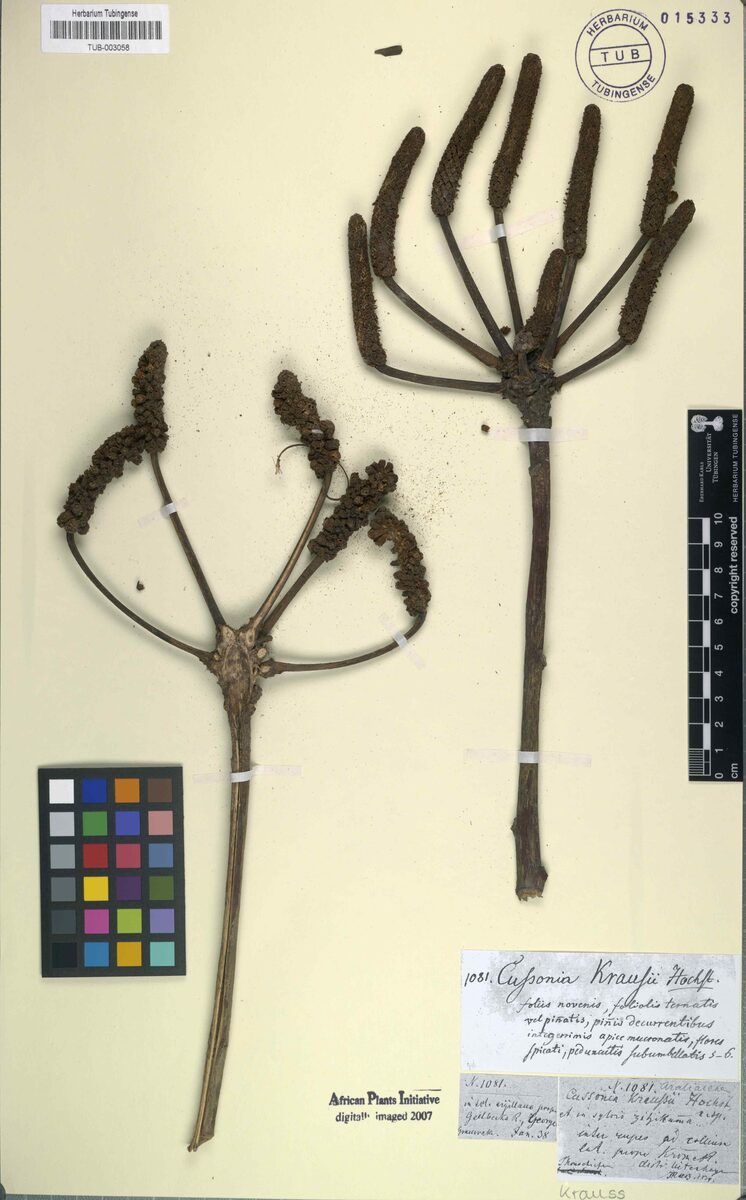
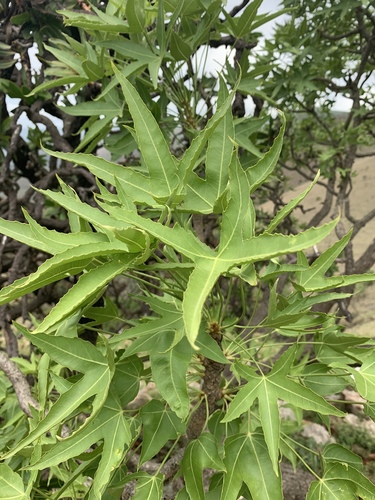
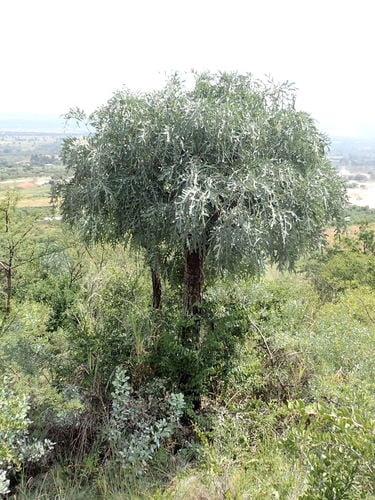
A thickset tree. It grows 3-10 m tall. The bark is yellowish-grey. It is thick and corky. The leaves are crowded near the ends of the branches. They are compound leaves and up to 70 cm across. There are 5-9 leaflets from the end of a stout leaf stalk. This can be 40 cm long. The leaflets are dark green or bluish-green. They are lobed and dissected. The edge has sharp teeth. The flowers are greenish-yellow. They are closely packed along 8-12 thick spikes. These are 5-15 cm long by 1.5-4 cm wide. The fruit is angular. It is 4-6 mm across. They are purple when mature.
Edible Uses
The fruit are eaten. The thick young roots or tubers are dug out, peeled, and chewed. The roots are traditionally chewed for their moisture, with the fibre spat out. The roots serve as a famine food.
Traditional Uses
The roots are chewed for their moisture and the fibre spat out. The thick young roots or tubers are dug out and peeled and chewed. CAUTION: There are reports that the roots are poisonous. The fruit are eaten.
Medicinal Uses
Cussonia spicata is harvested locally for its wood, roots, and leaves to be used as food, medicine, and timber. The wood is light and perishable but is used to construct beehives, wooden bicycle wheels, doors, mole traps, tool handles, and utensils. The succulent roots are edible and have been used as a traditional malaria treatment. The leaves are harvested for fodder and are used in traditional medicine for treating indigestion. It is used both locally and internationally as an ornamental plant. In English it is commonly known as the cabbage tree, spiky cabbage tree, common cabbage tree, or elephant's toothbrush. Common names in other languages include:
Known Hazards
There are reports that the roots are poisonous.
Distribution
A tropical plant. It is native to E and S Africa. It grows on mountain slopes and dry lowveld. It loses its leaves with heavy frost. In Malawi it grows between 1,250-2,450 m altitude. It can grow in arid places. It suits hardiness zones 9-11.
Where It Grows
Africa, Australia, Botswana, Central Africa, Comoros, Congo, East Africa, Eswatini, Kenya, Malawi, Mozambique, South Africa, Southern Africa, Sudan, Swaziland, Tanzania, Uganda, Zambia, Zimbabwe,
Cultivation
Plants are grown from fresh seed. It can also be grown from cuttings.
Propagation
Seed - best sown as soon as it is ripe. After washing the thin layer of pulp off the seed, it should be sown immediately into seed trays in a fine seedling germination mixture and covered lightly. Seed may take from three to eight weeks to germinate. Seedlings are best left in the tray for the first year and transplanted into individual containers at the beginning of the second growing season. They can be ready to plant out into their permanent positions 2 years later.Cuttings
Other Uses
Wood is white and soft and is used for making temporary stools and doors, water troughs, beehives and wheels for wheelbarrows. The tree is used for boundary marking and to provide shade.
Production
Trees are fast growing.
Other Information
The roots are a famine food.
Notes
There are 20 Cussonia species. They occur in South Africa.
Synonyms
Also Known As
Chamdimbo, Chandimbo, Elephant's tooth brush, Enfenge, Intsenge, Kiepersol, Lerole, Lowveld cabbage tree, Maneneh, Mnyonzi, Mosetshe, Mporori, Mubwabwa, Mufenje, Musengele, Musheme, Mushondya, Mussenga, Mutanana, Mwenyiere, Oldimaroi, Olurur, Sokwet, Umsenge, Umsenge, Umtsentse, Wacomo
References (29)
- Barwick, M., 2004, Tropical and Subtropical Trees. A Worldwide Encyclopedic Guide. Thames and Hudson p 138
- Bodkin, F., 1991, Encyclopedia Botanica. Cornstalk publishing, p 308
- Cundall, P., (ed.), 2004, Gardening Australia: flora: the gardener's bible. ABC Books. p 447
- Dharani, N., 2002, Field Guide to common Trees & Shrubs of East Africa. Struik. p 82
- Etherington, K., & Imwold, D., (Eds), 2001, Botanica's Trees & Shrubs. The illustrated A-Z of over 8500 trees and shrubs. Random House, Australia. p 247
Show all 29 references Hide references
- Food Composition Tables for use in Africa FAO http://www.fao.org/infoods/directory No. 628
- Fowler, D. G., 2007, Zambian Plants: Their Vernacular Names and Uses. Kew. p 76
- Fox, F. W. & Young, M. E. N., 1982, Food from the Veld. Delta Books. p 98
- Grivetti, L. E., 1980, Agricultural development: present and potential role of edible wild plants. Part 2: Sub-Saharan Africa, Report to the Department of State Agency for International Development. p 66
- Jardin, C., 1970, List of Foods Used In Africa, FAO Nutrition Information Document Series No 2.p 131
- Long, C., 2005, Swaziland's Flora - siSwati names and Uses http://www.sntc.org.sz/flora/
- Lord, E.E., & Willis, J.H., 1999, Shrubs and Trees for Australian gardens. Lothian. p 53
- Nova Acta Regiae Soc. Sci. Upsal. 3:212, t. 13. 1780
- Palgrave, K.C., 1996, Trees of Southern Africa. Struik Publishers. p 704
- Peters, C. R., O'Brien, E. M., and Drummond, R.B., 1992, Edible Wild plants of Sub-saharan Africa. Kew. p 61
- Royal Botanic Gardens, Kew (1999). Survey of Economic Plants for Arid and Semi-Arid Lands (SEPASAL) database. Published on the Internet; http://www.rbgkew.org.uk/ceb/sepasal/internet [Accessed 28th March 2011]
- Ruffo, C. K., Birnie, A. & Tengnas, B., 2002, Edible Wild Plants of Tanzania. RELMA p 246
- Ruiters-Welcome, A. K., 2019, Food plants of southern Africa. Ph.D. thesis. Univ. of Johannesburg p 28
- Shava, S., 2000, The Use of Indigenous Plants as Food by a Rural Community in the Eastern Cape: an Educational Exploration. Masters Thesis Rhodes University. p 63
- Swaziland's Flora Database http://www.sntc.org.sz/flora
- van Wyk, B, van Wyk, P, and van Wyk B., 2000, Photographic guide to Trees of Southern Africa. Briza. p 111
- van Wyk, Be., & Gericke, N., 2007, People's plants. A Guide to Useful Plants of Southern Africa. Briza. p 84
- Venter, F & J., 2009, Making the most of Indigenous Trees. Briza. p 118
- Welcome, A. K. & Van Wyk, B.-E., 2019, An inventory and analysis of the food plants of southern Africa. South African Journal of Botany 122 (2019) 136–179
- White, F., Dowsett-Lemaire, F. and Chapman, J. D., 2001, Evergreen Forest Flora of Malawi. Kew. p 152
- Williamson, J., 2005, Useful Plants of Malawi. 3rd. Edition. Mdadzi Book Trust. p 91
- World Checklist of Useful Plant Species 2020. Royal Botanic Gardens, Kew
- www.zimbabweflora.co.zw 2011
- Young, J., (Ed.), 2001, Botanica's Pocket Trees and Shrubs. Random House. p 301