Aralia cordata
Thunb.
Japanese asparagus
iNaturalist· cc-by
(c) Marco Mussita, some rights reserved (CC BY), uploaded by Marco Mussita
iNaturalist· cc-by-nc
(c) matsu_shino, some rights reserved (CC BY-NC)
iNaturalist· cc-by-nc
(c) olgaaseeva, some rights reserved (CC BY-NC)
Summary
Source: WikipediaAralia cordata is an upright herbaceous perennial plant growing up to 2 to 3 metres (6.6 to 9.8 ft) in height, native to Japan, Korea, Russian Far East, and eastern China. Its common names include spikenard, herbal aralia, udo (from Japanese: ウド), Japanese spikenard, and mountain asparagus. It is commonly found on the slopes of wooded embankments. Aralia cordata is a species of Aralia in the family Araliaceae. The plant yields new shoots every spring, which are blanched and then eaten as a vegetable. In Korea, the dried root of the plant has been traditionally used as medicine. The young shoots have a strong yet pleasant distinct aromatic flavor. In addition to food and medicinal use, the plant is cultivated as an ornamental.
Description
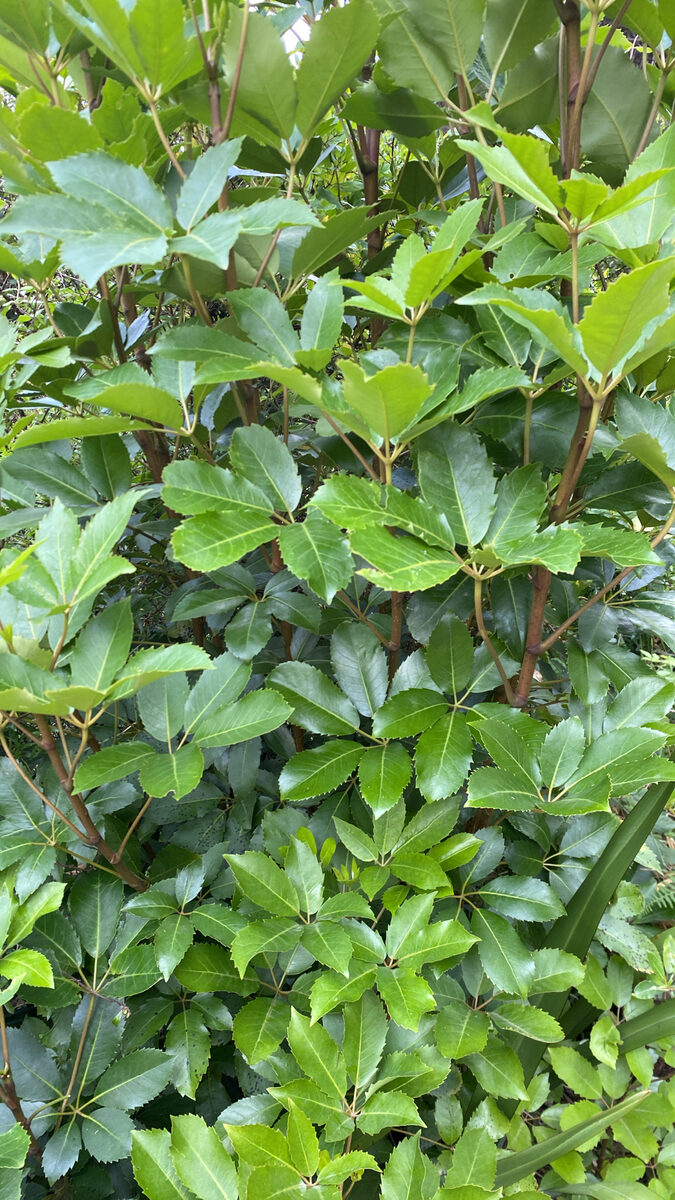
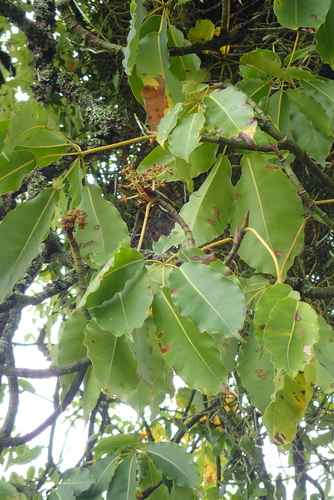
A stout herb. It grows 2.4 m high and spreads 2.4 m wide. The leaves are large and compound. The leaflets are round and 1 cm long. They have fine teeth. Each year it produces edible shoots from its roots. The flowers are in large panicles. The fruit are black. They are 3 mm across.
Edible Uses
Edible Parts: Leaves Root Shoots Stem Edible Uses: Young branched shoots - cooked or raw. They can be up to 1.5 metres long and have a mild and agreeable flavour. They are usually blanched and are crisp and tender with a unique lemon-like flavour. They can be sliced and added to salads, soups etc. The shoots contain about 1.1% protein, 0.42% fat, 0.8% soluble carbohydrate, 0.55% ash. Root - cooked. Used like scorzonera. References More on Edible Uses Composition Figures in grams (g) or miligrams (mg) per 100g of food. Shoots (Fresh weight) 0 Calories per 100g Water : 0% Protein: 1.1g; Fat: 0.42g; Carbohydrate: 0.8g; Fibre: 0g; Ash: 0.55g; Minerals - Calcium: 0mg; Phosphorus: 0mg; Iron: 0mg; Magnesium: 0mg; Sodium: 0mg; Potassium: 0mg; Zinc: 0mg; Vitamins - A: 0mg; Thiamine (B1): 0mg; Riboflavin (B2): 0mg; Niacin: 0mg; B6: 0mg; C: 0mg; Reference: Notes:
Traditional Uses
The shoots are briefly boiled then added to salads or cooked more and used in other dishes. The roots are eaten like parsnips.
This uses section is brief — help expand it
Medicinal Uses
Analgesic Antiinflammatory Carminative Diuretic Febrifuge Stimulant Stomachic Tonic The root is sometimes used in China as a substitute for ginseng (Panax species). It is said to be analgesic, antiinflammatory, carminative, diuretic, febrifuge, stimulant, stomachic and tonic. The root contains an essential oil, saponins, sesquiterpenes and diterpene acids. It is used in Korea to treat the common cold and migraines.
Distribution
It is a warm temperate plant. It suits hardiness zones 8-10.
Where It Grows
Asia, Australia, Canada, China, Japan*, Korea, Russia, Taiwan, Tasmania, USA,
Cultivation
Prefers a good deep loam and a semi-shady position. Requires a sheltered position. Plants are hardier when grown in poorer soils. Tolerates a pH in the range 5.0 to 7.4. Dormant plants are hardy to about -25°c. The young growth in spring, even on mature plants, is frost-tender and so it is best to grow the plants in a position sheltered from the early morning sun. This is a commonly cultivated food crop in Japan, where it is grown for its edible shoots. There are several named varieties.
Propagation
Seed - best sown as soon as ripe in a cold frame. Stored seed requires 3 - 5 months of cold stratification. Germination usually takes place within 1 - 4 months at 20°c. When large enough to handle, prick the seedlings out into individual pots and grow them on in light shade in a greenhouse for at least their first winter. Once the plants are 25cm or more tall, they can be planted out into their permanent positions, late spring or early summer being the best time to do this. Root cuttings 8cm long, December in a cold frame. Store the roots upside down in sand and pot up in March/April. High percentage. Division of suckers in late winter. Very easy, the suckers can be planted out direct into their permanent positions if required.
Other Uses
None known Special Uses Food Forest
Other Information
It is a commercially cultivated vegetable. It is an important vegetable in Japan.
Notes
There are about 40-55 Aralia species. Chemical composition - Protein = 1.1%. Fat = 0.42%. Carbohydrate (soluble) = 0.8%. Ash = 0.55%.
Nutrition
| Part | Moisture | kJ | kcal | Protein | Vit A | Vit C | Iron | Zinc |
|---|---|---|---|---|---|---|---|---|
| Leaves/Stalks | 95.3 | 59 | 14 | 1.1 | — | — | 0.3 | — |
Synonyms
Also Known As
Cimakina, Japanese Spikenard, Mountain asparagus, Oudo, Tu dang gui, Udo
References (29)
- Arora, R. K., 2014, Diversity in Underutilized Plant Species - An Asia-Pacific Perspective. Bioversity International. p 36
- Bircher, A. G. & Bircher, W. H., 2000, Encyclopedia of Fruit Trees and Edible Flowering Plants in Egypt and the Subtropics. AUC Press. p 37
- Brown, D., 2002, The Royal Horticultural Society encyclopedia of Herbs and their uses. DK Books. p 126
- Chen, B. & Qiu, Z., Consumer's Attitudes towards Edible Wild Plants, Ishikawa Prefecture, Japan. p 22 www.hindawi.com/journals/ijfr/aip/872413.pdf
- Cundall, P., (ed.), 2004, Gardening Australia: flora: the gardener's bible. ABC Books. p 170
Show all 29 references Hide references
- Etherington, K., & Imwold, D., (Eds), 2001, Botanica's Trees & Shrubs. The illustrated A-Z of over 8500 trees and shrubs. Random House, Australia. p 97
- Facciola, S., 1998, Cornucopia 2: a Source Book of Edible Plants. Kampong Publications, p 25
- Flora of China. www.eFloras.org
- Fl. jap. 127. 1784
- Food Composition Tables for use in East Asia FAO http://www.fao.org/infoods/directory No. 783
- Hedrick, U.P., 1919, (Ed.), Sturtevant's edible plants of the world. p 66
- Hibbert, M., 2002, The Aussie Plant Finder 2002, Florilegium. p 31
- Hu, Shiu-ying, 2005, Food Plants of China. The Chinese University Press. p 585
- Jackes, D. A., Edible Forest Gardens
- Kays, S. J., and Dias, J. C. S., 1995, Common Names of Commercially Cultivated Vegetables of the World in 15 languages. Economic Botany, Vol. 49, No. 2, pp. 115-152
- Kiple, K.F. & Ornelas, K.C., (eds), 2000, The Cambridge World History of Food. CUP p1874
- Kuhnlein, H. V., et al, 2009, Indigenous Peoples' food systems. FAO Rome p 148
- Larkcom, J., 1991, Oriental Vegetables, John Murray, London, p 129
- Lim, T. K., 2015, Edible Medicinal and Non Medicinal Plants. Volume 9, Modified Stems, Roots, Bulbs. Springer p 11
- Macmillan, H.F. (Revised Barlow, H.S., et al), 1991, Tropical Planting and Gardening. Sixth edition. Malayan Nature Society. Kuala Lumpur. p 371
- Martin, F.W. & Ruberte, R.M., 1979, Edible Leaves of the Tropics. Antillian College Press, Mayaguez, Puerto Rico. p 176
- Plants for a Future database, The Field, Penpol, Lostwithiel, Cornwall, PL22 0NG, UK. http://www.scs.leeds.ac.uk/pfaf/
- READ
- Terra, G.J.A., 1973, Tropical Vegetables. Communication 54e Royal Tropical Institute, Amsterdam, p 25
- Tozer, F., 2007, The Uses of Wild Plants. Green Man Publishing. p 30
- USDA, ARS, National Genetic Resources Program. Germplasm Resources Information Network - (GRIN). [Online Database] National Germplasm Resources Laboratory, Beltsville, Maryland. Available: www.ars-grin.gov/cgi-bin/npgs/html/econ.pl (10 April 2000)
- Wiersema, J. H. & Leon, B., 2013, World Economic Plants. A Standard Reference CRC Press. 2nd Ed. p 63
- World Checklist of Useful Plant Species 2020. Royal Botanic Gardens, Kew
- Zeven, A. C. & de West, J. M. J., 1982, Dictionary of cultivated plants and their regions of diversity. Wageningen. p 32