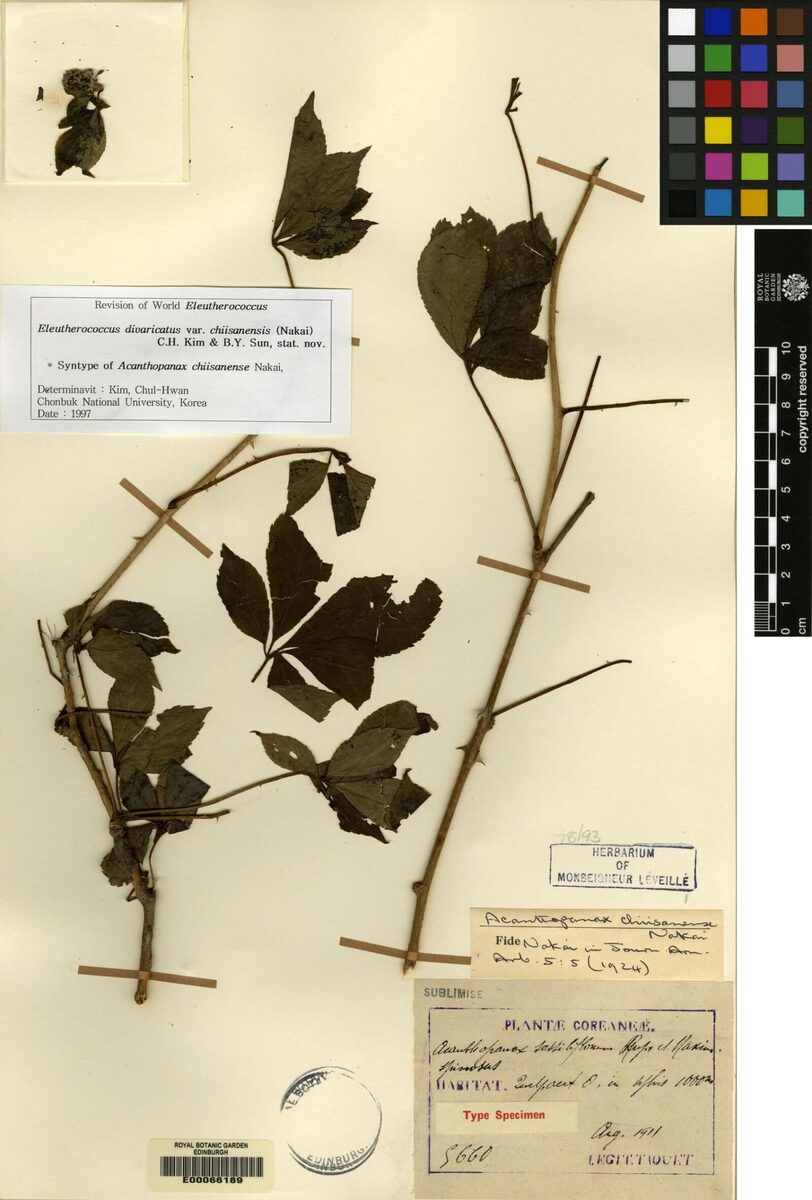
Aralia elata
(Miq.) Seem.
Japanese angelica-tree, Japanese aralia
iNaturalist· cc-by-nc
(c) krs10ellington, some rights reserved (CC BY-NC)
iNaturalist· cc-by-sa
(c) Douglas Goldman, some rights reserved (CC BY-SA), uploaded by Douglas Goldman
iNaturalist· cc-by-nc
(c) Devon Cummings, some rights reserved (CC BY-NC), uploaded by Devon Cummings
Summary
Source: WikipediaAralia elata, also known as the Japanese angelica tree, Chinese angelica-tree, or Korean angelica-tree, is a species of woody plant in the family Araliaceae native to eastern Asia (in Russia, China, Taiwan, the Korean Peninsula, and Japan).
Description
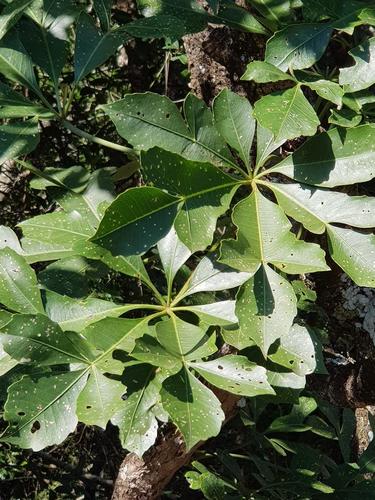
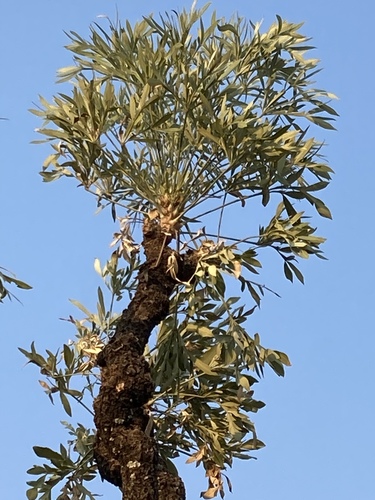
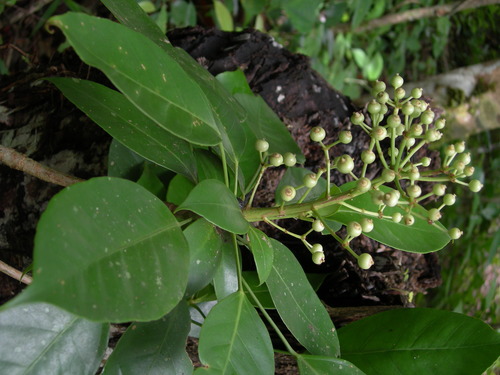
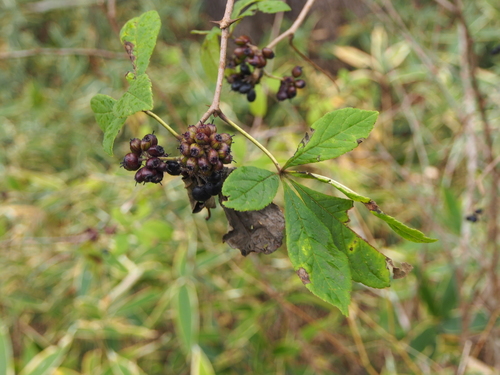
A shrub or small tree. It grows 6-12 m tall. It spreads 9 m wide. The stems are spiny and with few branches. It can produce suckers. It loses its leaves during the year. The stems have very large leaves at the top. The leaves are 1.2 m long and doubly divided. There are several pairs of branches from a prickly stalk. The are many leaflets which are curved and have teeth along the edge. They often have prickles underneath. The leaves turn red and yellow. There are about 80 leaflets. The flowers are tiny and cream in frothy clusters. These form at the tip of the shoot. The fruit are plum like and 6 mm across. The have 5 ribs and are black. They occur in large clusters.
Edible Uses
Edible Parts: Leaves Shoots Edible Uses: Young shoots - cooked. They can also be blanched and used in salads. The young shoots of Aralia elata are a popular wild food in Japan where the tree is known as Taranoki and the shoots as Taranome. In Korea the shoots are called dureup.
Traditional Uses
The young tender shoots and sprouts are partly boiled and eaten like asparagus. They are also used in soups or stir-fried.
This uses section is brief — help expand it
Medicinal Uses
Anodyne Cancer Carminative The roots and stems are anodyne and carminative. All parts of the plant are used for the treatment of rheumatoid arthralgia, coughs, diabetes, jaundice, stomach ulcers and stomach cancers.
Distribution
It is a temperate plant. In China it grows from sea level to 2,700 m above sea level. It suits hardiness zones 4-9. In Sichuan and Yunnan.
Where It Grows
Asia, Australia, Canada, China, Japan*, Korea, North America, Russia, Siberia, USA,
Cultivation
Plants can be grown from seed. They can also be grown from root suckers. It can be grown using root cuttings. It is more difficult to grow from cuttings of branches.
Propagation
Seed - best sown as soon as ripe in a cold frame. Stored seed requires 3 - 5 months of cold stratification. Germination usually takes place within 1 - 4 months at 20°c. When large enough to handle, prick the seedlings out into individual pots and grow them on in light shade in a greenhouse for at least their first winter. Once the plants are 25cm or more tall, they can be planted out into their permanent positions, late spring or early summer being the best time to do this. Root cuttings 8cm long, December in a cold frame. Store the roots upside down in sand and pot up in March/April. High percentage. Division of suckers in late winter. Very easy, the suckers can be planted out direct into their permanent positions if required.
Other Uses
Landscape Uses: Specimen. Special Features: Not North American native, Blooms are very showy. attracts wildlife. Nectary - Shelter [1-2]. Special Uses Food Forest
Other Information
It is a commercially cultivated vegetable. It is a cultivated food crop.
Notes
There are about 40-55 Aralia species.
Nutrition
| Part | Moisture | kJ | kcal | Protein | Vit A | Vit C | Iron | Zinc |
|---|---|---|---|---|---|---|---|---|
| Leaves | 84 | 201 | 48 | 5.5 | — | — | 7.4 | — |
Synonyms
Also Known As
Bang a, Dureumnamu, Dureupnamu, Turup, Turupnamu
References (30)
- Chen, B. & Qiu, Z., Consumer's Attitudes towards Edible Wild Plants, Ishikawa Prefecture, Japan. p 22 www.hindawi.com/journals/ijfr/aip/872413.pdf
- Cheng, Z., et al, 2022, Ethnobotanical study on wild edible plants used by Dulong people in northwestern Yunnan, China. Journal of Ethnobiology and Ethnomedicine (2022) 18:3
- Coombes, A.J., 2000, Trees. Dorling Kindersley Handbooks. p 114
- Cundall, P., (ed.), 2004, Gardening Australia: flora: the gardener's bible. ABC Books. p 170
- Etherington, K., & Imwold, D., (Eds), 2001, Botanica's Trees & Shrubs. The illustrated A-Z of over 8500 trees and shrubs. Random House, Australia. p 96
Show all 30 references Hide references
- Facciola, S., 1998, Cornucopia 2: a Source Book of Edible Plants. Kampong Publications, p 25
- Fan, L., et al, The Use of Edible Wild Plants and Fungi in Korean-Chinese Villages. Journal of Environmental Information Science 44-5 p 71-79
- Farrar, J.L., 1995, Trees of the Northern United States and Canada. Iowa State University press/Ames p 220
- Flora of China. www.eFloras.org
- Food Composition Tables for use in East Asia FAO http://www.fao.org/infoods/directory No. 364
- J. Bot. 6:134. (Revis. Heder. 90. 1868). 1868
- Hibbert, M., 2002, The Aussie Plant Finder 2002, Florilegium. p 31
- Hwang, H., et al, 2013, A Study on the Flora of 15 Islands in the Western Sea of Jeollanamdo Province, Korea. Journal of Asia-Pacific Biodiversity Vol. 6, No. 2 281-310
- Hwang, K., et al, 2015, Extracts from Aralia elata (Miq.) Seem alleviate hepatosteatosis via improving hepatic insulin sensitivity. Complementary and Alternative Medicine. 15:347
- Jackes, D. A., Edible Forest Gardens
- Joyce, D., 1998, The Garden Plant Selector. Ryland, Peters and Small. p 123
- Kays, S. J., and Dias, J. C. S., 1995, Common Names of Commercially Cultivated Vegetables of the World in 15 languages. Economic Botany, Vol. 49, No. 2, pp. 115-152
- Lamberton, K (Ed.), 2004, The Australian gardening encyclodepia. Murdoch Books, NSW Australia. p 172
- Lord, E.E., & Willis, J.H., 1999, Shrubs and Trees for Australian gardens. Lothian. p 204
- Ong, H. G., et al, 2015, Ethnobotany of the wild edible plants gathered in Ulleung Island, South Korea. Genet Resourc Crop Evol. Springer
- Pemberton, R. W. & Lee, N. S., 1996, Wild Food Plants in South Korea: Market Presence, New Crops, and Exports to the United States. Economic Botany, Vol. 50, No. 1, pp. 57-70
- Plants for a Future database, The Field, Penpol, Lostwithiel, Cornwall, PL22 0NG, UK. http://www.scs.leeds.ac.uk/pfaf/
- Ryan, S., 2008, Dicksonia. Rare Plants Manual. Hyland House. p 7
- Schuler, S., (Ed.), 1977, Simon & Schuster's Guide to Trees. Simon & Schuster. No. 82
- Shikov, A. N. et al, 2017, Traditional and Current Food Use of Wild Plants Listed in the Russian Pharmacopoeia. Frontiers in Pharmacology. Vol. 8 Article 841
- Song, M., et al, 2013, Traditional knowledge of wild edible plants in Jeju Island, Korea. Indian Journal of Traditional Knowledge. 12(2) pp 177-194
- Tozer, F., 2007, The Uses of Wild Plants. Green Man Publishing. p 31
- USDA, ARS, National Genetic Resources Program. Germplasm Resources Information Network - (GRIN). [Online Database] National Germplasm Resources Laboratory, Beltsville, Maryland. Available: www.ars-grin.gov/cgi-bin/npgs/html/econ.pl (10 April 2000)
- Wiersema, J. H. & Leon, B., 2013, World Economic Plants. A Standard Reference CRC Press. 2nd Ed. p 63
- World Checklist of Useful Plant Species 2020. Royal Botanic Gardens, Kew