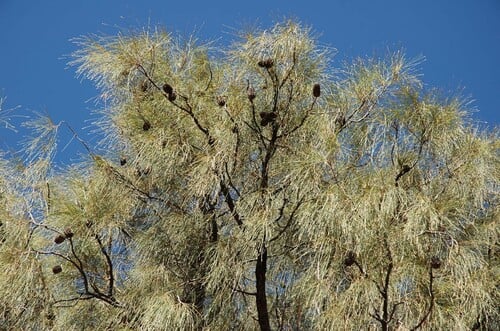
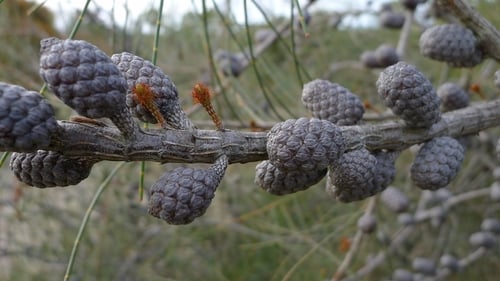
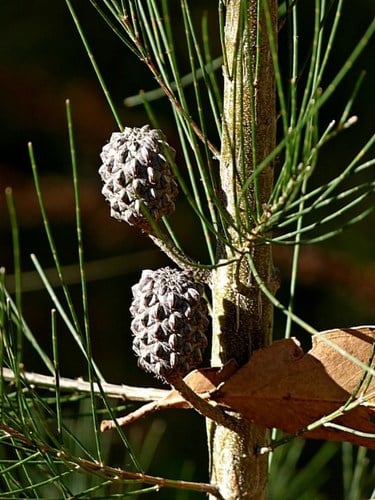
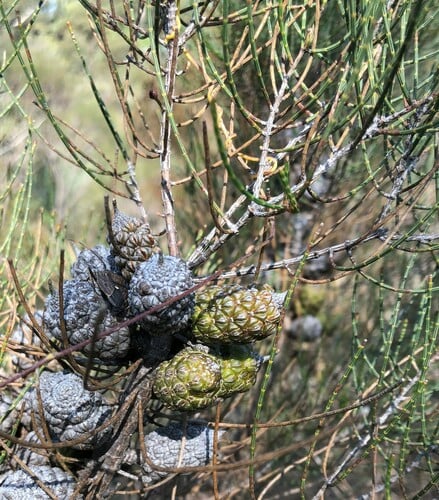
Casuarina oligodon
L.A.S. Johnson
Soft yar
iNaturalist· cc-by-nc
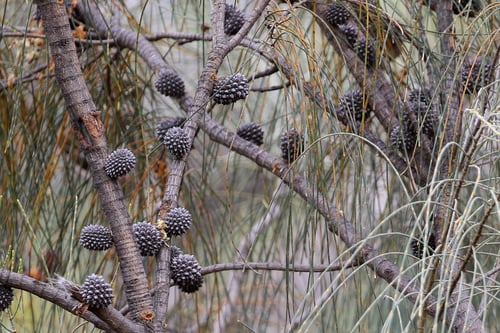
(c) Callum Blacklaw, some rights reserved (CC BY-NC), uploaded by Callum Blacklaw
iNaturalist· cc-by-nc
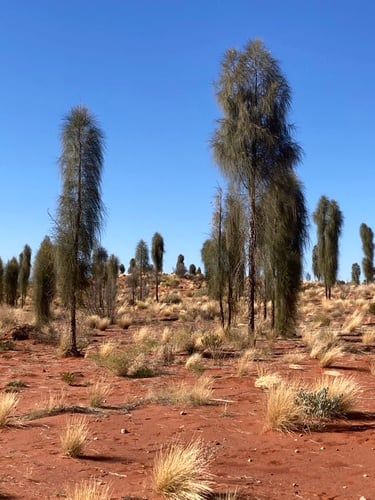
(c) Callum Blacklaw, some rights reserved (CC BY-NC), uploaded by Callum Blacklaw
wikimedia· cc-by
Wikimedia Commons
Summary
Source: WikipediaCasuarina oligodon, the she oak, is a species of Casuarina tree first described by Lawrence Alexander Sidney Johnson. Casuarina oligodon is part of the genus Casuarina and the family Casuarinaceae. It is dioecious, very rarely monoecious.
Description
Casuarina oligodon is a medium-growth evergreen tree reaching 25 m tall with 25 m spread, hardy to UK zone 10. Wind-pollinated and nitrogen-fixing, it requires full sun and well-drained soil, tolerating light sandy, medium loamy, and heavy clay soils across mildly acid to basic pH, including very acid and very alkaline conditions. Prefers moist soil.
Edible Uses
None known
Medicinal Uses
None known
Distribution
It is a tropical plant. In Papua New Guinea it grows between 1,500-1,800 m above sea level.
Where It Grows
Australia, Papua New Guinea, PNG,
Cultivation
This is truly a tropical highland species, being found at elevations up to 2,500 metres or sometimes even higher. It grows in areas where the mean annual rainfall is in the range 1,900 - 2,600 mm, there is a high relative humidity throughout the year with a weak dry season of up to 2 months and the temperatures vary from 11 - 15°c minimum at night to 24 - 30°c maximum during the day. Prefers a sunny position. Mostly found in sandy soils along creeks and rivers in the wild, but also grows well in colluvial soils, humic brown clay soils, alluvial and meadow soils. Prefers a pH in the range 5.5 - 6.5, tolerating 4.5 - 7.5. For use as fence posts, a rotation length of 12 - 15 years is sufficient with thinnings at age 6 which could be utilized as fuel wood etc. According to Johnson (1982), the species consists of two subspecies: subsp. Oligodon and subsp. Abbreviata Subsp. Oligodon has longer leaves, up to 1mm long. It is used locally in the eastern highlands of Papua New Guinea Subsp. Abbreviata has shorter leaves up to 0.5mm long. It is used to restore soil fertility and control soil erosion in the N Baliem valley of Irian Jaya. This species has a symbiotic relationship with certain soil micro-organisms, these form nodules on the roots of the plants and fix atmospheric nitrogen. Some of this nitrogen is utilized by the growing plant but some can also be used by other plants growing nearby.
Propagation
Sow seed in seedbeds. Germination typically begins after 10 days, though natural viability is low. Seedlings are pricked out when approximately 50–60 mm tall and transferred into polythene tubes for transplanting. Seed production is very good. Seeds are stored in household refrigerators until needed for sowing; longevity under these conditions has not been formally studied, but storage behaviour appears to be orthodox for this family.
Other Uses
The species has an extensive root system that helps control soil erosion on steep slopes. Fallen foliage forms a protective mulch layer that assists in soil stabilisation and rebuilding. It is used to reforest grasslands in the highlands of Papua New Guinea, where it competes effectively with grasses including Imperata cylindrica, Saccharum robustum, and Themeda australis. Its ability to fix atmospheric nitrogen and produce useful leaf litter makes it a good companion for coffee, providing shade and improved growing conditions. The tree is planted as an intercrop in subsistence food gardens and as a fallow intercrop. It is also widely used as a windbreak and is traditionally planted around entire villages. The wood is hard, heavy, and tends to split when sawn. Split timber is used in building fences and houses. Round wood is used for construction posts and poles; suitable for fencing and for protected and unprotected structural use in buildings. Specialty uses include tool handles, shuttles, and permanently submerged freshwater piles. The wood is regarded as one of the best firewoods in the world, with a charcoal calorific value exceeding 700 kcal/kg.
Also Known As
Casuarina oligodon or She-oak, kilu
References (1)
- World Checklist of Useful Plant Species 2020. Royal Botanic Gardens, Kew