Allocasuarina littoralis
(Salisb.) L. A. S. Johnson
Black she-oak
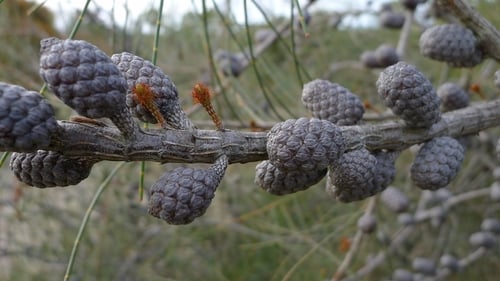
iNaturalist· cc-by
(c) Max Campbell, some rights reserved (CC BY), uploaded by Max Campbell
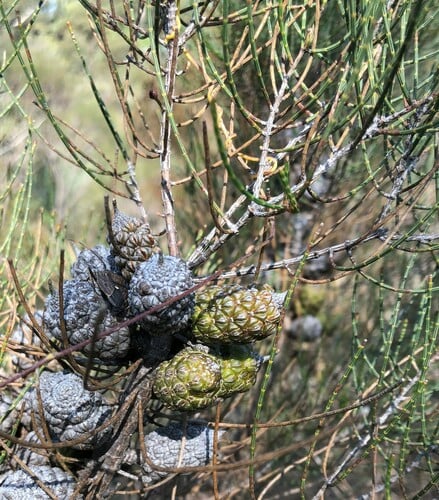
iNaturalist· cc-by-nc
(c) Scott W. Gavins, some rights reserved (CC BY-NC), uploaded by Scott W. Gavins
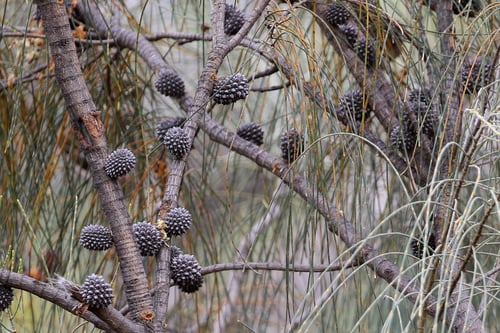
iNaturalist· cc-by
(c) Proteros, some rights reserved (CC BY), uploaded by Proteros
Summary
Source: WikipediaAllocasuarina littoralis, commonly known as black she-oak, is a species of flowering plant in the family Casuarinaceae and is endemic to eastern Australia. It is dioecious, or less commonly a monoecious tree or shrub, that has its leaves reduced to scales, usually in whorls of six to eight, the mature fruiting cones 10–30 mm (0.4–1 in) long containing winged seeds (samaras) 4.0–10 mm (0.2–0.4 in) long.
Description
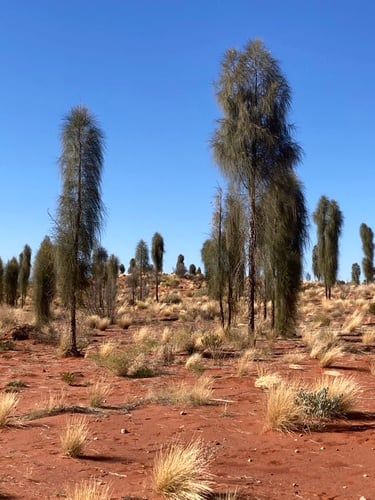
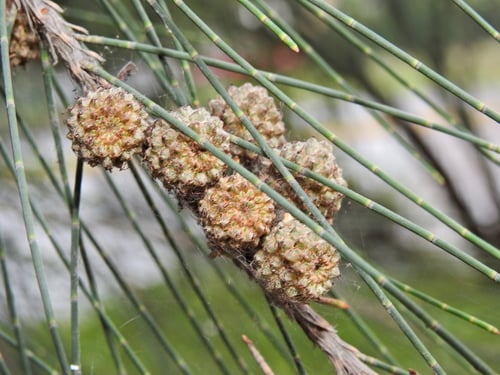
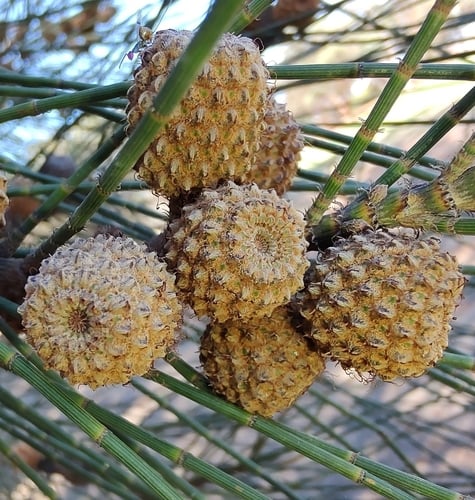
A tree. It grows 10 m tall. It is often a low wind swept shrub near the coast. The branches are slender and 0.5 mm across. The bark is greyish-black and rough and cracked. There are 6-8 reduced leaves. The fruit are cones 1-3 cm long.
Edible Uses
The gum exudate from this plant is edible — it can be chewed directly or melted in hot water to make a jelly.
Traditional Uses
The gum exudate is chewed and also the jelly made by melting the gum in hot water. The cones are boiled to removed tannins and then eaten.
This uses section is brief — help expand it
Medicinal Uses
None known.
Distribution
It is a subtropical to temperate plant. Arboretum Tasmania.
Where It Grows
Asia, Australia*, Indonesia, SE Asia, Tasmania,
Cultivation
It can be grown from seeds.
Propagation
Seed requires no pre-treatment. Sow in containers or a nursery seedbed, barely covering the seed. Germination begins in around 7 days at 25°C. Once large enough to handle, prick seedlings out into individual pots and grow on until ready to plant out. Cuttings of half-ripe wood can also be taken in a frame.
Other Uses
This plant tolerates salt-laden coastal winds, making it an excellent windbreak for exposed situations. It can also be grown as a hedge or screen. Its shallow, spreading root system gives it strong potential for erosion control on sandy soils. The bark is used for tanning. The wood is hard, heavy, and durable, and is used for turnery, tool handles, yokes, furniture, farm buildings, roof shingles, veneer, and joinery. It makes an excellent high-quality fuel and can be used to produce high-grade charcoal.
Synonyms
Also Known As
Wayetuck
References (5)
- Baker, M. L. & de Salas, M. F., 2012, A Census of the Vascular Plants of Tasmania. (On line)
- Caton, J.M. & Hardwick, R. J., 2016, Field Guide to Useful Native Plants from Temperate Australia. Harbour Publishing House. p 40
- Edible and Useful Native Plants (off internet)
- Melzer, R. & Plumb, J., 2011, Plants of Capricornia. Belgamba, Rockhampton. p 90
- www.fsd.monash.edu.au/files/bethgottpamphley_po.pdf