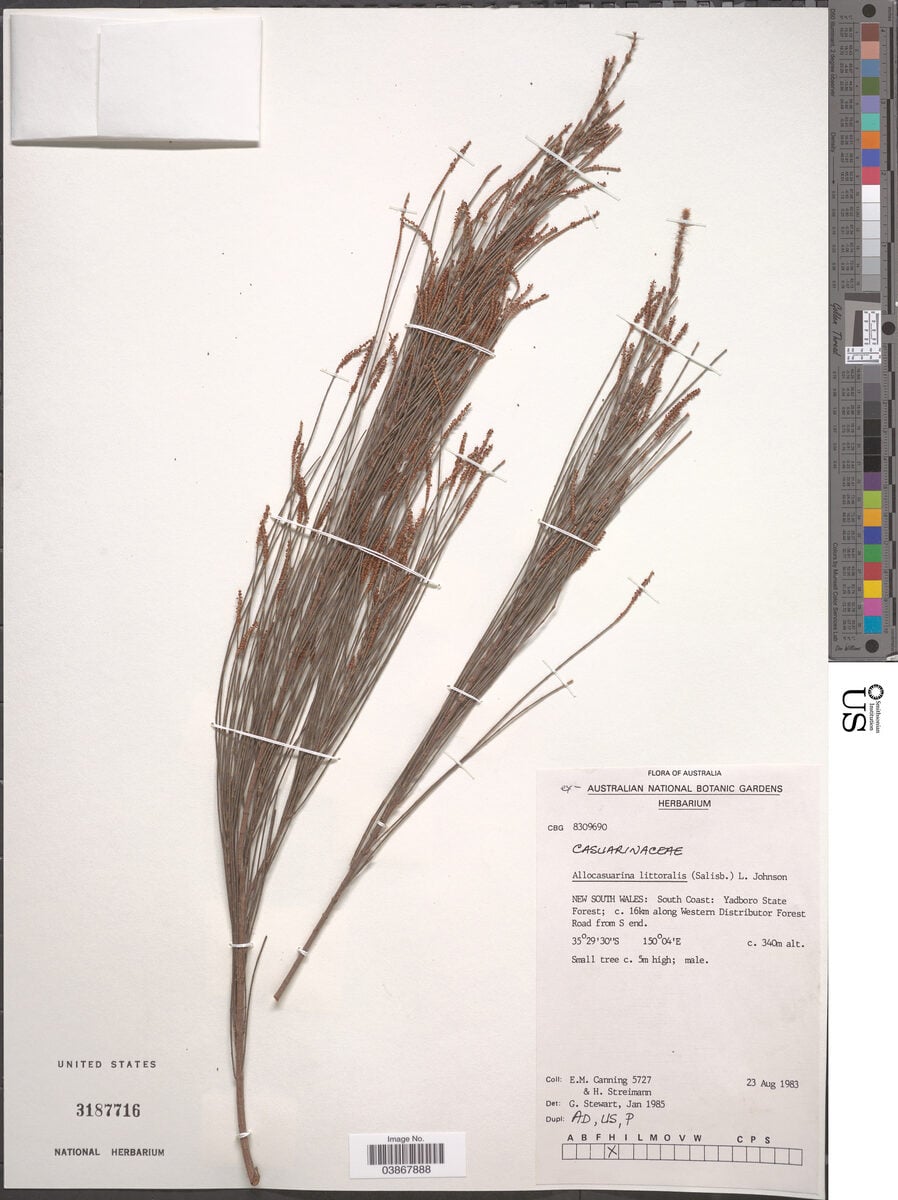
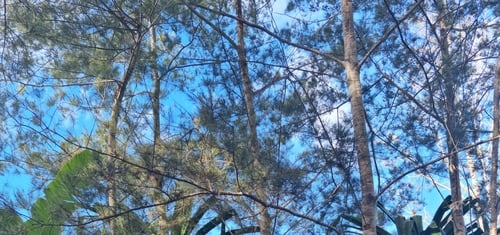
Casuarina equisetifolia
Forster & G. Forster
She oak, Shingle Oak, Coastal She Oak
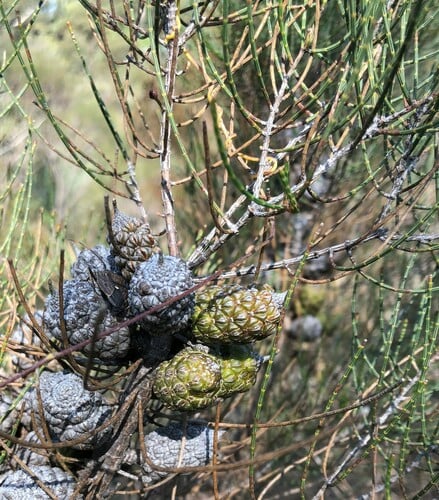
iNaturalist· cc-by-nc
(c) Pedro Alanis, some rights reserved (CC BY-NC), uploaded by Pedro Alanis
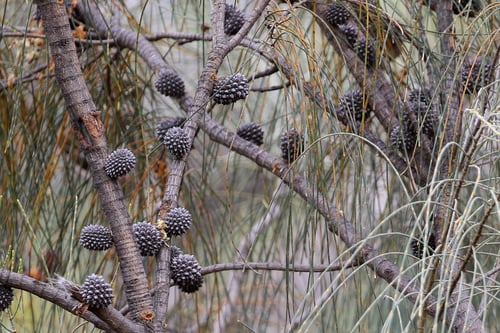
iNaturalist· cc-by-nc
(c) 小铖/Smalltown, some rights reserved (CC BY-NC), uploaded by 小铖/Smalltown
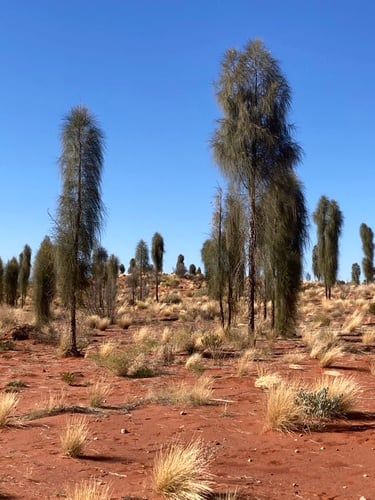
iNaturalist· cc-by-nc
(c) Pete Woodall, some rights reserved (CC BY-NC), uploaded by Pete Woodall
Summary
Source: WikipediaCasuarina equisetifolia, commonly known as coastal she-oak, horsetail she-oak, ironwood, beach sheoak, beach casuarina, whistling tree or Australian pine is a species of flowering plant in the family Casuarinaceae and is native to Australia, New Guinea, Southeast Asia and India. It is a small to medium-sized, monoecious tree with scaly or furrowed bark on older specimens, drooping branchlets, the leaves reduced to scales in whorls of 7 or 8, the fruit 10–24 mm (0.4–0.9 in) long containing winged seeds (samaras) 6–8 mm (0.2–0.3 in) long.
Description
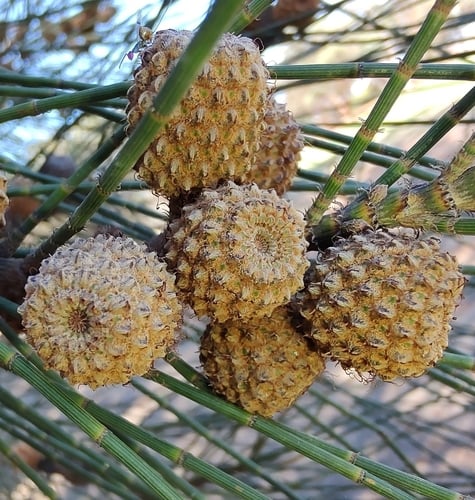
A small tree. It grows 5-10 m high. It can spread to 3-10 m wide. Often there are several stems. The bark is rough and brown. It peels off in long strips. The branches hang downwards. There are 6-8 angled needles. The leaves hang downwards. The leaves are reduce to tiny scales on long fine branches. The flowers are separately male and female. The male are in small spikes and the female in round clusters. The fruit are brown round, woody cones. They are 1.5-2 cm across.
Edible Uses
The seeds are roasted and used as a salt substitute. The leaves and green fruit were chewed to stimulate saliva production and relieve thirst.
Traditional Uses
The seeds are roasted for salt. The leaves and green fruit were chewed to stimulate salivation to quench thirst.
This uses section is brief — help expand it
Medicinal Uses
Root extracts are used to treat dysentery, diarrhoea, and stomach-ache. A decoction of the twigs is applied to reduce swelling. Powdered bark is used on facial pimples.
Known Hazards
Plant has spines or sharp edges; use extreme caution when handling
Distribution
A tropical plant. It grows in coastal sand dunes in drier regions. It suits hardiness zones 10-12.
Where It Grows
Africa, Anguilla, Australia, British Indian Ocean Terr., BIOT, Burkina Faso, Cambodia, Caroline Islands, Dominican Republic, East Africa, East Timor, Fiji, Grenada, Guam, Hawaii, India, Kiribati, Madagascar, Maldives, Marquesas, Micronesia, Myanmar, Nauru, Niue, Pacific, Palau, Papua New Guinea, PNG, Rotuma, Samoa, SE Asia, Somalia, Sri Lanka, St Helena, Tanzania, Timor-Leste, Tuvalu, United Arab Emirates, UAE, Vanuatu, Wallis and Futuna, West Indies,
Cultivation
It grows best in areas where the mean annual temperature is in the range 10 - 35°c and prefers a mean annual rainfall in the range 700 - 2,000mm, though it tolerates 200 - 3,500mm. In most areas where it grows there is a distinct dry period of 4 - 6 months, although this seasonality decreases towards the equator in Southeast Asia and in the southern parts of its range in Australia. Requires a sunny position and a well-drained soil. Prefers alkaline to neutral soils. Prefers a pH in the range 5 - 6.5, but tolerates 4 - 8.5. Plants are very resistant to salt spray and can also tolerate occasional inundation by sea water at extremely high tides. Young plants are susceptible to drought until their roots reach the groundwater table, which may take up to 2 - 3 years after planting, but then they become very drought resistant. This species has proved to be very invasive in many of the areas into which it has been introduced. Common ru has a life span of 40 - 50 years and displays fast early growth. Under favourable conditions, early growth rates are about 2 metres per year. On favourable sites, it can yield an annual increment of 15 cubic metres per hectare of wood in 10 years. In South China, where an estimated 1 million hectares in shelterbelts along the coastal dunes have been established since 1954, heights of 7 - 8 metres and diameters of 5 - 7 cm are achieved in about 4 years. The rotation period ranges from 4 - 5 years for fuel wood and 10 - 15 years for poles. Common ru can be the only woody species growing over a ground cover of dune grasses and salt-tolerant broadleaved herbs; it can also be part of a richer association of trees and shrubs collectively termed the Indo-Pacific strand flora. The tree is not fire resistant and protection is necessary. The plant coppices only to a limited extent and best results are obtained when cut young. Timely thinning is essential as Casuarina species trees demand light. Young trees are susceptible to competition from weeds, especially grasses. Although the tree is evergreen, it usually sheds a large amount of twigs throughout the year. In Asia, leaf litter from plantations is often removed for use as fuel and this draws heavily upon soil phosphorus and potassium reserves. This can result in reduced yield in the subsequent rotation. In cultivation, this species hybridizes with C. Glauca and C. Junghuhniana. Root nodules containing the actinorhizal symbiont Frankia enable C. Equisetifolia to fix atmospheric nitrogen. These root nodules can be prolific. The tree possesses proteoid roots and forms associations with vesicular arbuscular mycorrhizae. This species can be monoecious or dioecious. Dioecious plants will require both male and female forms to be grown if fruit and seed are required.
Propagation
Seeds can be sown without pre-treatment but should be protected from ants. Germination is epigeal and takes up to 2 weeks. Seedlings should be raised in well-drained, light soils rather than clay, to reduce disease and pest problems. Proper watering, spacing, and adequate light help prevent damping-off in the nursery. Seedlings can be pricked out when 3–10 cm tall and transferred to beds or containers, and are generally ready for out-planting at 25–30 cm tall. Storage behaviour is orthodox; viability can be maintained for several years in hermetic storage at 3°C with 5–9% moisture content. There are approximately 26,000 seeds per kg, though viability is often low even in fresh seed, averaging around 50%. Cuttings are taken from small branchlets 2 mm in diameter and 10–15 cm long; rooting hormone improves strike rates. Air-layering is possible but considered too costly for large-scale production.
Other Uses
The bark contains 6–18% tannin, used for preserving ropes and as a red dye. The heavy hardwood has an air-density of 900–1,000 kg/cubic metre. Heartwood ranges from pale red to dark red-brown, with yellowish-pink sapwood; grain is straight to slightly interlocked with a fine, even texture. Shrinkage can be moderate to very high, and in the latter case the wood is prone to warping and checking during seasoning. The heartwood resists pressure treatment and dry-wood termites, while sapwood accepts treatment well. Timber is used for house posts, rafters, electric poles, tool handles, oars, wagon wheels, and mine props. It is also processed into paper pulp via neutral sulphate and semi-chemical methods, and serves as a raw material for rayon fibres. The wood ignites readily even when green and retains heat in the ash for extended periods — it has been called the best firewood in the world. Calorific value of the wood is 5,000 kcal/kg and that of the charcoal exceeds 7,000 kcal/kg. It has fuelled domestic cooking and industrial uses including railroad locomotives. In Asia, leaf litter from plantations is commonly gathered for fuel. The tree is salt-tolerant and grows in sand, making it valuable for controlling erosion along coastlines, estuaries, riverbanks, and waterways. In Sarawak, Indonesia, it is a protected species due to its coastal stabilisation role. Its dense, highly branched twigs absorb wind energy effectively, and it is widely used in shelterbelts in cyclone-prone regions and areas with hot, dry winds. In South China, approximately 1 million hectares has been planted in coastal dune shelterbelts. The tree fixes atmospheric nitrogen and thrives on barren or polluted sites and in deep sandy soils, making it useful for land reclamation and soil improvement. It intercepts little solar radiation and, when lopped, yields substantial green leaf manure. It is amenable to trimming and can be shaped into a hedge. Trials at Prabhunagar, India showed citrus trees grown beneath this species outperformed those in pure stands.
Other Information
It is cultivated.
Notes
There are 17 Casuarina species. The young leaves are used for fodder. It can become invasive.
Synonyms
Also Known As
Ai-kakeu, Akao, Beach She-oak, Filao, Fithuroanu, Ghailoro, Ghairoro, Horsetail She-oak, Karo, Laremanifi, Moinga, Mvinje, Nakure, Ngas, Nokonoko, Pinle-kabwe, Pinle-tinyu, Rairoro, Shawri, Sngav, Te burukam
References (37)
- Ambasta S.P. (Ed.), 2000, The Useful Plants of India. CSIR India. p 111
- Amoen. acad. 4:133. 1759 "equisefolia" (Forster & Forster f., Char. gen. pl. ed. 1:105, t. 52. 1775)
- Barwick, M., 2004, Tropical and Subtropical Trees. A Worldwide Encyclopedic Guide. Thames and Hudson p 98
- Bodkin, F., 1991, Encyclopedia Botanica. Cornstalk publishing, p 226
- Bole, P.V., & Yaghani, Y., 1985, Field Guide to the Common Trees of India. OUP p 13
Show all 37 references Hide references
- Borrell, O.W., 1989, An Annotated Checklist of the Flora of Kairiru Island, New Guinea. Marcellin College, Victoria Australia. p 60
- Brickell, C. (Ed.), 1999, The Royal Horticultural Society A-Z Encyclopedia of Garden Plants. Convent Garden Books. p 2355
- Cabalion, P. and Morat, P., 1983, Introduction le vegetation, la flore et aux noms vernaculaires de l'ile de Pentcoste (Vanuatu), In: Journal d'agriculture traditionnelle et de botanique appliquee JATBA Vol. 30, 3-4
- Cooper, W. and Cooper, W., 2004, Fruits of the Australian Tropical Rainforest. Nokomis Editions, Victoria, Australia. p 113
- Cowie, I, 2006, A Survey of Flora and vegetation of the proposed Jaco-Tutuala-Lore National Park. Timor-Lests (East Timor) www.territorystories.nt/gov.au p 45
- Cundall, P., (ed.), 2004, Gardening Australia: flora: the gardener's bible. ABC Books. p 341
- Dharani, N., 2002, Field Guide to common Trees & Shrubs of East Africa. Struik. p 66
- Elliot, W.R., & Jones, D.L., 1982, Encyclopedia of Australian Plants suitable for cultivation. Vol 2. Lothian. p 482
- Etherington, K., & Imwold, D., (Eds), 2001, Botanica's Trees & Shrubs. The illustrated A-Z of over 8500 trees and shrubs. Random House, Australia. p 190
- Flora of Australia, Volume 3, Hamamelidales to Casuarinales, Australian Government Publishing Service, Canberra (1989) p 104, 105
- Greig, D., 1996, Flowering Natives for Home Gardens. Angus & Robertson. p 112
- Hall, N. et al, 1972, The Use of Trees and Shrubs in the Dry Country of Australia, AGPS, Canberra. p 207
- Haslam, S., 2004, Noosa's Native Plants. Noosa Integrated Catchment Assn. Inc. p 20 (var. incana)
- Havel, J.J., 1975, Forest Botany, Volume 3 Part 2 Botanical taxonomy. Papua New Guinea Department of Forests, p 30
- Hearne, D.A., & Rance, S.J., 1975, Trees for Darwin and Northern Australia. AGPS, Canberra p 42, Pl 10
- Holliday, I., 1989, A Field Guide to Australian Trees. Hamlyn. p 110
- Hussey, B.M.J., Keighery, G.J., Cousens, R.D., Dodd, J., Lloyd, S.G., 1997, Western Weeds. A guide to the weeds of Western Australia. Plant Protection Society of Western Australia. p 132
- Kitalong, A. H., DeMeo, R. A., & Holm, T., 2013, A Field Guide to the Native Trees of Palau. 2nd edition. USDA p48
- Lazarides, M. & Hince, B., 1993, Handbook of Economic Plants of Australia, CSIRO. p 52
- Lord, E.E., & Willis, J.H., 1999, Shrubs and Trees for Australian gardens. Lothian. p 13
- Mbuya, L.P., Msanga, H.P., Ruffo, C.K., Birnie, A & Tengnas, B., 1994, Useful Trees and Shrubs for Tanzania. Regional Soil Conservation Unit. Technical Handbook No 6. p 168
- Molyneux, B & Forrester, S., 1997, The Austraflora A-Z of Australian Plants. Reed. p 65
- Parham, B. E. V., 1972, Plants of Samoa. New Zealand Department of Scientific and Industrial Research. Information Series. No. 85 p 128
- Peekel, P.G., 1984, (Translation E.E.Henty), Flora of the Bismarck Archipelago for Naturalists, Division of Botany, Lae, PNG. p 123, 125
- Schuler, S., (Ed.), 1977, Simon & Schuster's Guide to Trees. Simon & Schuster. No. 89
- Smith, N., Mori, S.A., et al, 2004, Flowering Plants of the Neotropics. Princeton. p 91 (Drawing)
- Sujanapal, P., & Sankaran, K. V., 2016, Common Plants of Maldives. FAO & Kerala FRI, p 74
- Topp, J. M. W., 1988, An Annotated Check List of the Flora of Diego Garcia, British Ocean Territory. Atoll Research Bulletin No. 313
- Townsend, K., 1994, Across the Top. Gardening with Australian Plants in the tropics. Society for Growing Australian Plants, Townsville Branch Inc. p 126
- Townsend, K., 1999, Field Guide to Plants of the Dry Tropics. Society for Growing Australian Plants, Townsville Branch Inc. p 32
- World Checklist of Useful Plant Species 2020. Royal Botanic Gardens, Kew
- Zeven, A. C. & de West, J. M. J., 1982, Dictionary of cultivated plants and their regions of diversity. Wageningen. p 65