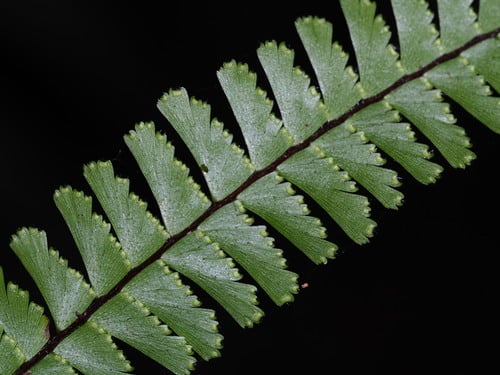
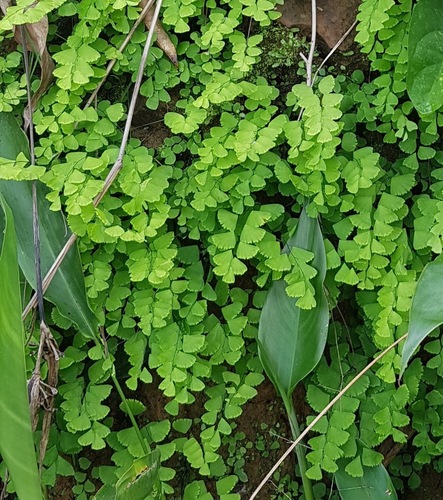
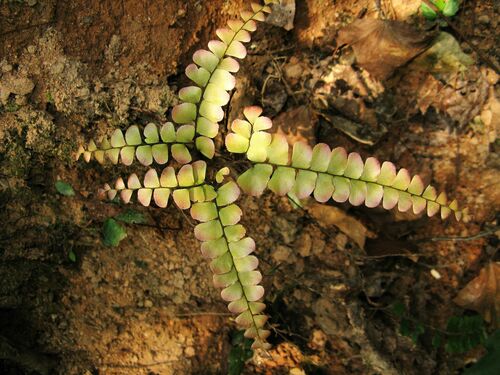
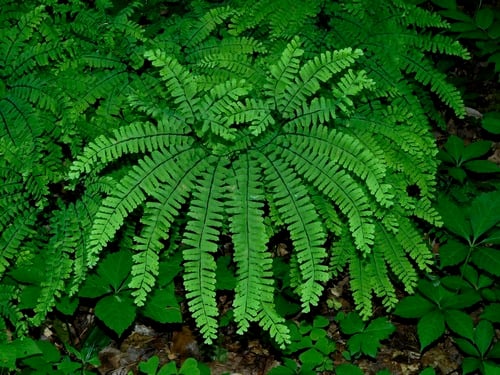
Pellaea calomelanos
(Sw.) Link
iNaturalist· cc-by-nc
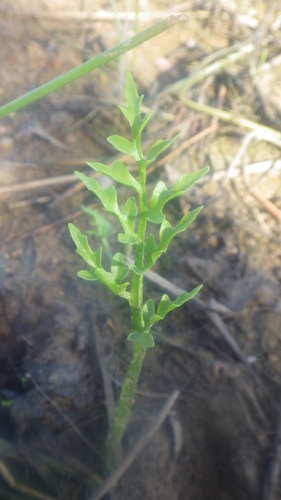
(c) Craig Peter, some rights reserved (CC BY-NC), uploaded by Craig Peter
iNaturalist· cc-by-nc
(c) Johan Heyns, some rights reserved (CC BY-NC), uploaded by Johan Heyns
iNaturalist· cc-by-nc
(c) Amanda Kalaku, some rights reserved (CC BY-NC), uploaded by Amanda Kalaku
Summary
Source: WikipediaPellaea calomelanos is a species of fern. It is found in eastern and southern Africa (Angola, Botswana, Democratic Republic of the Congo, Ethiopia, Kenya, Malawi, Mozambique, Namibia, Somalia, South Africa, South Sudan, Sudan, Tanzania, Uganda, Zambia, Zimbabwe) where it is associated with Afromontane vegetation, as well as on Madagascar, The Comoros, and the Mascarene Islands. Disjunct populations are found in northern India, Spain (La Cellera de Ter and Sant Llorenç de la Muga, Catalonia), and the Azores. The Kwena and Kgatla peoples use milk decoctions of the rhizome to calm frightened children at night.
Description
A fern. The rhizome or underground stem is 4-8 mm across. The fronds are in tufts. They are 30 cm long.
This description is brief — help expand it
Edible Uses
The stems are used to make tea.
Traditional Uses
The stems are used for tea.
This uses section is brief — help expand it
Distribution
It is a subtropical plant.
Where It Grows
Africa, Asia, China, Comoro Island, Europe, India, Madagascar, Reunion, South Africa, Southern Africa, Spain,
Synonyms
References (2)
- Ruiters-Welcome, A. K., 2019, Food plants of southern Africa. Ph.D. thesis. Univ. of Johannesburg p 93
- Welcome, A. K. & Van Wyk, B.-E., 2019, An inventory and analysis of the food plants of southern Africa. South African Journal of Botany 122 (2019) 136–179