Crescentia alata
H. B. Kunth
Mexican calabash
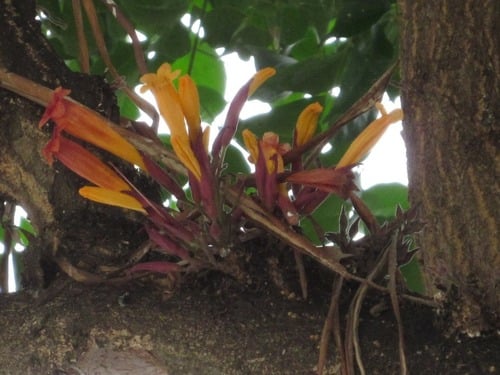
iNaturalist· cc-by-nc
(c) gena of Jesus, some rights reserved (CC BY-NC), uploaded by gena of Jesus
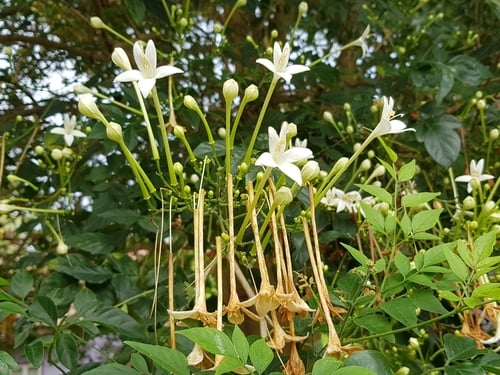
iNaturalist· cc-by-nc
(c) FRANCISCO MIGUEL FARRIOLS ESTRADA, some rights reserved (CC BY-NC), uploaded by FRANCISCO MIGUEL FARRIOLS ESTRADA
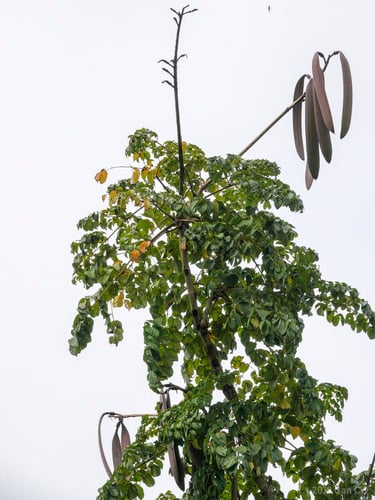
iNaturalist· cc-by-nc
(c) rafa_mrtz, some rights reserved (CC BY-NC)
Summary
Source: WikipediaCrescentia alata, variously called Mexican calabash, jícaro, morro, morrito, or winged calabash, is a plant species in the family Bignoniaceae and in the genus Crescentia, native to Central America south to Costa Rica.
Description
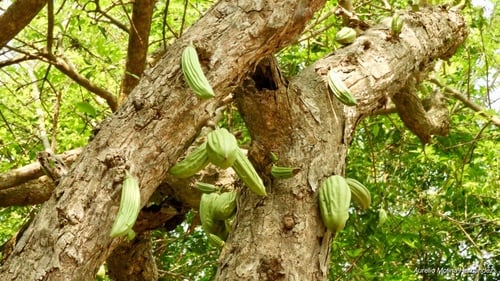
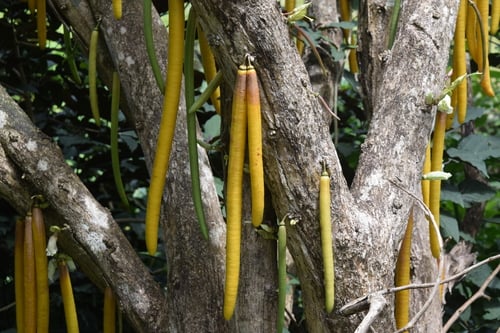
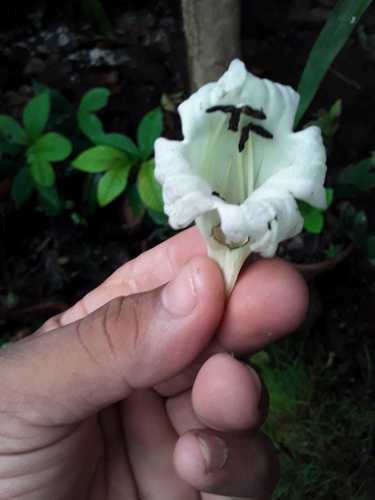
A tree. It grows 8 m tall. It has drooping branches but no small branches. The leaves are 8-15 cm long. They have 3 leaflets. The leaves are cross shaped. They line the main branch. The leaf stalks have wings. The flowers emerge directly from the main trunk. They are brown with yellow throats. The flowers are bell shaped. The fruit is round and green and gourd-like. The fruit are 10 cm long.
Edible Uses
The seeds are used to make a non-alcoholic drink called 'horchata', prepared by grinding them and combining with raw rice, roasted pumpkin seeds, lemon peel, sugar, water, and ice. A bland, relatively stable oil is also obtained from the seeds. The fruits are sometimes eaten or made into a drink.
Traditional Uses
The fruit are occasionally eaten. They are also made into a drink. The ripe seeds are ground then mixed with rice, roasted pumpkin seeds, lemon peel, sugar, water and ice and made into a non-alcoholic drink called "horchata". Caution: Alcohol is a cause of cancer. The seeds yield an edible oil.
Medicinal Uses
The fruit is pectoral. The pulp is used particularly to treat colds and diseases of the kidneys. A decoction of the leaves is used as an astringent and antihemorrhagic, and is much employed in the treatment of haemoptysis and dysentery.
Distribution
It suits a tropical climate. It needs an average, well-drained soil. It can grow in full sun or light shade. It grows in areas with an annual rainfall between 1,000-2,500 mm. In Africa it grows below 1,000 m altitude. It can grow in arid places. It suits plant hardiness zones 10-11.
Where It Grows
Africa, Asia, Belize, Central America*, Costa Rica, Egypt, El Salvador, Guam, Guatemala, Honduras, India, Indochina, Indonesia, Mexico, Nicaragua, North Africa, North America, Panama*, Philippines, SE Asia, Thailand,
Cultivation
Plants can be grown from seeds.
Propagation
Propagate by seed.
Other Uses
The fruits have woody shells used to make cups, containers, and other vessels, though they are smaller and less suited to bowls than those of C. cujete. In Guatemala the shells are widely used as drinking cups and various containers — a fruit cut in half yields two small cups, one of which is commonly carried by Indian pedestrians, often attached to the waist. A form bearing exceptionally small fruits, little larger than a hen's egg, is reportedly used in Guatemala to make spinning tops for children. A decoction of the leaves is said to promote hair growth. The wood is used locally for making wagons and other articles.
Other Information
It is a famine food.
Notes
There are 6 Crescentia species. They are trees from tropical America.
Synonyms
Also Known As
Cuatecomate, Dteen-ped-farang, Gourd tree, Guaje, Jicara, Jicaro, Jicarillo, Morrito, Morro, Music tree, Pohon maja lonjong, Sacaguacal, Tecomate, Winged calabash, Xicara
References (24)
- Arenas, F. S. 2004. Etnobotánica y usos potenciales del Cirián (Crescentia alata) en el estado de Morelos, México. Polibotanica 18:13–31.
- Arriaga, M. R. et al, 2014, Catalogue of fruit species in the southeast of the State of Mexico, Mexico. Revista Mexicana de Ciencias Agricolas Vol. 5 Num. 8. pp 1509-1517
- Barwick, M., 2004, Tropical and Subtropical Trees. A Worldwide Encyclopedic Guide. Thames and Hudson p 136
- Chizmar Fernandez, C., et al, 2009, Plantas comestibles de Centroamerica. Instituto de Biodiversidad, Costa Rica. p 117
- Cruz, I. M., et al, 2015, Edible fruits and seeds in the State of Mexico. Revista Mexicana de Ciencias Agricolas. Vol. 6. Num. 2 pp 331-346
Show all 24 references Hide references
- Etherington, K., & Imwold, D., (Eds), 2001, Botanica's Trees & Shrubs. The illustrated A-Z of over 8500 trees and shrubs. Random House, Australia. p 241
- Facciola, S., 1998, Cornucopia 2: a Source Book of Edible Plants. Kampong Publications, p 49
- FAO, 1993, Valor Nutritivo Y Usis en Alimantacion humana de Algunis Cultivos Autoctonos Subexplotados de Mesoamerica. FAO, Santiago, Chile. p 36
- Hellmuth, N. M., 2011, Maya Ethnobotany. Complete Inventory of plants. Associacion FLAAR Mesoamerica. Tenth edition.
- Hermandez Bermejo, J.E., and Leon, J. (Eds.), 1994, Neglected Crops. 1492 from a different perspective. FAO Plant Production and Protection Series No 26. FAO, Rome. p 30
- Kermath, B. M., et al, 2014, Food Plants in the Americas: A survey of the domesticated, cultivated and wild plants used for Human food in North, Central and South America and the Caribbean. On line draft. p 609 (As Parmentiera alata)
- Krishen P., 2006, Trees of Delhi, A Field Guide. DK Books. p 199
- Kunkel, G. 1984. Plants for human consumption.
- Llamas, K.A., 2003, Tropical Flowering Plants. Timber Press. p 136
- McMakin, P.D., 2000, Flowering Plants of Thailand. A Field Guide. White Lotus. p 9
- Menninger, E.A., 1977, Edible Nuts of the World. Horticultural Books. Florida p 78
- Piedra-Malagón, E. M. et al, 2022, Edible native plants of the Gulf of Mexico Province. Biodiversity Data Journal 10: e80565 p 14
- Royal Botanic Gardens, Kew (1999). Survey of Economic Plants for Arid and Semi-Arid Lands (SEPASAL) database. Published on the Internet; http://www.rbgkew.org.uk/ceb/sepasal/internet [Accessed 4th April 2011]
- Segura, S. et al, 2018, The edible fruit species in Mexico. Genet Resour Crop Evol (2018) 65:1767–1793
- Sukarya, D. G., (Ed.) 2013, 3,500 Plant Species of the Botanic Gardens of Indonesia. LIPI p 213
- Swaminathan, M.S., and Kochnar, S.L., 2007, An Atlas of Major Flowering Trees in India. Macmillan. p 226
- F. W. H. A. von Humboldt et al., Nov. gen. sp. 3:123[folio]; 3:158[quarto]. 1819
- Wickens, G.E., 1995, Edible Nuts. FAO Non-wood forest products. FAO, Rome. p 108
- Zuchowski W., 2007, Tropical Plants of Costa Rica. A Zona Tropical Publication, Comstock Publishing. p 260