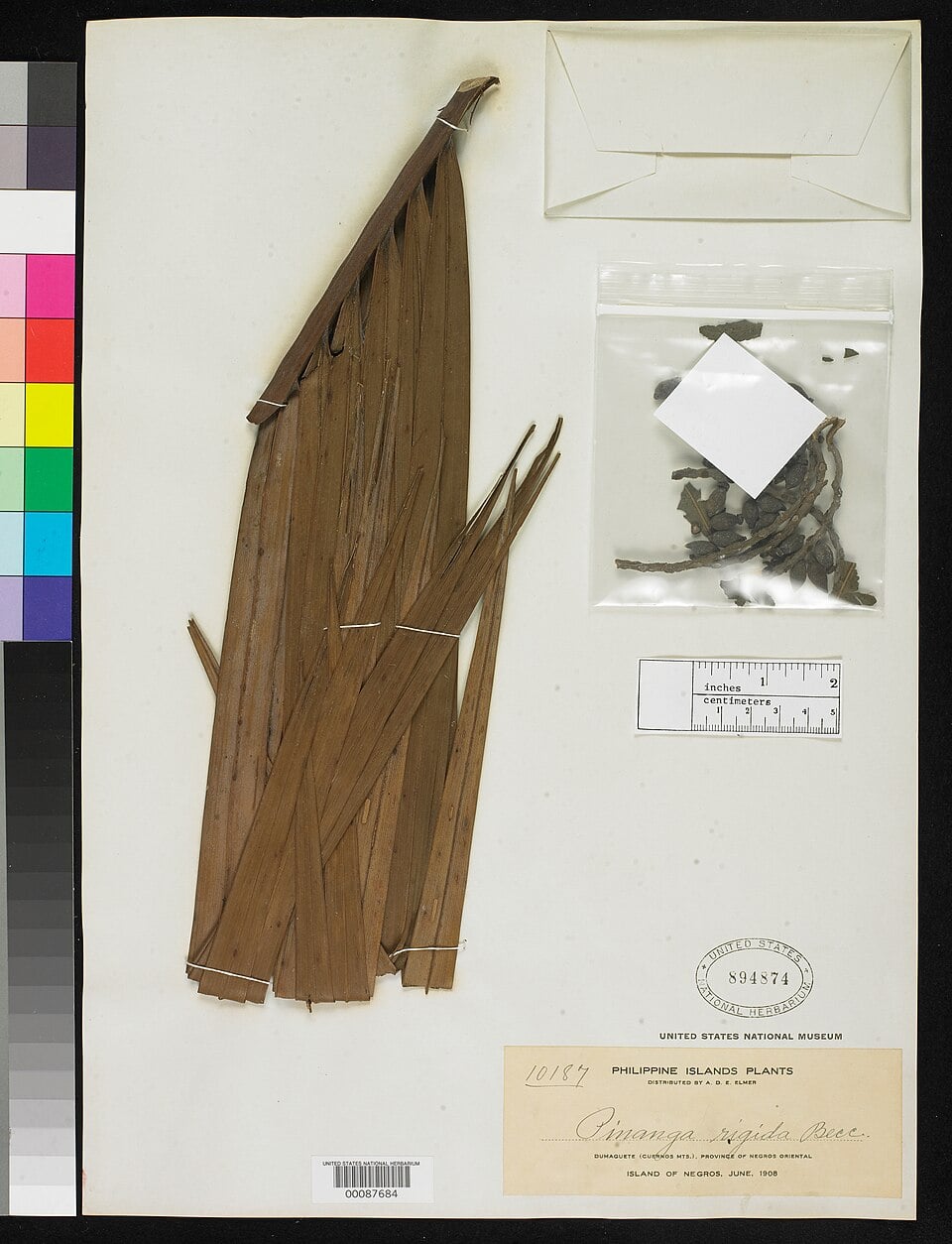
Calamus manan
Miq.
iNaturalist· cc-by-nc
(c) Ethan Beaver, some rights reserved (CC BY-NC), uploaded by Ethan Beaver
iNaturalist· cc-by-nc
(c) Ethan Beaver, some rights reserved (CC BY-NC)
Summary
Source: WikipediaCalamus manan, the manau rattan or rotan manau, is a species of flowering plant in the palm family Arecaceae, native to Thailand, Peninsular Malaysia, Sumatra, and Borneo. A vine, its single stem is widely harvested from the wild for cane furniture-making, leading to an unsustainable population decline. One unbranched stem at Buitenzorg (now Bogor Botanical Gardens), was carefully measured to a length of 240 metres (787 ft).
Description
Evergreen climbing rattan reaching 100 m (328 ft) tall by 7 m (23 ft) wide, growing at fast rate. Tolerates light sandy, medium loamy, and heavy clay soils preferring well-drained conditions. Grows in mildly acidic to basic pH. Adapts to semi-shade or full light preferring moist soil. Hardy to UK zone 10; frost tender.
Edible Uses
The very acid integument of the seed is eaten. The fruit pulp is eaten, being white, acidulous and refreshing. Although we have no specific information for this species, many members of this genus have potentially edible young shoots. Indeed, in Laos the shoots are considered to be a delicacy and over half the species growing there are said to be cooked and eaten as a vegetable. The top 100cm of the plant is used. If the leaf sheaths are left in place until just before cooking then the shoot will remain fresh for up to one week.
Traditional Uses
The flesh of the ripe fruit is eaten raw. The shoots are used as a vegetable.
This uses section is brief — help expand it
Medicinal Uses
None known
Distribution
It is a tropical plant.
Where It Grows
Asia, Indonesia, Malaysia, SE Asia,
Cultivation
Most species in this genus are more or less vigorous climbing plants in rainforests. In general, they are likely to grow best with their roots in the shade but with their stems able to grow up to the light. They are also likely to grow best in a humus-rich soil. About 24 months after field planting, the cirri develop, after which the aerial stems may grow at rates between 1 - 3 metres or more per year. Flowering may begin in the fifth year after planting and is annual thereafter Seedlings are produced abundantly in hill forests. A period of 15 years is estimated for plantation-grown plants to reach harvestable state Harvesting of the stems involves dragging the rattan from the canopy, removing dead leaf-sheaths and debris and discarding the uppermost 2 - 3 metres, which are immature and too soft for use. The leaf-sheaths and debris are usually removed by coiling and pulling the rattan stem around a conveniently placed small tree trunk, resulting in a clean stem. The cane is then cut into 3 metre lengths suitable for bundling and transport out of the forest to the processor. A dioecious species, both male and female forms need to be grown if fruit and seed are required.
Propagation
Seed - needs to be sown as soon as possible since it has a very short viability. The fruit wall and the fleshy seed-coat must be removed before sowing and the clean seeds kept moist, as any drying out will cause the embryo to die. Seeds are usually sown in seed-beds in the shade. They germinate in 3 - 15 weeks. They are potted in polybags when the first leaf has emerged. Once potted, seedlings should be kept in the shade and provided with plenty of moisture without waterlogging. Seedlings are usually ready for planting 9 - 12 months after transplanting into bags and require tree support. Seedlings require about 50% relative light intensity for establishment and growth. Seed stored will not tolerate temperatures below 10C for periods exceeding 2 months and seed moisture content needs to be about 50%; whole fresh fruits can be stored up to 2 weeks in well ventilated conditions at 22-28C without appreciable loss of viability.
Other Uses
Furniture Wood Other uses rating: High (4/5). Other Uses: The stems are used for making furniture. This species is said to produce the best quality large-diameter cane in the genus, and it is much sought after for making furniture. The cane is variable in size and colouration. It is durable, has great strength and flexibility and is used mainly as the framework of furniture. Growth rates of over 7 m a year. Special Uses
Synonyms
Also Known As
Rotan manan, Tabu-tabu
References (3)
- Hariyadi, B., 2008, The Entwined Tree: Traditional Natural Resource Management of Serampas, Jambi, Indonesia. Ph. D thesis. Univ. or Hawaii. p 401
- Ong, H. C., Mojiun, P. F. J., & Milow, P., 2011, Traditional knowledge of edible plants among the Temuan villagers in Kampung Guntor, Negeri Sembilan, Malaysia. African Journal of Agricultural Research Vol. 6(8), pp. 1962-1965, 18 April, 2011
- Pawera, L., et al, 2020, Wild Food Plants and Trends in Their Use: From Knowledge and Perceptions to Drivers of Change in West Sumatra, Indonesia, Foods. 2020, 9, 1240