Cordyline fruticosa
(L.) A. Chev.
Good luck tree, Ti tree
iNaturalist· cc0
no rights reserved, uploaded by 葉子
iNaturalist· cc-by-nc
(c) Peter Zika, some rights reserved (CC BY-NC)
iNaturalist· cc-by-nc
(c) lerc-1, some rights reserved (CC BY-NC), uploaded by lerc-1
Summary
Source: WikipediaCordyline fruticosa is an evergreen flowering plant in the family Asparagaceae. It is known by a wide variety of common names, including ti plant, palm lily, and cabbage palm. The plant has been cultivated in Asia and Oceania, with a number of uses including food and traditional medicine. It is of great cultural importance to the traditional inhabitants of the Pacific Islands and Maritime Southeast Asia.
Description
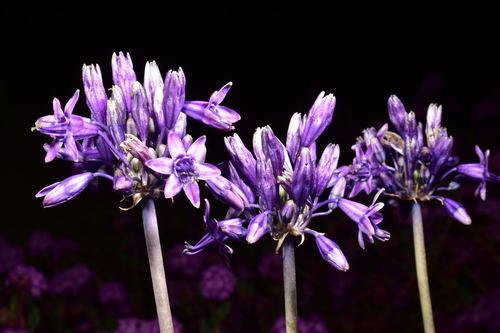
An erect, suckering, clump forming, bush. It grows 2-5 m high. It reaches 1-2.5 m across. Normally the stems don't branch. Older trees form branches higher up. The stems are woody and covered with leaf scars. Often the leaves taper at the base, and have a bluntly pointed tip. The leaf petiole is broad and clasps the stem. It is short and has a channel along it. The leaves are strap shaped, and occur in a crown at the top and clustered in spirals near the end of the stem. The leaves are 75 cm long by 15 cm wide. The leaves are green. Some kinds have leaves with yellow or red stripes. They are 30-60 cm long. The flowers are 0.8 cm long and purple. It produces white to purple flowers in loose panicles, which are 30-60 cm long. The fruit are bright red berries. They are 8-12 mm across.
Edible Uses
The starchy rhizomes are baked and sweet. Young, unrolled leaf shoots are eaten cooked and also used for flavoring rice. The roots, though edible, are rarely used, though roasted roots can be fermented to make an alcoholic drink.
Traditional Uses
The starchy rhizomes can be used for food. They are baked. They are sweet. As food, the roots, although edible are rarely used. The young, unrolled leaf shoots are also eaten, cooked. They are also used for flavouring rice. The roasted roots can be fermented to make an alcoholic drink. Caution: Alcohol is a cause of cancer.
Medicinal Uses
The roots and young leaves can be cooked and eaten as survival food. The leaves can make a rain cloak. In the Philippines, the roots were used to flavor the traditional intus sugarcane wines of the Lumad people of Mindanao. In Polynesia, the leaves of the green-leafed form are used to wrap food, line earth ovens and fermentation pits of breadfruit, and their rhizomes harvested and processed into a sweet molasses-like pulp eaten like candy or used to produce a honey-like liquid used in various sweet treats. In Hawaii, the roots mixed with water and fermented are also distilled into an alcoholic beverage known as okolehao. Fibers extracted from leaves are also used in cordage and in making bird traps. The plants are widely used for traditional medicine, dye, and ornamentation throughout Austronesia and New Guinea. The flowers are a traditional treatment for asthma, and their anthocyanin content has been assessed to see if they might be commercial herbal remedy. Ti is a popular ornamental plant, with numerous cultivars available, many of them selected for green or reddish or purple foliage.
Known Hazards
Roasted roots fermented to make alcoholic drink; alcohol is a cause of cancer.
Distribution
A tropical plant. It needs a temperature above 13°C. Tropical and subtropical. It grows from sea level up to 2600 m altitude. It grows in rainforests. It suits humid locations. It likes moist places. It suits hardiness zones 10-12. In XTBG Yunnan. Arboretum Tasmania.
Where It Grows
Africa, American Samoa, Asia, Australia, Central America, China, Chuuk, Cook Islands, Costa Rica, Dominican Republic, East Africa, East Timor, Easter Island, Fiji, French Polynesia, FSM, Guam, Haiti, Hawaii, Himalayas, India, Indochina, Indonesia, Kiribati, Laos, Malaysia, Mariana Islands, Marquesas, Marshall Islands, Micronesia, Mozambique, Myanmar, Nauru, Nepal, New Zealand, Pacific*, Palau, Papua New Guinea, PNG, Philippines, Rotuma, Samoa, SE Asia, Solomon Islands, Sri Lanka, Tahiti, Tasmania, Thailand, Timor-Leste, Tonga, Tuvalu, USA, Vanuatu, Vietnam, Wallis & Futuna, West Indies, Yap,
Cultivation
It is grown from cuttings of the stalk. It can also be grown from seed, suckers or division of the clump.
Propagation
Seed - pre-soak for about 10 minutes in warm water and sow in pots. The seed usually germinates in 1 - 3 months at 25°c. There is usually a good percentage germination. Prick out the seedlings into individual pots as soon as they are large enough to handle and grow them on until they are at least 10cm tall before planting them out. Stem cuttings - cut off the main stem just below the head and then saw off 5cm thick blocks of stem and place them 3cm deep in pure peat in a shaded position. Keep them moist until they are rooting well, then pot them up into individual pots. Plant out when they are making good growth. Suckers.
Other Uses
The leaves are made into fringed skirts, especially for ceremonial occasions. The leaves are sometimes used as plates or trays upon which food is spread. They are free of any pronounced taste, and so are also used to wrap food that is going to be baked. The leaves are sometimes used for thatch. An ornamental plant that is often used in hedges.
Other Information
It is cultivated.
Notes
It is used as a medicine in Indonesia. There are 15-20 Cordyline species. Also put in the family Laxmanniaceae. and Agavaceae.
Synonyms
Also Known As
Andong, Good Luck Plant, Hanjuang, Hawaiian Red Ti, Kone-linne, Kun-linne, Lau ti, Masawe, Palm lily, Qai, Rauti, Si, Takaya, Tanget, te raunti, Ti vao, Ti-pore, Tie shu, Vakota, Vasili, Zaw-ma, Zhu jiao
References (64)
- Altschul, S.V.R., 1973, Drugs and Foods from Little-known Plants. Notes in Harvard University Herbaria. Harvard Univ. Press. Massachusetts. no. 304
- Ambasta, S.P. (Ed.), 2000, The Useful Plants of India. CSIR India. p 141
- Anderson, E. F., 1993, Plants and people of the Golden Triangle. Dioscorides Press. p 207
- Barrau, J., 1976, Subsistence Agriculture in Polynesia and Micronesia. Bernice P. Bishop Museu, Bulletin 223 Honolulu Hawaii. Kraus reprint. p 60 (As Cordyline terminalis)
- Bodkin, F., 1991, Encyclopedia Botanica. Cornstalk publishing, p 281 (As Cordyline terminalis)
Show all 64 references Hide references
- Borrell, O.W., 1989, An Annotated Checklist of the Flora of Kairiru Island, New Guinea. Marcellin College, Victoria Australia. p 13 (As Cordyline terminalis)
- Borrell, O.W., 1989, An Annotated Checklist of the Flora of Kairiru Island, New Guinea. Marcellin College, Victoria Australia. p 13
- Bremness, L., 1994, Herbs. Collins Eyewitness Handbooks. Harper Collins. p 99 (As Cordyline terminalis)
- Brickell, C. (Ed.), 1999, The Royal Horticultural Society A-Z Encyclopedia of Garden Plants. Convent Garden Books. p 295
- Burkill, I.H., 1966, A Dictionary of the Economic Products of the Malay Peninsula. Ministry of Agriculture and Cooperatives, Kuala Lumpur, Malaysia. Vol 1 (A-H) p 671
- Cherikoff V. & Isaacs, J., The Bush Food Handbook. How to gather, grow, process and cook Australian Wild Foods. Ti Tree Press, Australia p 198 (As Cordyline terminalis)
- Clarke, W.C. & Thaman, R.R., 1993, Agroforestry in the Pacific Islands: Systems for sustainability. United Nations University Press. New York. p 234
- Cooper, W. and Cooper, W., 2004, Fruits of the Australian Tropical Rainforest. Nokomis Editions, Victoria, Australia. p 152
- Crowe, A., 1997, A Field Guide to the Native Edible Plants of New Zealand. Penguin. p 17
- Cundall, P., (ed.), 2004, Gardening Australia: flora: the gardener's bible. ABC Books. p 412
- Elliot, W.R., & Jones, D.L., 1984, Encyclopedia of Australian Plants suitable for cultivation. Vol 3. Lothian. p 89 (As Cordyline terminalis)
- Engel, D.H., & Phummai, S., 2000, A Field Guide to Tropical Plants of Asia. Timber Press. p 178
- Etherington, K., & Imwold, D., (Eds), 2001, Botanica's Trees & Shrubs. The illustrated A-Z of over 8500 trees and shrubs. Random House, Australia. p 226
- Etkin, N.L. (Ed.), 1994, Eating on the Wild Side, Univ. of Arizona. p 106 (As Cordyline terminalis)
- Facciola, S., 1998, Cornucopia 2: a Source Book of Edible Plants. Kampong Publications, p 92
- Franklin, J., Keppel, G., & Whistler, W., 2008, The vegetation and flora of Lakeba, Nayau and Aiwa Islands, Central Lau Group, Fiji. Micronesica 40(1/2): 169–225, 2008
- French, B.R., 1986, Food Plants of Papua New Guinea, A Compendium. Asia Pacific Science Foundation p 335 (As Cordyline terminalis)
- Hedrick, U.P., 1919, (Ed.), Sturtevant's edible plants of the world. p 217
- Hibbert, M., 2002, The Aussie Plant Finder 2002, Florilegium. p 73
- Hinton, B & B., 1982, A Wilderness in Bloom. Wildflowers of tropical Australia. p 40 (As Cordyline terminalis)
- Jard. bot. Saigon 66. 1919
- Jones D, L, 1986, Ornamental Rainforest Plants in Australia, Reed Books, p 262 (As Cordyline terminalis)
- Kiple, K.F. & Ornelas, K.C., (eds), 2000, The Cambridge World History of Food. CUP p 1741 (As Cordyline terminalis)
- Lamoureux, C.H., 1976, Trailside Plants of Hawaii's National Parks. Hawaii Natural History Association. p 20 (As Cordyline terminalis)
- Lazarides, M. & Hince, B., 1993, Handbook of Economic Plants of Australia, CSIRO. p 65
- Liefting, A., et al, Samoan plant names. http://en.wikipedia.org
- Lim, T. K., 2015, Edible Medicinal and Non Medicinal Plants. Volume 9, Modified Stems, Roots, Bulbs. Springer p 28
- Llamas, K.A., 2003, Tropical Flowering Plants. Timber Press. p 245
- Lord, E.E., & Willis, J.H., 1999, Shrubs and Trees for Australian gardens. Lothian. p 94 (As Cordyline terminalis)
- Martin, F.W. & Ruberte, R.M., 1979, Edible Leaves of the Tropics. Antillian College Press, Mayaguez, Puerto Rico. p 202
- Massal, E. and Barrau, J., 1973, Food Plants of the South Sea Islands. SPC Technical Paper No 94. Noumea, New Caledonia. p 39 (As Cordyline terminalis)
- Ochse, J.J. et al, 1931, Vegetables of the Dutch East Indies. Asher reprint. p 458
- Parham, H. B. R, 1940, Supplement to the Journal of the Polynesian Society No. 16. Fiji Plants: Their Name and Uses.
- Parham, B. E. V., 1972, Plants of Samoa. New Zealand Department of Scientific and Industrial Research. Information Series. No. 85 p 126
- Peekel, P.G., 1984, (Translation E.E.Henty), Flora of the Bismarck Archipelago for Naturalists, Division of Botany, Lae, PNG. p 81, 82
- Plants of Haiti Smithsonian Institute http://botany.si.edu
- Powell, J.M., Ethnobotany. In Paijmans, K., 1976, New Guinea Vegetation. Australian National University Press. p 109 (As Cordyline terminalis)
- Seidemann J., 2005, World Spice Plants. Economic Usage, Botany, Taxonomy. Springer. p 116 (As Cordyline terminalis)
- Smith, A.C., 1979, Flora Vitiensis Nova, Lawaii, Kuai, Hawaii, Volume 1 p 149
- Solomon, C., 2001, Encyclopedia of Asian Food. New Holland. p 389 (As Cordyline terminalis)
- Staples, G.W. and Herbst, D.R., 2005, A tropical Garden Flora. Bishop Museum Press, Honolulu, Hawaii. p 581
- Sukarya, D. G., (Ed.) 2013, 3,500 Plant Species of the Botanic Gardens of Indonesia. LIPI p 736, 738 (Also as Cordyline terminalis)
- Terra, G.J.A., 1973, Tropical Vegetables. Communication 54e Royal Tropical Institute, Amsterdam, p 41
- Thaman, R.R., 1976, The Tongan Agricultural System, University of the South Pacific, Suva, Fiji. p 392 (As Cordyline terminalis)
- Thaman, R. and W. Clarke, Paper on Agroforestry on Aneityum and Tanna, Vanuatu from Internet
- Thaman, R. R., et al, 1994, The Flora of Nauru. Atoll Research Bulletin No. 392. Smithsonian Institute p 56
- Thaman, R. R, 2016, The flora of Tuvalu. Atoll Research Bulletin No. 611. Smithsonian Institute p 34
- Townsend, K., 1994, Across the Top. Gardening with Australian Plants in the tropics. Society for Growing Australian Plants, Townsville Branch Inc. p 140 (As Cordyline terminalis)
- USDA, ARS, National Genetic Resources Program. Germplasm Resources Information Network - (GRIN). [Online Database] National Germplasm Resources Laboratory, Beltsville, Maryland. Available: www.ars-grin.gov/cgi-bin/npgs/html/econ.pl (10 April 2000)
- Vander Velde, N, 2003, The Vascular Plants of Majuro Atoll, Republic of the Marshall Islands. Atoll research Bulletin. No. 503. Smithsonian Institute. p 16
- Walter, A. & Lebot, V., 2007, Gardens of Oceania. ACIAR Monograph No. 122 p. 67 (As Cordyline terminalis)
- Wiersema, J. H. & Leon, B., 2013, World Economic Plants. A Standard Reference CRC Press. 2nd Ed. p 199
- Wijayakusuma, H.M.H., et al, 1996, Tanaman Berkhasiat Obat Di Indonesia. Pustaka Kartini. p 19
- Wijayakusuma, H.M.H., et al, 1996, Tanaman Berkhasiat Obat Di Indonesia. Pustaka Kartini. p 19 (As Cordyline terminalis)
- World Checklist of Useful Plant Species 2020. Royal Botanic Gardens, Kew
- Yuncker, T.G., 1959, Plants of Tonga, Bernice P. Bishop Museum, Hawaii, Bulletin 220. p 79 (As Cordyline terminalis)
- Zeven, A. C. & de West, J. M. J., 1982, Dictionary of cultivated plants and their regions of diversity. Wageningen. p 49 (As Cordyline terminalis)
- Zizka, G., 1991, Flowering Plants of Easter Island. Palmarum Hortus Francofurtensis (As Cordyline terminalis)
- Zuchowski W., 2007, Tropical Plants of Costa Rica. A Zona Tropical Publication, Comstock Publishing. p 116