Corchorus trilocularis
(L.) Burm.
iNaturalist· cc-by-nc
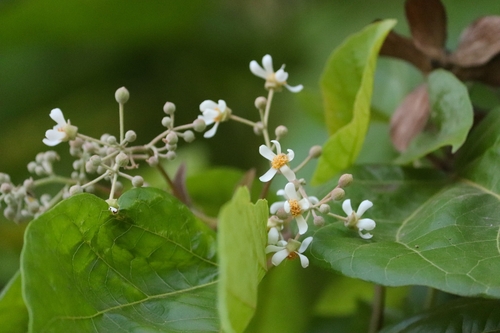
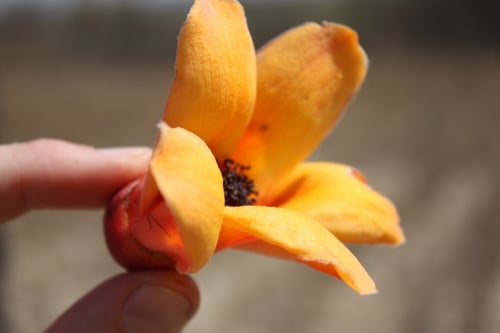
(c) Tony Benn, some rights reserved (CC BY-NC), uploaded by Tony Benn
iNaturalist· cc-by-nc
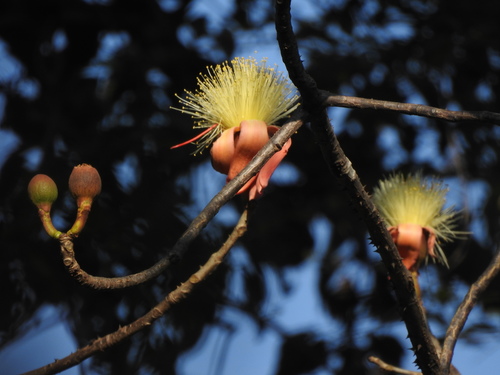
(c) زين _النجم, some rights reserved (CC BY-NC), uploaded by زين _النجم
iNaturalist· cc-by-nc
(c) juju98, some rights reserved (CC BY-NC), uploaded by juju98
Description
An annual herb. It grows to about 1 m tall. It is an erect plant and branches. Sometimes the branches hang over. The young branches are often purple. When young they can be hairy on both sides of the stem. The leaf is 2-12 cm long by 0.5-3.5 cm wide. They are oblong and the tip is pointed. The edges of the leaf can have teeth or be indented. The leaf stalk is 2.5 cm long. Flowers occur as one to 3 together on flower stalks opposite the upper leaves. The fruit is a many seeded capsule 2.5-7 cm long. The fruit points upwards and is straight or slightly curved. It has 3-4 angles and 3-4 valves. The seeds inside these are dark brown and oval. They are about 1 mm across.
Edible Uses
The leaves are cooked as a potherb with a slippery texture best paired with coarser leaves, used as a sauce or relish, and cook quickly. Leaves can be dried and stored for later use. The seeds and flowers are also edible.
Traditional Uses
The leaves are cooked as a potherb. Because it is slippery it is cooked with other coarse leaves. They are also used as a sauce or relish. It cooks quickly. Leaves can be dried and stored.
Medicinal Uses
The leaves are used as a plaster to reduce swellings. The seeds are used in the treatment of gripe and nausea.
Distribution
It is a tropical plant. It grows as a weed along roadsides, hill sides and on grassy plains. It grows between sea level and 2,400 m above sea level. It can grow in arid places.
Where It Grows
Afghanistan, Africa, Angola, Arabia, Asia, Australia, Benin, Bhutan, Botswana, Burkina Faso, Burundi, Cameroon, Cape Verde, Central Africa, China, Comoros, Congo, Côte d'Ivoire, East Africa, Egypt, Eritrea, Eswatini, Ethiopia, Europe, Gambia, Ghana, Guinea-Bissau, Himalayas, India, Indonesia, Iraq, Israel, Ivory Coast, Kenya, Liberia, Madagascar, Malawi, Mali, Mauritania, Mauritius, Mediterranean, Middle East, Mozambique, Namibia, Niger, Nigeria, North Africa, Northeastern India, Oman, Pakistan, Palestine, Qatar, Rwanda, Sahel, Saudi Arabia, SE Asia, Senegal, Sierra Leone, Somalia, South Africa, Southern Africa, South Sudan, Spain, Sri Lanka, Sudan, Swaziland, Tanzania, Togo, Uganda, United Arab Emirates, UAE, Uganda, West Africa, Yemen, Zambia, Zimbabwe,
Cultivation
Plants can be grown from seeds. The seeds can be planted in rows or broadcast.
Other Uses
Fibres from the stems are used for making robes. (almost certainly a typo for ropes) The fibre is used to make ropes.
Production
Leaves are collected during the rainy season.
Other Information
It is a cultivated food plant. It is a popular vegetable. It is sold in markets. It is highly palatable.
Notes
There are about 100 Corchorus species.
Nutrition
| Part | Moisture | kJ | kcal | Protein | Vit A | Vit C | Iron | Zinc |
|---|---|---|---|---|---|---|---|---|
| Leaves | 78 | 312 | 76 | 6.7 | — | — | — | — |
| Leaves raw | 83.9 | 139.2 | 32.1 | 3.4 | — | — | 3 | 0.5 |
Synonyms
Also Known As
Al moulinouquia, Apoth, Atigo, Bwenka, Chelewa, Chench, Chepkaratian, Chimdendele, Delelemukula, Denje, Etigo-apio, Gucha, Kala, Kankhumba, Kibwando, Kumulele, Lagada, Legen, Likombe, Linyololo, Mlenda, Mondrokol, Ntonono, Otigo lum, Phinyu, Senujaga, Sesemranda, Shosha interse, Weakeh
References (58)
- Addis, G., et al, 2013, The Role of Wild and Semi-wild Edible Plants in Household Food Sovereignty in Hamer and Konso Communities, South Ethiopia. Ethnobotany Research & Applications. 11:251-271
- Agea, J. G., et al 2011, Wild and Semi-wild Food Plants of Bunyoro-Kitara Kingdom of Uganda: etc. Environmental Research Journal 5(2) 74-86
- Al-Fatimi, M. A., Wild Edible Plants Traditionally Collected and Used in Southern Yemen. Research Square. University of Aden. p 17
- Andabati, B., & Muyonga, J., 2014, Phenolic content and antioxidant activity of selected Ugandian traditional medicinal foods. African Journal of Food Science. 8(8), pp 427-434
- Arora, R. K., 2014, Diversity in Underutilized Plant Species - An Asia-Pacific Perspective. Bioversity International. p 39
Show all 58 references Hide references
- Balemie, K., & Kebebew, F., 2006, Ethnobotanical study of wild edible plants in Derashe and Kucha Districts, South Ethiopia. Journal of Ethnobiology and Ethnomedicine. p 4
- Duguma, H. T., 2020, Wild Edible Plant Nutritional Contribution and Consumer Perception in Ethiopia. Hindawi International Journal of Food Science Volume 2020, Article ID 2958623, 16 pages
- Exell, A.W. et al, (Ed), 1963, Flora Zambesiaca Vol 2 Part 1 Crown Agents, London. p 84
- FAO, 1988, Traditional Food Plants, FAO Food and Nutrition Paper 42. FAO Rome p 218
- Fondio, L. & Grubben, G.J.H., 2004. Corchorus olitorius L. [Internet] Record from Protabase. Grubben, G.J.H. & Denton, O.A. (Editors). PROTA (Plant Resources of Tropical Africa), Wageningen, Netherlands. < http://database.prota.org/search.htm>. Accessed 15 October 2009.
- Godfrey, J. et al, 2013, Harvesting, preparationand preservation of commonly consumed wild and semi-wild food plants in Bunyoro-Kitara Kingdom, Uganda. Int. J. Med. Arom. Plants. Vol.3 No.2 pp 262-282
- Goode, P., 1989, Edible Plants of Uganda. FAO p 30
- Goode, P., 1989, Edible Plants of Uganda. FAO p 36
- Goode, P., 1989, Edible Plants of Uganda. FAO p 39
- Grivetti, L. E., 1980, Agricultural development: present and potential role of edible wild plants. Part 2: Sub-Saharan Africa, Report to the Department of State Agency for International Development. p 49
- Grubben, G. J. H. and Denton, O. A. (eds), 2004, Plant Resources of Tropical Africa 2. Vegetables. PROTA, Wageningen, Netherlands. p 223
- Guil-Guerrero, J. L., et al, 2001, Edible Wild Plants. in Recent Progress in Medicinal Plants Vol. 8 Sci. Tech publishing, Texas
- Harkonen, M. & Vainio-Mattila, K., 1998, Some examples of Natural Products in the Eastern Arc Mountains. Journal of East African Natural History 87:265-278
- Hedrick, U.P., 1919, (Ed.), Sturtevant's edible plants of the world. p 216
- Idohou, I., et al, 2013, National inventory and prioritization of crop wild relatives: case study for Benin. Genet Resour Crop Evol (2013) 60:1337–1352
- Jardin, C., 1970, List of Foods Used In Africa, FAO Nutrition Information Document Series No 2.p 69
- Lazarides, M. & Hince, B., 1993, Handbook of Economic Plants of Australia, CSIRO. p 64
- Long, C., 2005, Swaziland's Flora - siSwati names and Uses http://www.sntc.org.sz/flora/
- Lulekal, E., et al, 2011, Wild edible plants in Ethiopia: a review on their potential to combat food insecurity. Afrika Focus - Vol. 24, No 2. pp 71-121
- Magwede, K., van Wyk, B.-E., & van Wyk, A. E., 2019, An inventory of Vhavenḓa useful plants. South African Journal of Botany 122 (2019) 57–89
- Martin, F.W. & Ruberte, R.M., 1979, Edible Leaves of the Tropics. Antillian College Press, Mayaguez, Puerto Rico. p 221
- Masters, T., 2021, Traditional food plants of the upper Aswa River catchment of northern Uganda—a cultural crossroads. Journal of Ethnobiology and Ethnomedicine (2021) 17:24
- Maundu, P. et al, 1999, Traditional Food Plants of Kenya. National Museum of Kenya. 288p
- Mertz, O., Lykke, A. M., and Reenberg, A., 2001, Importance and Seasonality of Vegetable Consumption and Marketing in Burkina Faso. Economic Botany, 55(2):276-289
- Mpasiwakomu, R. A., 2017, The Diversity and Utilization of Wild Edible and Medicinal Plant Species found in Uvinza Miombo Woodlands, Tanzania. M. Sc. thesis University of Tanzania.
- Msola, D. K., 2007, The role of Wild Foods in Household Income and Food Security in Mufundi District, Tanzania. Morogoro, Tanzania. p 46
- Mutie, F. G., 2020, Conservation of Wild Food Plants and Their Potential for Combatting Food Insecurity in Kenya as Exemplified by the Drylands of Kitui County. Plants 2020, 9, 1017
- Mutie, F. M., et al, 2023, Important Medicinal and Food Taxa (Orders and Families) in Kenya, Based on Three Quantitative Approaches. Plants 2023, 12, 1145
- Newman, 1970,
- Ngugi, G., 2000, Case Study from Kenya on Indigenous Wild Vegetables. Paper 4 Workshop in Kenya 1999. p 34
- Norton, J., et al, 2009, An Illustrated Checklist of the Flora of Qatar. UNESCO Office in Doha.
- Ojelel, S. & Kakudidi, E. K., 2015, Wild edible plant species utilized by a subsistence farming community in the Obalanga sub-county, Amuria district, Uganda. Journal of Ethnobiology and Ethnomedicine. 11:7
- Paczkowska, G . & Chapman, A.R., 2000, The Western Australian Flora. A Descriptive Catalogue. Western Australian Herbarium. p 561
- Peters, C. R., O'Brien, E. M., and Drummond, R.B., 1992, Edible Wild plants of Sub-saharan Africa. Kew. p 190
- Prafulla, S., 2017, Wild Food Diversity of Nawegaon-Nagzira Tiger Reserve in Gondia-Bhandara district of Maharashtra, India. Int. J. of Life Sciences, 2017, Vol. 5 (4): 620-626
- Purseglove, J.W., 1968, Tropical Crops Dicotyledons, Longmans. p 613
- Royal Botanic Gardens, Kew (1999). Survey of Economic Plants for Arid and Semi-Arid Lands (SEPASAL) database. Published on the Internet; http://www.rbgkew.org.uk/ceb/sepasal/internet [Accessed 11th June 2011]
- Rubaihayo, E. B., Conservation and use of traditional vegetables in Uganda. Bioversity International.
- Ruiters-Welcome, A. K., 2019, Food plants of southern Africa. Ph.D. thesis. Univ. of Johannesburg p 75
- Scudder, 1962,
- Shava, S., et al, 2009, Traditional food crops as a source of community resilience in Zimbabwe. International Journal of the African Renaissance 4(1)
- Singh, G. K. & Ahirwar, R. K., 2013, An Ethnobotanical Survey for Certain Wild Edible Plants of Chanda Forest District Dindori Central India. International Journal of Science and Research. 6:14
- Singh, H.B., Arora R.K.,1978, Wild edible Plants of India. Indian Council of Agricultural Research, New Delhi. p 39, 84
- Swaziland's Flora Database http://www.sntc.org.sz/flora
- Mant. pl. 1:77. 1767
- Termote, C., et al, 2014, Assessing the potential of wild foods to reduce the cost of a nutritionally adequate diet: An example from eastern Baringo District, Kenya. Food and Nutrition Bulletin, vol. 35, no. 4
- Vainio-Mattila, K., 2000, Wild vegetables used by the Sambaa in the Usumbara Mountains, NE Tanzania. Ann. Bot. Fennici 37:57-67
- van Wyk, Be., & Gericke, N., 2007, People's plants. A Guide to Useful Plants of Southern Africa. Briza. p 68
- WATT,
- Welcome, A. K. & Van Wyk, B.-E., 2019, An inventory and analysis of the food plants of southern Africa. South African Journal of Botany 122 (2019) 136–179
- Wiersema, J. H. & Leon, B., 2013, World Economic Plants. A Standard Reference CRC Press. 2nd Ed. p 198
- Williamson, J., 2005, Useful Plants of Malawi. 3rd. Edition. Mdadzi Book Trust. p 78
- World Checklist of Useful Plant Species 2020. Royal Botanic Gardens, Kew