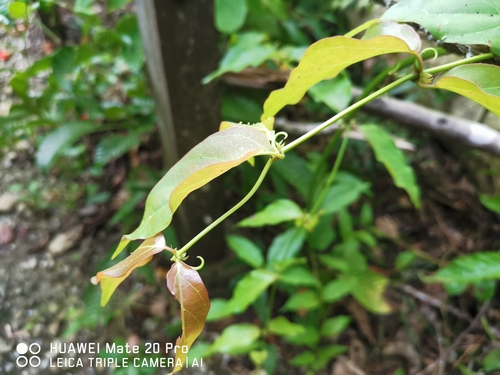
Coprosma virescens
Petrie
iNaturalist· cc-by-nc
(c) Alice Shanks, some rights reserved (CC BY-NC), uploaded by Alice Shanks
iNaturalist· cc-by-nc
(c) Alice Shanks, some rights reserved (CC BY-NC)
Summary
Source: WikipediaCoprosma virescens is an endemic New Zealand plant in the genus Coprosma of the family Rubiaceae. Its Māori name (in common New Zealand usage) is mikimiki, a name which is also applied to closely related species such as C. dumosa, C. rhamnoides, C. propinqua and C. crassifolia. It is a small-leaved evergreen shrub or tree which grows 2–3 metres (6 ft 7 in – 9 ft 10 in) high. It has very slender, more or less glabrous divaricating branches. The small leaves are petiolate with petioles from 2–5 millimetres (0.079–0.197 in) long. The leaves narrow suddenly at the petiole and may be up to 9 millimetres (0.35 in) long and 6 millimetres (0.24 in) wide with wavy margins or a few blunt teeth throughout South Island in lower montane forest and scrubland. The apetalous male flowers occur in axillary clusters of one to two on very short branches. Female flowers are found on their own at the ends of short branchlets. The fruit is an oblong drupe, yellow to white in colour and up to 6 millimetres (0.24 in) long. However, the fruit appears greenish when ripe because of the visible presence of the green seeds within. This feature gives rise to the specific name. It has a wide distribution, and is found in both the North and South Islands. In the North Island it is found from the Gisborne ranges and south from Taihape. In the South Island it is common from Canterbury southwards, extending to Southland. It is not found in Westland, and is uncommon in the remaining South Island regions. Through much of its range it is uncommon or absent. C. virescens is popular in cultivation because of its tangled twiggy growth form, and that it will tolerate a wide range of soils and conditions.
Description
A shrub. It grows 3 m high. The small branches are angled. They are a coppery gold colour. The leaves are small.
This description is brief — help expand it
Edible Uses
The white fruit, about 5mm in diameter, can be eaten raw or cooked. It is sweet but has little flavour. The roasted seed makes an excellent coffee substitute.
Medicinal Uses
None known.
Distribution
It is a warm temperate plant. It grows in lowland forest and scrub. It suits hardiness zones 8-10.
Where It Grows
Australia, New Zealand,
Cultivation
Requires a moist, very well-drained neutral to slightly acid soil in full sun or light shade. Succeeds in most soils. Somewhat intolerant of frost, this species is only likely to succeed outdoors in the mildest areas of Britain. Another report says that it is proving to be hardy in an Essex garden. Hybridizes freely with other members of this genus. Plants are tolerant of heavy clipping or pruning. Plants are normally dioecious, though in some species the plants produce a few flowers of the opposite sex before the main flowering and a few hermaphrodite flowers are sometimes produced. Male and female plants must usually be grown if seed is required.
Propagation
Seed is best sown as soon as it is ripe in a greenhouse or cold frame. Stored seed should be sown in spring in a cold frame. Germination can be slow, often taking more than 12 months even with fresh seed. Prick seedlings out into individual pots once large enough to handle. Grow plants through at least their first winter under glass, then plant out in late spring or early summer with some cold protection for their first winter outdoors. Alternatively, take cuttings of mature wood from the current year's growth in autumn and root in a frame.
Other Uses
The wood yields a yellow dye that requires no mordant.
Notes
There are about 90 Coprosma species.
References (3)
- Cundall, P., (ed.), 2004, Gardening Australia: flora: the gardener's bible. ABC Books. p 411
- Etherington, K., & Imwold, D., (Eds), 2001, Botanica's Trees & Shrubs. The illustrated A-Z of over 8500 trees and shrubs. Random House, Australia. p 225
- Plants for a Future database, The Field, Penpol, Lostwithiel, Cornwall, PL22 0NG, UK. http://www.scs.leeds.ac.uk/pfaf/