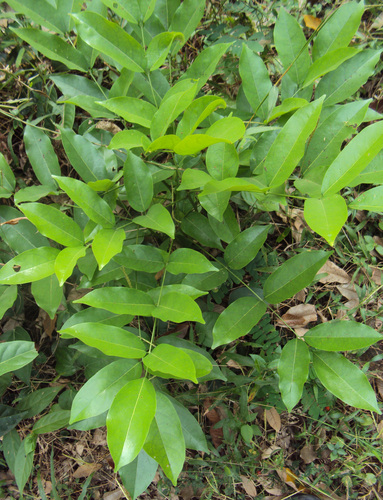
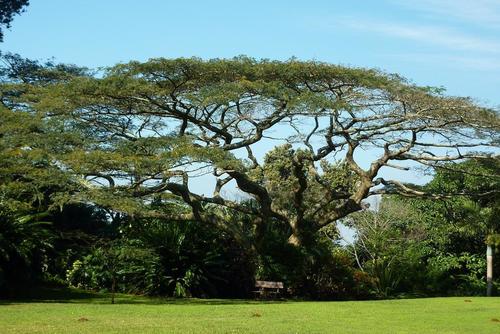
Senegalia ataxacantha
(DC.) Kyalangaliwa & Boatwr.
Flame acacia, Flame thorn
iNaturalist· cc-by-sa
(c) Tony Rebelo, some rights reserved (CC BY-SA), uploaded by Tony Rebelo
iNaturalist· cc-by-nc
(c) tjeerd, some rights reserved (CC BY-NC), uploaded by tjeerd
iNaturalist· cc-by
(c) Hildegard Klein, some rights reserved (CC BY), uploaded by Hildegard Klein
Summary
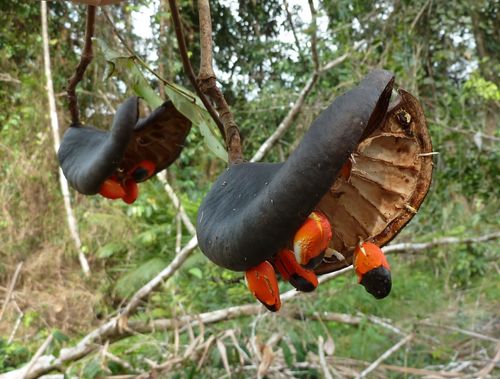
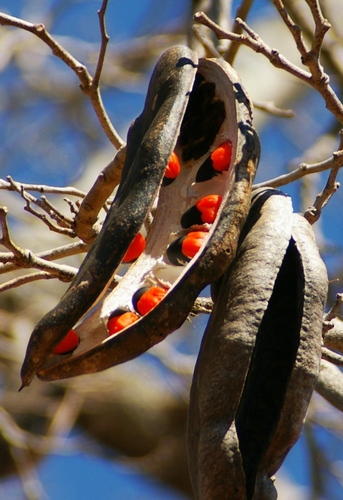
Source: WikipediaSenegalia ataxacantha, commonly known as the flame thorn, is an African tree species with conspicuous red pods and numerous hooked prickles.
Description
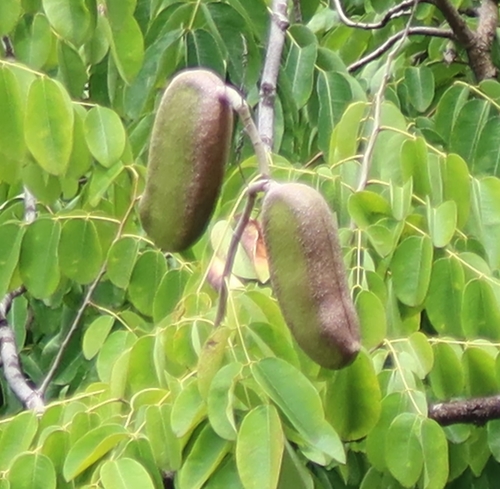
A climber or straggling herb. It is usually thorny. It has several stems. It forms thickets. It can be a small tree to 10 m high. The branches are flexible. It loses its leaves during the year. The leaves have 10-25 pairs of leaf stalks each with 14-62 pairs of leaflets. The leaflets are 2-5 mm long by 0.5-1.5 mm wide. The flowers are creamy white in spikes 10 cm long. The fruit are young pods which are red then turn brown. They are slender and 20 cm long by 2.4 cm wide. They taper at both ends.
Edible Uses
Traditionally, the root bark is used as an aphrodisiac.
Traditional Uses
The gum is occasionally eaten.
This uses section is brief — help expand it
Medicinal Uses
The plant (part not specified) is used in traditional medicine to treat constipation and abdominal pains. The plant (part not specified) is used in traditional medicine to treat syphilis, boils, helminthiasis and wounds, headache, toothache, respiratory diseases. The bark of all Acacia species contains greater or lesser quantities of tannins and are astringent. Astringents are often used medicinally - taken internally, for example. they are used in the treatment of diarrhoea and dysentery, and can also be helpful in cases of internal bleeding. Applied externally, often as a wash, they are used to treat wounds and other skin problems, haemorrhoids, perspiring feet, some eye problems, as a mouth wash etc. Many Acacia trees also yield greater or lesser quantities of a gum from the trunk and stems. This is sometimes taken internally in the treatment of diarrhoea and haemorrhoids.
Known Hazards
Especially in times of drought, many Acacia species can concentrate high levels of the toxin Hydrogen cyanide in their foliage, making them dangerous for herbivores to eat.
Distribution
It is a tropical plant. It grows among sand dunes and in open wooded grassland. It grows in hot arid areas. It can probably tolerate frost when it has shed its leaves. It grows in acid soils. It grows in areas with an annual rainfall between 200-1,200 mm. It grows between 100-1,980 m above sea level. It can grow in arid places. It grows in the Sahel.
Where It Grows
Africa, Angola, Benin, Botswana, Burkina Faso, Cameroon, Central Africa, Central African Republic, CAR, Chad, Côte d'Ivoire, East Africa, Eswatini, Ghana, Guinea, Guinée, Guinea-Bissau, Ivory Coast, Kenya, Liberia, Malawi, Mali, Mauritania, Mozambique, Namibia, Niger, Nigeria, Sahel, Senegal, Sierra Leone, South Africa, Southern Africa, Sudan, Swaziland, Tanzania, Togo, Uganda, West Africa, Zambia, Zimbabwe,
Cultivation
Young plants are frost tender. Prefers a moist soil, but the plant is fairly drought resistant. Initial growth of newly transplanted seedlings is slow, but then increases. There are conflicting reports on whether or not this tree has a symbiotic relationship with certain soil bacteria, so it is unclear as to whether this tree fixes atmospheric nitrogen.
Propagation
Seed - it has a hard seedcoat and benefits from scarification before sowing in order to speed up and improve germination. This can usually be done by pouring a small amount of nearly boiling water on the seeds (being careful not to cook them!) and then soaking them for 12 - 24 hours in warm water. By this time they should have imbibed moisture and swollen - if they have not, then carefully make a nick in the seedcoat (being careful not to damage the embryo) and soak for a further 12 hours before sowing. Germination of treated seeds should take place within 2 weeks. Acacia seeds that have matured fully on the bush and have been properly dried have a hard seed coat and can be stored in closed containers without deterioration for 5 - 10 years or more in dry conditions at ambient temperatures. It is best to remove the aril, which attracts weevils and can lead to moulds forming. The arils are easilyremoved by placing the seeds in water and rubbing them between the hands, then drying the seeds and winnowing them.
Other Uses
The wood can be split into paper-like strips without cracking and these strips are commonly used as a weaving material for making baskets. The roots are also used in basketry, and have been traditionally used to make long-stem tobacco pipes. The bark is used for making strong ropes. The heartwood is deep red brown; it is demarcated from wide band of creamy sapwood. It is said to be resistant to decay owing to gum deposits. As the stems are generally quite thin, the wood is mostly used for small implements and tools. The long, straight shoots are used as walking sticks, bows, poles etc. An excellent and much used hedge plant. It forms an impenetrable and attractive screen and is commonly used for security purposes.
Other Information
Probably minor.
Notes
There are about 1,350 Acacia species. Over 1,000 occur in Australia. Also as Mimosaceae.
Synonyms
Also Known As
Karau, Kwandari, Kwandariya, Lugagane, M'furura, Mogokatau, Mokgwa, Mokona, Mokukum Muchanga, Mugowa, Mukakanyuri, Mukakanyuro, Mooka-tau, Mukombokunono, Olejo, Orueyo, Ulutatu, Umbambangwe, Umgamba, Umqaqwem, Uthathawu
References (13)
- Fowler, D. G., 2007, Zambian Plants: Their Vernacular Names and Uses. Kew. p 32 (As Acacia ataxacantha)
- MORTIMORE (As Acacia ataxacantha)
- Palgrave, K.C., 1996, Trees of Southern Africa. Struik Publishers. p 231 (As Acacia ataxacantha)
- Prodr. 2:459. 1825 (As Acacia ataxacantha)
- Roodt, V., 1998, Trees & Shrubs of the Okavango Delta. Medicinal Uses and Nutritional value. The Shell Field Guide Series: Part 1. Shell Botswana. p 193 (As Acacia ataxacantha)
Show all 13 references Hide references
- Royal Botanic Gardens, Kew (1999). Survey of Economic Plants for Arid and Semi-Arid Lands (SEPASAL) database. Published on the Internet; http://www.rbgkew.org.uk/ceb/sepasal/internet [Accessed 26th April 2011] (As Acacia ataxacantha)
- Ruiters-Welcome, A. K., 2019, Food plants of southern Africa. Ph.D. thesis. Univ. of Johannesburg p 60
- Swaziland's Flora Database http://www.sntc.org.sz/flora (As Acacia ataxacantha)
- van Wyk, B, van Wyk, P, and van Wyk B., 2000, Photographic guide to Trees of Southern Africa. Briza. p (As Acacia ataxacantha)
- van Wyk, Ben-Erik, 2019, The diversity and multiple uses of southern African legumes. Australian Systematic Botany, 2019, 32, 519–546
- Welcome, A. K. & Van Wyk, B.-E., 2019, An inventory and analysis of the food plants of southern Africa. South African Journal of Botany 122 (2019) 136–179
- World Checklist of Useful Plant Species 2020. Royal Botanic Gardens, Kew
- www.zimbabweflora.co.zw 2011 (As Acacia ataxacantha)