Commelina tuberosa
L.
iNaturalist· cc-by-nc
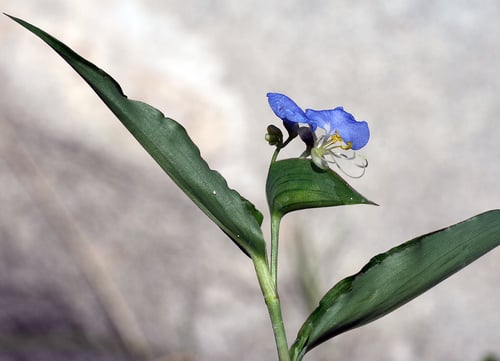
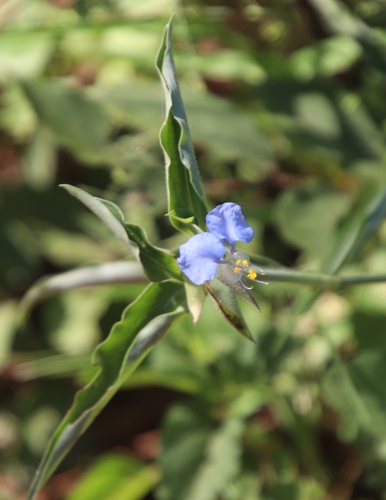
(c) zirahuenortega, some rights reserved (CC BY-NC), uploaded by zirahuenortega
iNaturalist· cc-by-nc-nd
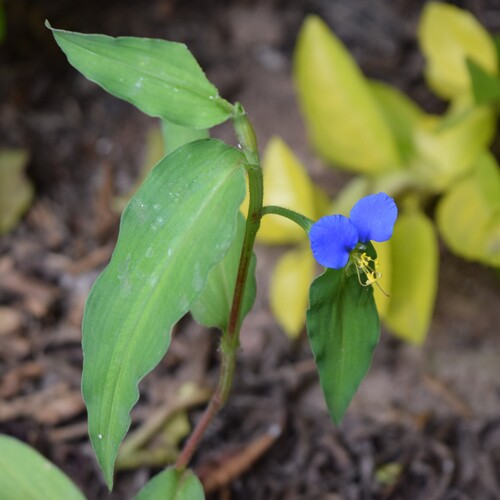
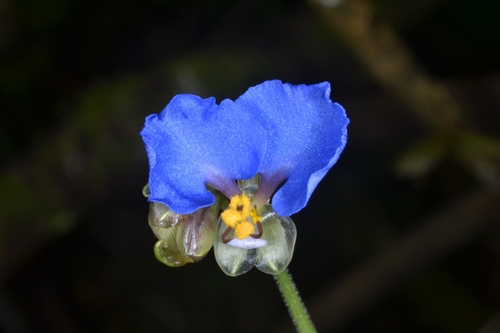
(c) David Midgley, some rights reserved (CC BY-NC-ND)
iNaturalist· cc-by-nc
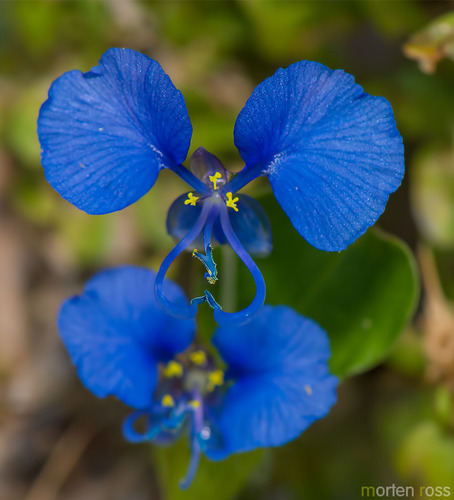
(c) Alejandra Lpz, some rights reserved (CC BY-NC)
Summary
Source: WikipediaCommelina tuberosa is an herbaceous perennial plant in the dayflower family which is native to Mexico but grown worldwide as an ornamental plant. It is characterized by its purple-splotched spathes with free margins, its bright blue petals of equal size, its tuberous roots, and its four to ten flowered lower cymes. In the wild, it is encountered in moist fields, open forests, or pine-oak forests. The species is sometimes considered to include the species Commelina coelestis, Commelina dianthifolia, and Commelina elliptica, such as in the Flora Mesoamericana. When these are treated as separate, they are often referred to as the "Commelina tuberosa complex". Horticulturally, the species are often treated as separate entities because of their differing habits and leaf shapes. In this sense, Commelina tuberosa is a low-growing plant with long narrow leaves. The Coelestis Group is a cultivar group of Commelina tuberosa which is grown ornamentally. Growing to 50 cm (20 in) tall by 100 cm (39 in) broad, it flowers in summer and autumn. Being a warm temperate plant which dislikes temperatures below −5 °C (23 °F), in cooler areas it must be lifted and stored in the winter months. It prefers a sunny or partially shaded sheltered spot in the garden.
Description
A herb. It has tuberous roots. It keeps growing from year to year. It is 30-90 cm high and spreads 45-75 cm wide. It has bright blue flowers.
This description is brief — help expand it
Edible Uses
The starchy tubers are edible when cooked, though they have a fairly bland flavour.
Medicinal Uses
None known
Distribution
A tropical plant. In Argentina it grows between 1,000-2,800 m above sea level. It suits hardiness zones 9-12.
Where It Grows
Argentina, Australia, Central America, Costa Rica, El Salvador, Guatemala, Honduras, Mexico, Nicaragua, North America, Peru, Tasmania,
Cultivation
Prefers a light well-drained loam with added leafmold. Succeeds in an ordinary, reasonably moist soil in a sunny position with some shelter. Plants are hardy to about -10°c if the roots are protected from freezing. It is probably best to dig up the roots in autumn and stored them like dahlias in a cool frost free place. When grown in a light well-drained soil and mulched well, the roots usually survive the winter outdoors. A very ornamental plant.
Propagation
Sow seed in March in a greenhouse; germination typically takes 4–5 weeks at 20°C. Once seedlings are large enough to handle, prick them out into individual pots and plant out in late spring or early summer after the last expected frosts. Divide in early spring, ensuring each portion has at least one growing bud. Cuttings taken during the growing season are very easy to root.
Other Uses
None known
Notes
There are about 230 Commelina species.
References (4)
- Cundall, P., (ed.), 2004, Gardening Australia: flora: the gardener's bible. ABC Books. p 404
- Hibbert, M., 2002, The Aussie Plant Finder 2002, Florilegium. p 72
- Plants for a Future database, The Field, Penpol, Lostwithiel, Cornwall, PL22 0NG, UK. http://www.scs.leeds.ac.uk/pfaf/
- Sp. pl. 1:41. 1753