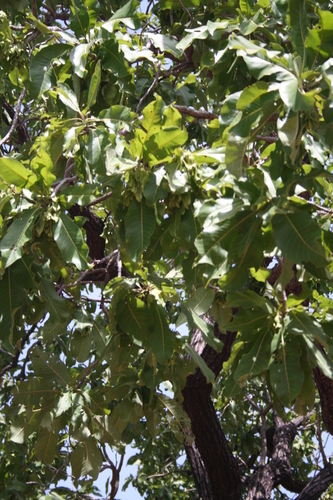
Combretum nigricans var. elliotii
Guill. & Perr., (Engl. & Diels) Aubrev.
iNaturalist· cc-by-nc
(c) ONG OeBenin, some rights reserved (CC BY-NC), uploaded by ONG OeBenin
iNaturalist· cc-by-nc
(c) iles-ecologiques, some rights reserved (CC BY-NC), uploaded by iles-ecologiques
iNaturalist· cc-by-nc
(c) Sylvain Piry, some rights reserved (CC BY-NC), uploaded by Sylvain Piry
Description
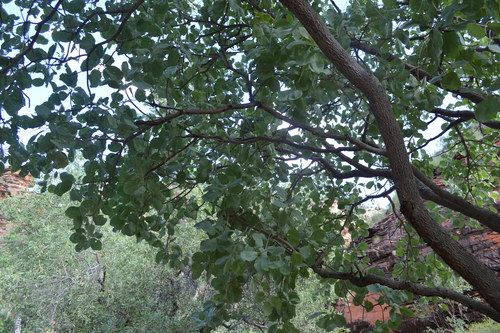
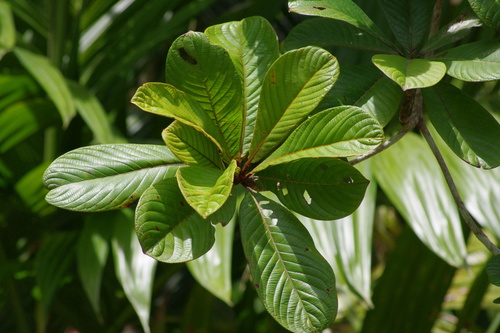
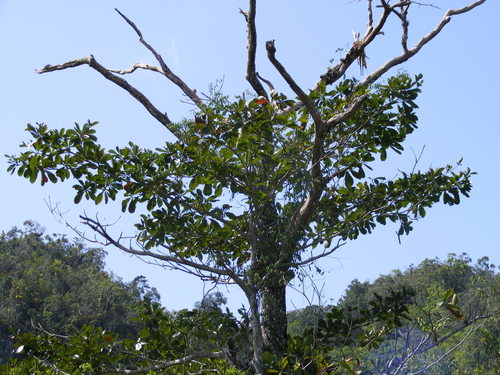
A small tree. It grows 10 m high. The trunk is 1 m around. The bark is smooth. The trunk is often twisted. The variety elliotii occurs between Senegal and Nigeria and variety nigricans in Senegal and Gambia. The bark yields a yellow, white or red-brown gum in the dry season. The leaves are opposite and taper to the tip. They are narrowly oval and 7 cm long by 3 cm wide. The leaves are slightly hairy. The flowers are greenish-white. They are in the axils of leaves along stalks 3-5 cm long. The fruit are reddish and have 4 wings.
Edible Uses
The gum (yellow, white, or red-brown) is eaten and sold in local markets. Leaves are used for tea.
Distribution
A tropical plant. It grows in savannah and near forests in dry regions. It grows in the Sahel. It grows on poor soils. It can grow in arid places.
Where It Grows
Africa, Benin, Burkina Faso, Central Africa, Central African Republic, CAR, Chad, Côte d'Ivoire, Gambia, Ghana, Guinea, Guinée, Guinea-Bissau, Ivory Coast, Mali, Niger, Nigeria, Sahel, Senegal, Sierra Leone, Sudan, Togo, West Africa,
Other Information
The gum is sold in local markets.
Notes
There are about 255 Combretum species.
Synonyms
Also Known As
Alemebe, Atchelogon, Betne, Buhiki, Buide, Bunro, Buski, Djambacatam-o, Dodje-gore, Mufopaie, Pau-de-pilao, Tchelogom, Uide
References (4)
- Burkill, H. M., 1985, The useful plants of west tropical Africa, Vol. 1. Kew.
- Maydell, H. von, 1990, Trees and shrubs of the Sahel: their characteristics and uses. Margraf. p 239
- Peters, C. R., O'Brien, E. M., and Drummond, R.B., 1992, Edible Wild plants of Sub-saharan Africa. Kew. p 86
- Royal Botanic Gardens, Kew (1999). Survey of Economic Plants for Arid and Semi-Arid Lands (SEPASAL) database. Published on the Internet; http://www.rbgkew.org.uk/ceb/sepasal/internet [Accessed 10th April 2011]