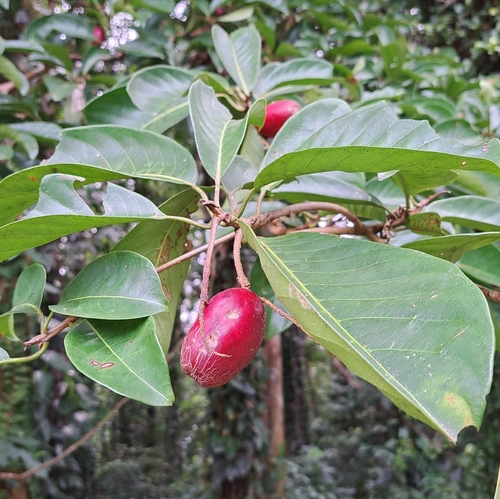
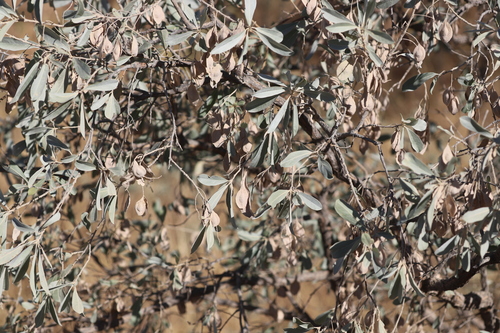
Combretum zeyheri
Sond.
Large-fruited bushwillow
iNaturalist· cc-by-nc
(c) Troos van der Merwe, some rights reserved (CC BY-NC), uploaded by Troos van der Merwe
iNaturalist· cc-by-nc
(c) Grant Reed, some rights reserved (CC BY-NC)
Summary
Source: WikipediaCombretum zeyheri, the large-fruited bushwillow or Zeyher's bushwillow, is a species of flowering plant in the family Combretaceae, usually found growing on acidic or sandy soils in tropical African savannas. A small to medium-sized tree, its roots are used as a source of material for making baskets and as a traditional medicine for haemorrhoids. Two interlocking wooden logs from a large-fruited bushwillow, connected by a notch, comprise the Kalambo structure. Located at Kalambo Falls, Zambia, and dating to roughly 476,000 years ago, the Kalambo structure is the oldest known wooden structure.
Description
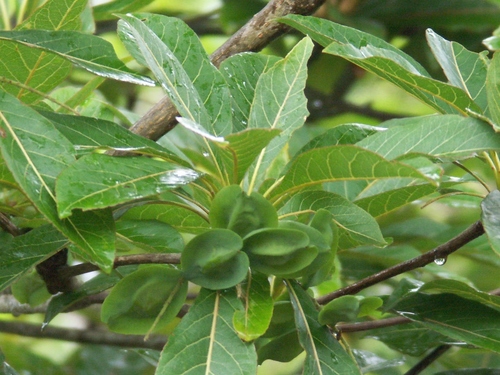
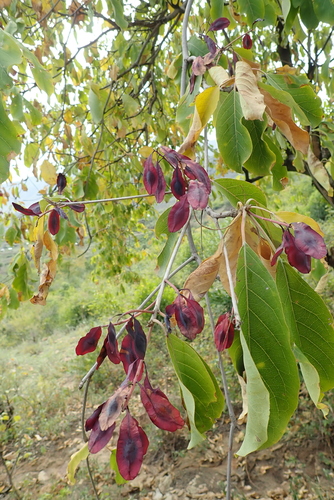
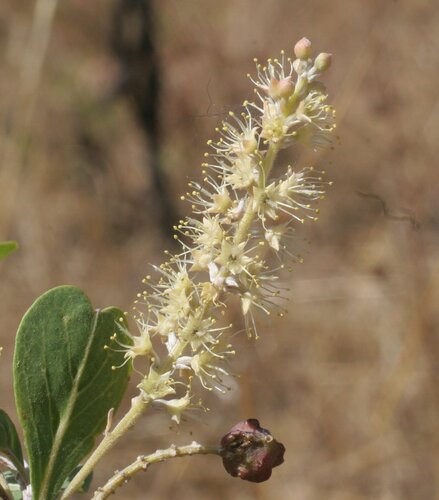
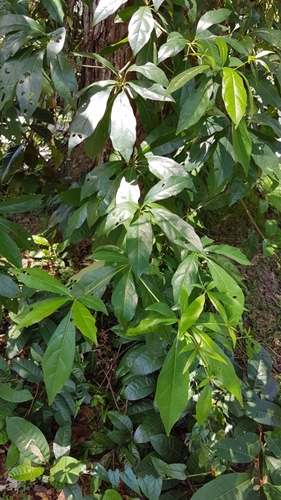
A small to medium sized tree. It loses its leaves during the year. The trunk is short and crooked. The crown is round. The bark is smooth and light brown. The young twigs have small white hairs. The leaves are opposite and simple. They are oblong and have fine hairs. The flowers can be 7 cm long. They are in spikes in the axils of leaves. They are greenish-yellow. The flowers appear with the new leaves. The fruit has 4 wings. They are 8 cm long by 8 cm wide. They are yellowish-green but ripen to light brown.
Edible Uses
The gum is considered a delicacy.
Traditional Uses
The gum is considered a delicacy.
This uses section is brief — help expand it
Medicinal Uses
A hot-water extract of the root and stem bark is added to porridge as a treatment against diarrhoea and vomiting. The roots are eaten in a porridge as a treatment for dysentery. They are also chewed as a remedy for colds and persistent coughing, and are used as a treatment against toothache. The dried leaves are smoked as a remedy for cough. A decoction is drunk, and also applied externally, as a treatment for scorpion bites. The powdered stem bark is used as a douche in the vagina to arrest menstrual flow.
Distribution
A tropical plant. It grows in rocky and sandy soil often over limestone material. It can tolerate drought. It grows between 10-1,600 m altitude. It grows in areas with about 450 mm per year. It can grow in arid places.
Where It Grows
Africa, Angola, Botswana, Central Africa, Congo, East Africa, Eswatini, Kenya, Malawi, Mozambique, Namibia, South Africa, Southern Africa, Swaziland, Tanzania, Zambia, Zimbabwe,
Other Uses
The roots are used to make beautiful and durable baskets.
Synonyms
Also Known As
Calama, Eumbo, Ghuvu, Kadale, Kagaro, Mlama, Muce, Muchenga, Muchenja, Mufikani, Muhuhu, Mukenge, Mupembere-kono, Muruka, Muteteoe, Pida, Raasblaar, Umbhondo, Umbula
References (16)
- Baidu-Forson, J.J., et al ,2014,. Assessment of agrobiodiversity resources in the Borotse flood plain, Zambia. CGIAR Research Program on Aquatic Agricultural Systems. Penang, Malaysia. Working Paper: AAS-2014-12.
- Fowler, D. G., 2007, Zambian Plants: Their Vernacular Names and Uses. Kew. p 20
- Lee, 1979,
- Linnaea 23:46. 1850
- Mannheimer, C. A. & Curtis. B.A. (eds), 2009, Le Roux and Muller's Field Guide to the Trees and Shrubs of Namibia. Windhoek: Macmillan Education Namibia. p 366
Show all 16 references Hide references
- Peters, C. R., O'Brien, E. M., and Drummond, R.B., 1992, Edible Wild plants of Sub-saharan Africa. Kew. p 86
- Rodin, 1985,
- Roodt, V., 1998, Trees & Shrubs of the Okavango Delta. Medicinal Uses and Nutritional value. The Shell Field Guide Series: Part 1. Shell Botswana. p 194
- Royal Botanic Gardens, Kew (1999). Survey of Economic Plants for Arid and Semi-Arid Lands (SEPASAL) database. Published on the Internet; http://www.rbgkew.org.uk/ceb/sepasal/internet [Accessed 10th April 2011]
- Ruiters-Welcome, A. K., 2019, Food plants of southern Africa. Ph.D. thesis. Univ. of Johannesburg p 45
- Swaziland's Flora Database http://www.sntc.org.sz/flora
- van Wyk, B, van Wyk, P, and van Wyk B., 2000, Photographic guide to Trees of Southern Africa. Briza. p 94
- Welcome, A. K. & Van Wyk, B.-E., 2019, An inventory and analysis of the food plants of southern Africa. South African Journal of Botany 122 (2019) 136–179
- Williamson, J., 2005, Useful Plants of Malawi. 3rd. Edition. Mdadzi Book Trust. p 77
- World Checklist of Useful Plant Species 2020. Royal Botanic Gardens, Kew
- www.zimbabweflora.co.zw 2011