Colocasia affinis
Schott
Black princess taro
iNaturalist· cc-by-nc
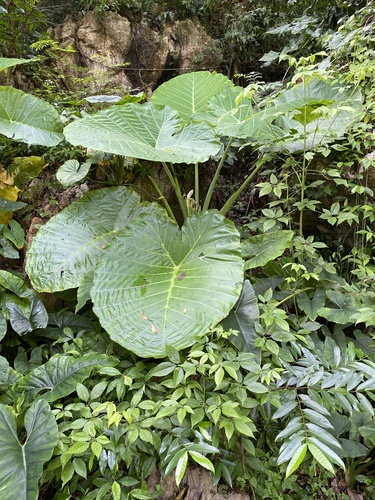
(c) eec, some rights reserved (CC BY-NC), uploaded by eec
iNaturalist· cc-by-nc
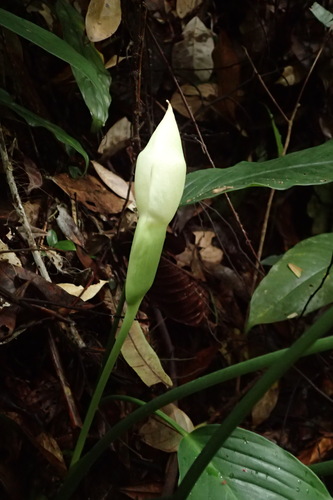
(c) rasekola, some rights reserved (CC BY-NC)
Description
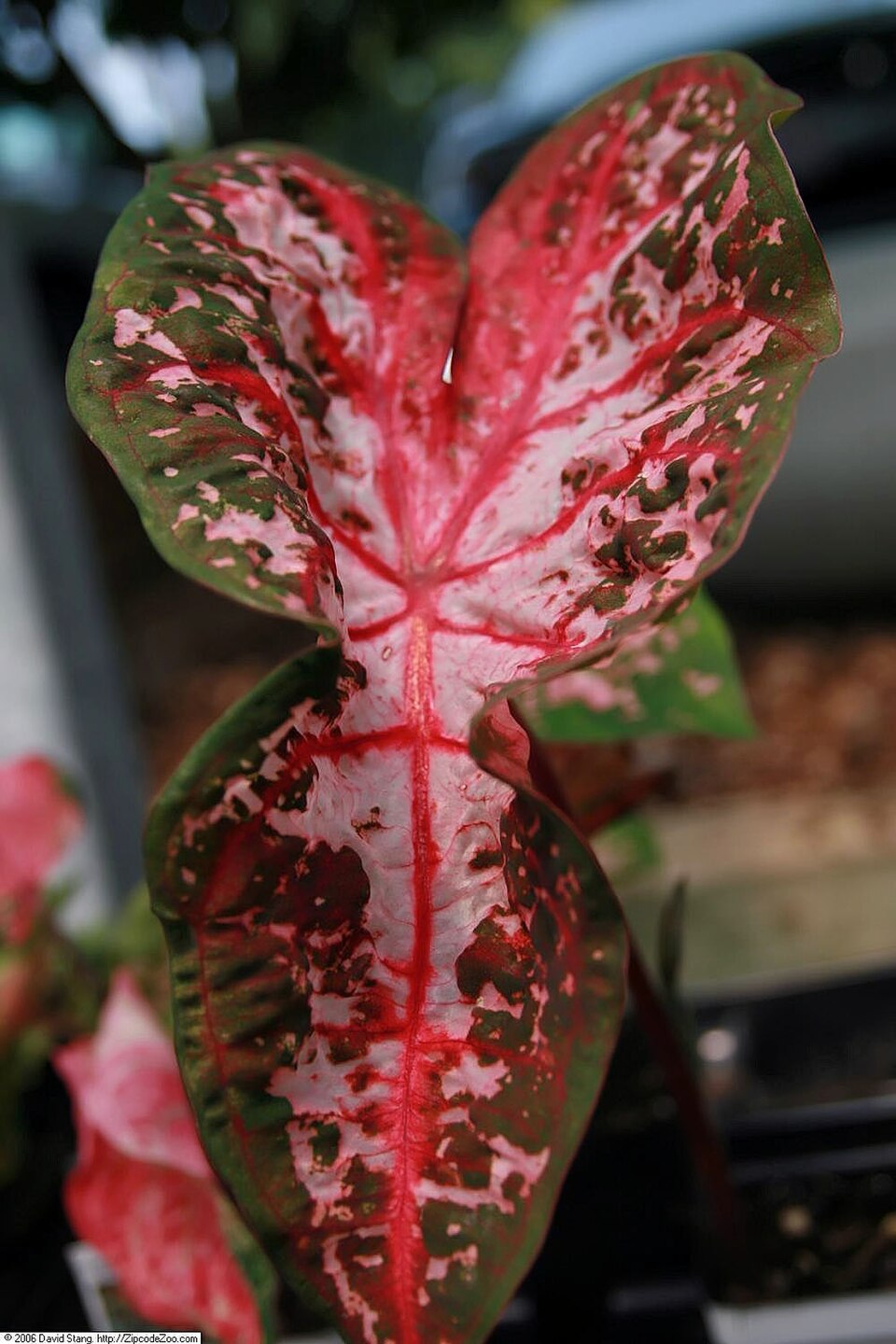
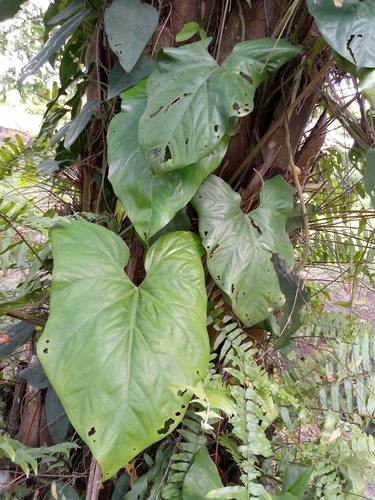
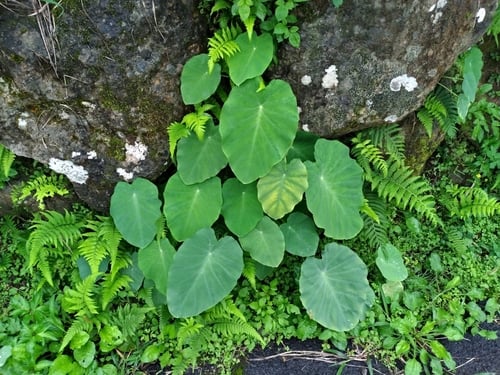
A taro like plant. It is a herb. It has trailing stolons. These are pale green and thin and can be 4-40 cm long. The leaves are oval with purple marks between the veins. There are 3-7 leaves. The leaf stalk is 20-45 cm long and cylinder shaped. The leaves are oval or heart shaped and 16-21 cm long by 13-16 cm wide. The leaves often have 4-6 pairs of large purple spots. The flowers are slender and yellow.
Edible Uses
The edible types are grown in the South Pacific and eaten like potatoes and known as taro, eddoe, and dasheen. The leaves are often boiled with coconut milk to make a soup. Poi, a Hawaiian dish, is made by boiling the starchy underground stem of the plant then mashing it into a paste.
Traditional Uses
The leaves and leaf stalks are boiled and eaten. Caution: Plants in this group can have oxalates. The roots are eaten.
This uses section is brief — help expand it
Distribution
It is a tropical plant. It can grow in damp places. It grows in moist, shady places in forests and on hillsides in limestone between 800-1,400 m above sea level. In Yunnan.
Where It Grows
Asia, Bangladesh, China, Himalayas, India, Myanmar, Nepal, Northeastern India, SE Asia, Sikkim, Tibet,
Notes
There are 6-8 Colocasia species.
Synonyms
Also Known As
Black-leaved taro, Bu-dong, Goneusu, Lep-lawp, Nyepop, Pein, Purple-leaved taro
References (9)
- Balkrishna, A., et al, 2022, Indigenous Uses of Plants among Forest-dependent Communities of Seijosa, Arunachal Pradesh. International Journal of Economic Plants 2022, 9(1):064-080
- Jha, P. K., et al, 1996, Plant genetic resources of Nepal: A guide for plant breeders of agricultural, horticultural and forestry crops. Euphytica 87:189-210
- Kar, A., et al, 2013, Wild Edible Plant Resources used by the Mizos of Mizoram, India. Kathmandu University Journal of Science, Engineering and Technology. Vol. 9, No. 1, July, 2013, 106-126
- Li, S., et al, 2020, Monpa, memory, and change: an ethnobotanical study of plant use in Mêdog County, South-east Tibet, China. Journal of Ethnobiology and Ethnomedicine. (2020) 16:5 p 16
- Lim, T. K., 2015, Edible Medicinal and Non Medicinal Plants. Volume 9, Modified Stems, Roots, Bulbs. Springer p 26
Show all 9 references Hide references
- Maikhuri, R, K, and Gangwar, A. K., 1993, Ethnobiological Notes on the Khasi and Garo Tribes of Meghalaya, Northeast India, Economic Botany, Vol. 47, No. 4, pp. 345-357
- Murtem, G. & Chaudhrey, P., 2016, An ethnobotanical note on wild edible plants of Upper Eastern Himalaya, India. Brazilian Journal of Biological Sciences, 2016, v. 3, no. 5, p. 63-81
- Sawian, J. T., et al, 2007, Wild edible plants of Meghalaya, North-east India. Natural Product Radiance Vol. 6(5): p 415
- Slocum, P.D. & Robinson, P., 1999, Water Gardening. Water Lilies and Lotuses. Timber Press. p 92