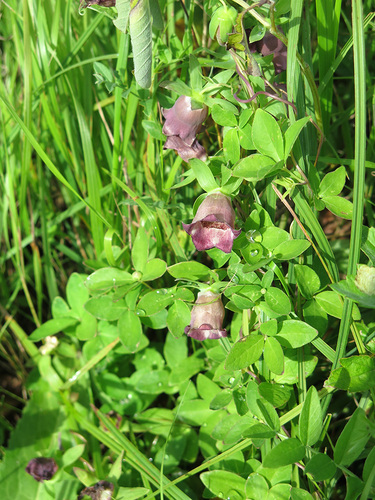
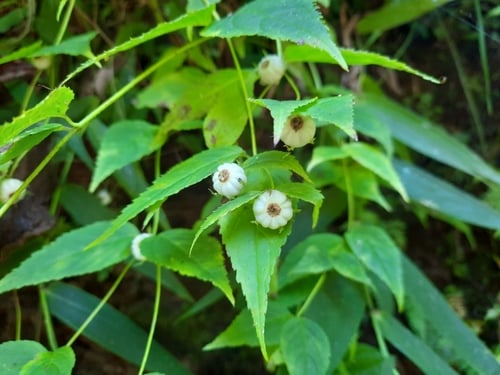
Codonopsis ovata
Benth.
Luduti
wikimedia· cc-by-sa
Wikimedia Commons - Krzysztof Ziarnek, Kenraiz
wikimedia· cc-by-sa
Wikimedia Commons - Krzysztof Ziarnek, Kenraiz
Summary
Source: WikipediaA perennial herb reaching 0.4 m (1 ft 4 in) tall and wide. Hardy to UK zone 4, not frost tender. Flowers June to August; seeds ripen August to September. Hermaphroditic plant. Prefers light sandy and medium loamy well-drained soils with mildly acidic to neutral pH. Grows in semi-shade or full sun, preferring moist soil. Noted as a scented plant.
Description
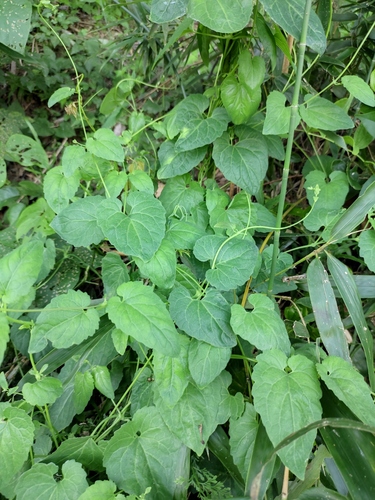
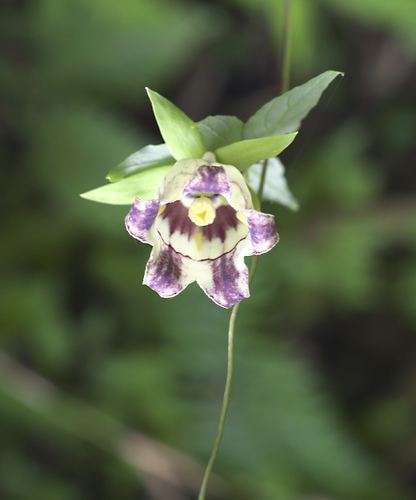
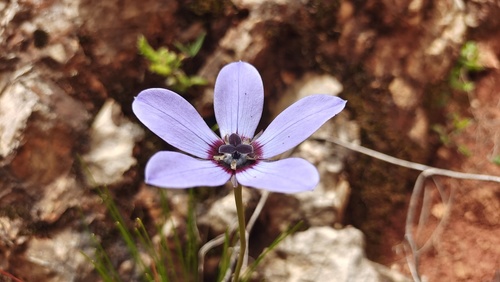
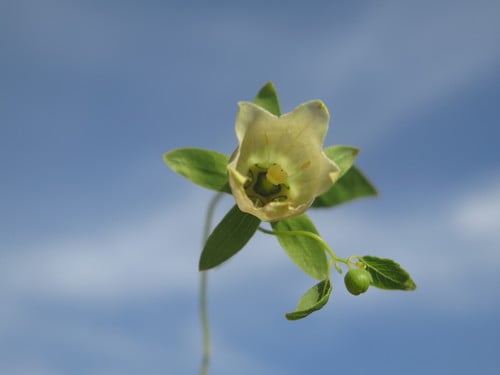
A herb that keeps growing from year to year. It has a fleshy root. It grows 20 cm high and spreads 25 cm wide. The stem is scaly. The branching shoots bear small leaves. The leaves are hairy. The flowers are nodding. The flowers are blue with purple veins. They are bell shaped.
Edible Uses
The root can be cooked and eaten, or dried and ground into a powder. It is regarded as a famine food, used when all else fails.
Traditional Uses
The roots are used for an edible flour. They are eaten raw or cooked.
This uses section is brief — help expand it
Medicinal Uses
The roots and leaves are used to make a poultice for treating bruises, ulcers, and wounds.
Distribution
It is a temperate plant. It grows in grassy spots with sandy or stony soils. It grows between 3000-4300 m altitudes. It is best in light to medium well-drained soils. It needs an open sunny position. It is resistant to frost and damaged by drought.
Where It Grows
Asia, Australia, China*, Europe, Himalayas, India, NW India, Pakistan,
Cultivation
Prefers a well-drained fertile light soil in full sun or semi shade. Plants only succeed in full sun if the soil remains moist during the growing season. Prefers a slightly acid soil. Dormant plants are hardy to about -20°c, but this species is not easy to grow in cultivation. The young growth in spring, even on mature plants, is frost-tender and so it is best to grow the plants in a position sheltered from the early morning sun. This species is not as cold tolerant as most members of the genus, it is best given a good mulch in the winter. The plant resents root disturbance and should be planted out into its permanent position as soon as possible. It is best grown on a high bank in order to give a good view of the flowers. The flowers, when inhaled near to, have the unpleasant odour of fur - likened by some to the smell of ferrets. Plants are very susceptible to the ravages of slugs. The young shoots in spring are particularly at risk, though older growth is also eaten.
Propagation
Surface sow seed in spring to early summer in ericaceous compost in a greenhouse, keeping the compost consistently moist. Seed usually germinates in 1–6 weeks at 20°c. Prick seedlings into individual pots as soon as they are large enough to handle and grow on under glass for their first winter. Plant out in late spring or early summer, protecting young plants from slugs until well established. Divide in spring with care, as the plant resents root disturbance. The best approach is to tease small divisions from the sides of the main clump to minimise disturbance, avoiding the need to dig up the whole plant. These divisions should be potted up and kept in light shade in a greenhouse until rooting well, then planted into permanent positions in summer if large enough, or the following spring.
Other Uses
None known Special Uses Scented Plants
Other Information
The roots are eaten raw as a snack in the field.
Notes
There are about 30 Codonopsis species.
Also Known As
Chamelia, Ludut
References (10)
- Ambasta, S.P. (Ed.), 2000, The Useful Plants of India. CSIR India. p 135
- Ballabh, B., et al, 2007, Raw edible plants of cold desert Ladakh. Indian Journal of Traditional Knowledge. 6(1) pp 182-184
- Bodkin, F., 1991, Encyclopedia Botanica. Cornstalk publishing, p 270
- Khan, M. & Hussain, S., 2014, Diversity of wild edible plants and flowering phenology of district Poonch (J & K) in the northwest Himalaya. Indian Journal of Sci, Res. 9(1): 032-038
- Morley, B. & Everard, B., 1970, Wild Flowers of the World. Ebury press. Plate 97
Show all 10 references Hide references
- Plants for a Future database, The Field, Penpol, Lostwithiel, Cornwall, PL22 0NG, UK. http://www.scs.leeds.ac.uk/pfaf/
- J. F. Royle, Ill. bot. Himal. Mts. 1(8):253; 2(7): t. 69, fig. 3. 1835
- Sharma, L. et al, 2018, Diversity, distribution pattern, endemism and indigenous uses of wild edible plants in Cold Desert Biosphere Reserve of Indian Trans Himalaya. Indian Journal of Traditional Knowledge. Vol 17(1) January 2018 pp 122-131
- Singh, H.B., Arora R.K.,1978, Wild edible Plants of India. Indian Council of Agricultural Research, New Delhi. p11
- Wild edible plants of Himachal Pradesh