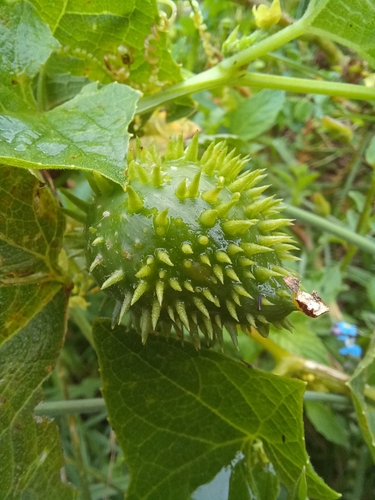
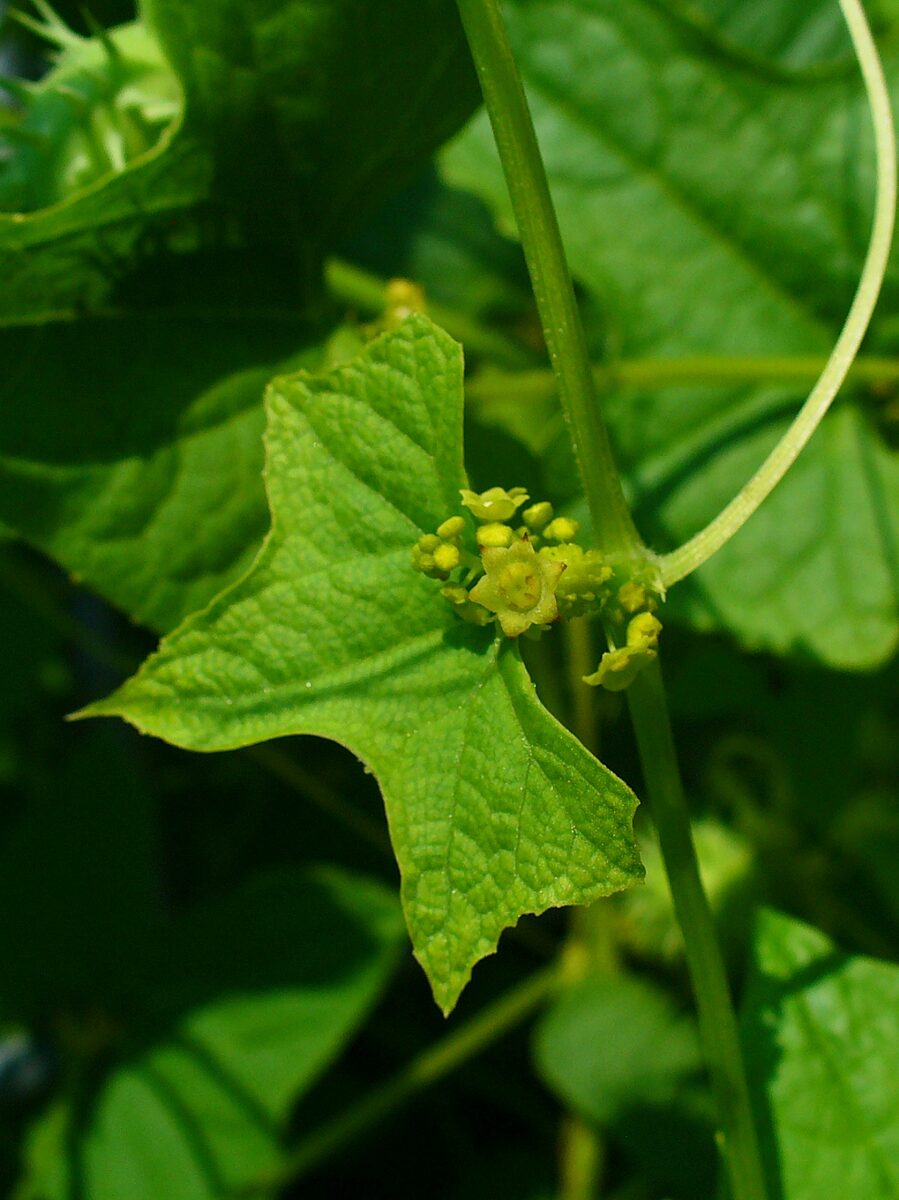
Trichosanthes kirilowii
Maxim.
Chinese snake gourd, Mongolian snake gourd
iNaturalist· cc-by-nc
(c) MP Zhou, some rights reserved (CC BY-NC)
iNaturalist· cc-by-nc
(c) tretyakovmiy, some rights reserved (CC BY-NC), uploaded by tretyakovmiy
Summary
Source: WikipediaTrichosanthes kirilowii is a flowering plant in the family Cucurbitaceae found particularly in Henan, Shandong, Hebei, Shanxi, and Shaanxi (China). It is one of the 50 fundamental herbs used in traditional Chinese medicine, where it shares the name guālóu (Chinese: 栝蔞) with the related T. rosthornii. It is known as "Chinese cucumber" and "Chinese snake gourd" in English.
Description
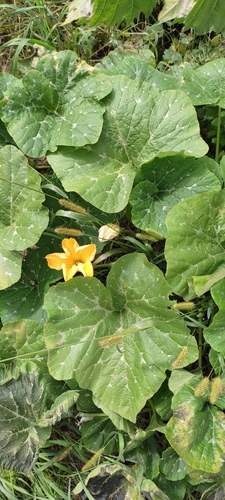
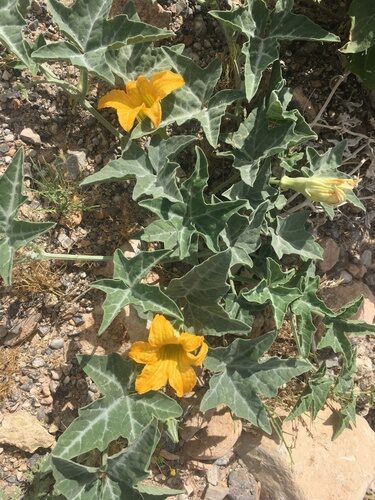
A pumpkin family plant. It is a vine up to 3-10 m long. It climbs. The leaves have 3-5 lobes. They are slightly rough underneath. The flowers are white. The fruit are red or orange. They are 7-11 cm long.
Edible Uses
Young fruits are pickled; the pulp of older, mature fruits (about 10cm long) is eaten. Leaves and young shoots are cooked as a vegetable. An edible starch is obtained from the root, though it requires leeching, which suggests a bitter flavour. To prepare it, the root is harvested in autumn, cut into thick slices and soaked in water for 4–5 days, with the water changed daily, until the root disintegrates and can be mashed into a fine pulp. It is then steamed into cakes or used for making dumplings. An edible oil is also obtained from the seed.
Traditional Uses
The starchy root, is peeled, cut into slices, soaked in repeated changes of water for five days until they disintegrate, and then mashed to a pulp which is made into steamed cakes. The pulp of the fruit is also eaten cooked. The young buds are boiled and eaten as a vegetable.
Medicinal Uses
This plant is a fundamental herb in Chinese herbalism, counted among the 50 most important. Recent research has isolated a protein called trichosanthin from the roots, which is undergoing trials as a possible remedy for AIDS. The leaf and stem are febrifuge. The fruit is antibacterial, anticholesterolemic, antifungal, depurative, emollient, expectorant and laxative, used to treat pulmonary infections with yellow and thick sputum, chest pains, stuffy feelings in the chest, constipation and dry stool. It has antibacterial action against E. coli, Bacillus dysenteriae, B. typhi, B. paratyphi, Pseudomonas, Vibrio cholerae, V. Proteus and others. The fruit is traditionally prepared as a winter soup to ward off colds and influenza, and is harvested in autumn and dried for later use. The fruit rind treats cancer, jaundice, retained placenta, bronchial infections with thick phlegm and sore throat. The seed is antitussive, emollient and expectorant. The root is antibiotic, anti-inflammatory, febrifuge, galactogogue, laxative, oxytocic, sialagogue and uterine tonic. For centuries the fresh root has been noted as an abortifacient — a sponge soaked in its juice was placed in the vagina to induce abortion in the second trimester of pregnancy. Internally, the root treats diabetes, dry coughs and assists in the second stage of labour. The root is harvested in autumn and dried. Powdered root and/or seed is used to treat mammary cancer.
Known Hazards
Root extracts are extremely toxic. Intravenous administration can cause pulmonary oedema, cerebral oedema, cerebral haemorrhage and myocardial damage. Seizures and fever in HIV patients with parenteral administration. Self-medication of root not advised.
Distribution
A subtropical or temperate plant. It grows in open forests and grasslands between 200-1,800 m above sea level in China.
Where It Grows
Asia, Cambodia, China, Indochina, Japan, Korea, Laos, Malaysia, Mongolia, SE Asia, Vietnam,
Cultivation
Requires a rich well-drained soil and plenty of moisture in the growing season. Sometimes cultivated in China for its edible fruit and medicinal uses. Male plants are favoured for root production. This species is not winter hardy in Britain and usually requires greenhouse cultivation. However, it may be possible to grow it as an annual in a very warm sheltered bed outdoors. A climbing plant, supporting itself by means of tendrils. Dioecious, male and female plants must be grown if seed is required.
Propagation
Sow seed in March into pots in a warm greenhouse using a rich soil, placing 2–3 seeds per pot and thinning to the strongest plant. Grow on quickly and plant out after the last expected frosts, providing protection such as a frame or cloche until the plants are establishing well.
Other Uses
Oil extracted from the seed is used for lighting.
Notes
It is used in medicine.
Synonyms
Also Known As
Bacbat, Chosen-karasu-uri, Haneultari, Ki-karasu uri
References (13)
- Facciola, S., 1998, Cornucopia 2: a Source Book of Edible Plants. Kampong Publications, p 89
- Hwang, H., et al, 2013, A Study on the Flora of 15 Islands in the Western Sea of Jeollanamdo Province, Korea. Journal of Asia-Pacific Biodiversity Vol. 6, No. 2 281-310
- Kim, H. & Song, M., 2013, Ethnobotanical analysis for traditional knowledge of wild edible plants in North Jeolla Province (Korea). Genetic. Resour. Crop Evol. (2013) 60:1571-1585
- Lim, T. K., 2015, Edible Medicinal and Non Medicinal Plants. Volume 9, Modified Stems, Roots, Bulbs. Springer p 82
- Mem. Acad. Imp. Sci. St.-Peersbourg Divers Savans 9:482. 1859 (Prim. fl. amur.)
Show all 13 references Hide references
- Pham-Hoang Ho, 1999, An Illustrated Flora of Vietnam. Nha Xuat Ban Tre. p 573
- Plants for a Future database, The Field, Penpol, Lostwithiel, Cornwall, PL22 0NG, UK. http://www.scs.leeds.ac.uk/pfaf/
- Song, M., et al, 2013, Traditional knowledge of wild edible plants in Jeju Island, Korea. Indian Journal of Traditional Knowledge. 12(2) pp 177-194
- Tanaka,
- Walters, T. W., 1989, Historical Overview on Domesticated Plants in China with Special Emphasis on the Cucurbitaceae. Economic Botany 43(3): 297-313
- Wang, J., et al, 2020, An ethnobotanical survey of wild edible plants used by the Yi people of Liangshan Prefecture, Sichuan Province, China. Journal of Ethnobiology and Ethnomedicine 16:10 p 7
- van Wyk, B., 2005, Food Plants of the World. An illustrated guide. Timber press. p 366
- World Checklist of Useful Plant Species 2020. Royal Botanic Gardens, Kew