Trichosanthes dioica
Roxb.
Pointed gourd, Wild snake gourd
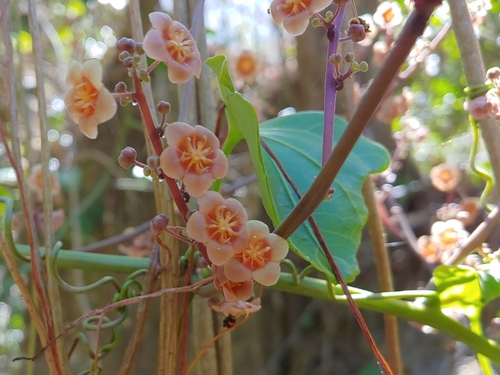
iNaturalist· cc-by
(c) Ramit Singal, some rights reserved (CC BY), uploaded by Ramit Singal
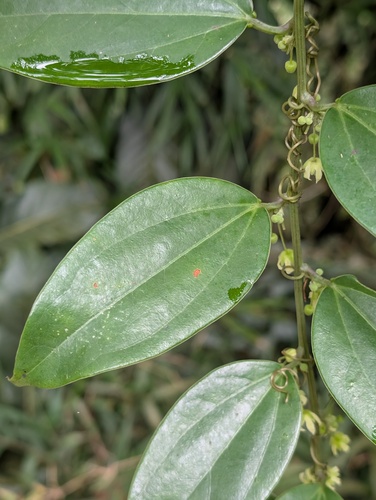
iNaturalist· cc-by-sa
(c) Ong Jyh Seng, some rights reserved (CC BY-SA), uploaded by Ong Jyh Seng
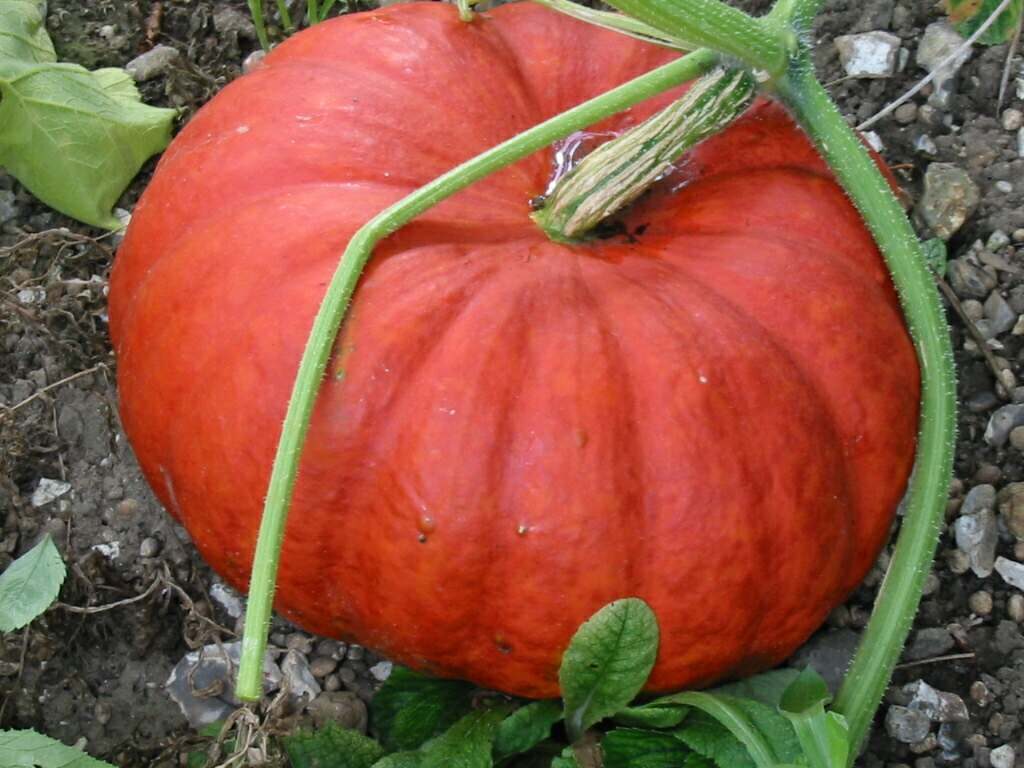
iNaturalist· cc-by-nc
(c) Mahesh A, some rights reserved (CC BY-NC), uploaded by Mahesh A
Summary
Source: WikipediaTrichosanthes dioica, also known as pointed gourd, is a tropical perennial cucurbit plant with its origin in the Indian subcontinent. The plant propagated vegetatively and grows with training on a support system (e.g., trellis) as pencil-thick vines (creepers) with dark-green cordate (heart-shaped) simple leaves. It is a well-developed dioecious plants having distinct male and female flowers on staminate and pistillate plants, respectively. The fruits are green with white or no stripes' and have unpalatable seeds. Size can vary from small and round to thick and long – 5–15 centimetres (2–6 inches). It thrives well under a hot to moderately warm and humid climate. The plant remains dormant during the winter season and prefers fertile, well-drained sandy loam soil due to its susceptibility to water-logging.
Description
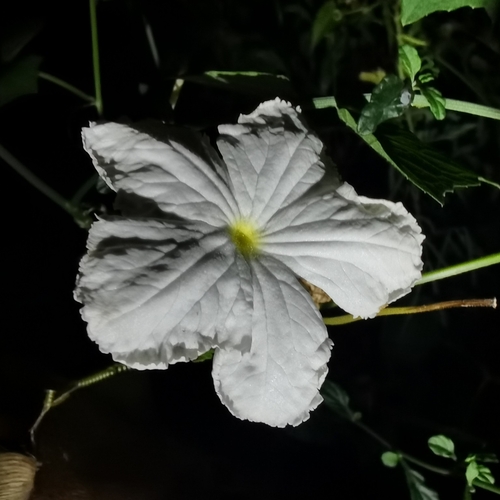
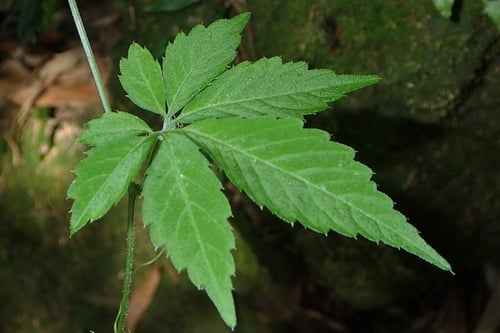
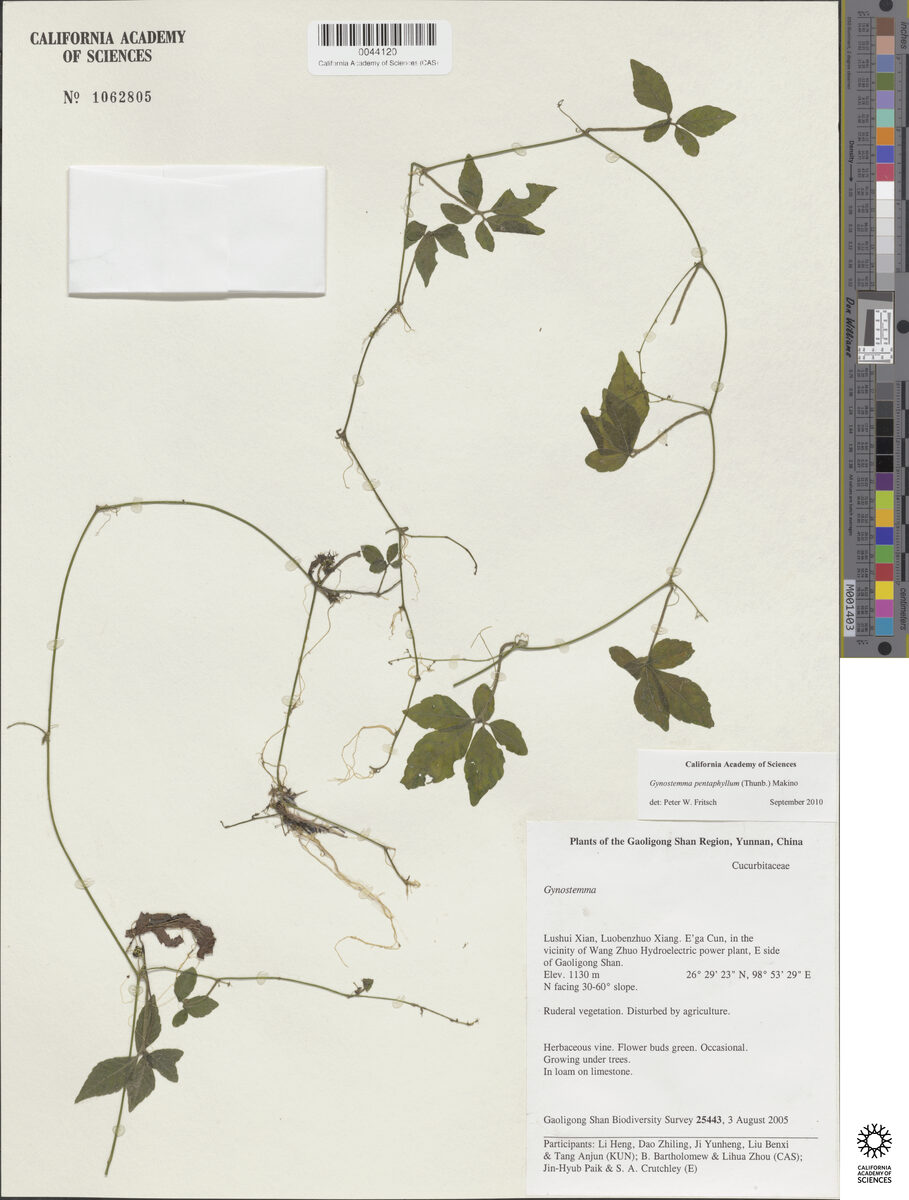
A pumpkin family plant. It is a climber. It is a herb. The stems are slender and angled. They have soft hairs. The tendrils are divided 2-4 times. The leaves have stalks. The leaves are 5-10 cm long. They are oval or heart shaped. There are teeth along the edge. Leaves are rigid and rough on both surfaces. Flowers are of one sex and white. The fruit are oblong or pointed on both sides. They are orange-red when ripe. They are 10 cm long and 5 cm wide. Seeds are slightly compressed.
Edible Uses
Young fruits are cooked as vegetables and used in curries, fried, pickled, and added to stews and confectionery. The leaves are eaten as a vegetable in soups and stews. It is a commercially cultivated vegetable.
Traditional Uses
The young fruit are cooked as a vegetable. They are used in curries. They are also fried, pickled and used in stews. They are also used in confectionary and pickled. The leaves are eaten as a vegetable. They are used in soups and stews.
Medicinal Uses
The juice of the fruits and leaves are used in traditional medicine.
Distribution
A tropical plant. It grows in tropical India. It suits a warm humid climate. It is common in NE India. In Nepal it grows to 600 m altitude. The soil needs to be well drained.
Where It Grows
Andamans, Asia, Australia, Bangladesh, Himalayas, India, Indochina, Myanmar, Nepal, Northeastern India, Pakistan, Polynesia, SE Asia, Sikkim, Sri Lanka,
Cultivation
Plants are grown from seed. It is often grown by stem cuttings. Pieces 60 cm long are taken from male and female plants. They are planted out of the nursery after 90 days.
Propagation
Seed - sow in situ. Cuttings of shoots about 60cm long, inserted 15cm into the soil.
Other Uses
A drying oil is obtained from the seed.
Other Information
It is a commercially cultivated vegetable.
Nutrition
| Part | Moisture | kJ | kcal | Protein | Vit A | Vit C | Iron | Zinc |
|---|---|---|---|---|---|---|---|---|
| Fruit | 92 | — | — | 2 | — | 362.5 | — | — |
Also Known As
Chathail, Duli ao, Jangli patal, Kaadu-padavala, Koitbach, Kombu-pudalai, Kommupotla, Kundru, Palwal, Parvar, Parwal, Parwar, Patal, Patol, Patolam, Phodol, Potol, Putulika, Tandoori, Tindola
References (30)
- Acharya K. P. and Acharya, R., 2010, Eating from the Wild: Indigenous knowledge on wild edible plants in Parroha VDC of Rupandehi District, Central Nepal. International Journal of Social Forestry. 3(1):28-48
- Ambasta, S.P. (Ed.), 2000, The Useful Plants of India. CSIR India. p 650
- Ara, R. I. T., 2015, Leafy Vegetables in Bangladesh. Photon eBooks. p 104
- Arora, R. K., 2014, Diversity in Underutilized Plant Species - An Asia-Pacific Perspective. Bioversity International. p 51
- Chunduri, J. R., 2013, Antioxidant and nutritional analysis of edible Cucurbitaceae vegetables of India. International Journal of Bioassays. 02(08) 1124-1129
Show all 30 references Hide references
- Dangol, D. R. et al, 2017, Wild Edible Plants in Nepal. Proceedings of 2nd National Workshop on CUAOGR, 2017.
- Esquinas-Alcazar, et al, 1983, Genetic Resources of Cucurbitaceae. International Board of Plant Genetic Resources.
- Facciola, S., 1998, Cornucopia 2: a Source Book of Edible Plants. Kampong Publications, p 89
- Fl. ind. ed. 1832, 3:701. 1832
- Flora of Pakistan. www.eFloras.org
- Gautam, R. S., et al, 2022, Ethnobotanical Review of Wild Edible Plants of Nepal. Journal of Natural History Museum Volume 32, 2021-22 p 111
- Ghosh, C. & Das A. P., 2011, Some useful and poisonous tea garden weeds from the Darjiling District of West Bengal, India. Pleione 5(1): 91 - 114
- Hedrick, U.P., 1919, (Ed.), Sturtevant's edible plants of the world. p 654
- Jha, P. K., et al, 1996, Plant genetic resources of Nepal: A guide for plant breeders of agricultural, horticultural and forestry crops. Euphytica 87:189-210
- Kays, S. J., and Dias, J. C. S., 1995, Common Names of Commercially Cultivated Vegetables of the World in 15 languages. Economic Botany, Vol. 49, No. 2, pp. 115-152
- Khanal, R., et al, 2014, Documenting abundance and use of underutilized plant species in the mid hill region of Nepal. ECOPRINT 21: 63-71, 2014
- Kiple, K.F. & Ornelas, K.C., (eds), 2000, The Cambridge World History of Food. CUP p 1865
- Manandhar, N.P., 2002, Plants and People of Nepal. Timber Press. Portland, Oregon. p 465
- Manju, S., and Sundriyal, R. C., 2001, Wild Edible Plants of the Sikkim Himalaya: Nutritive Values of Selected Species. Economic Botany 55(3): 377-390
- Martin, F.W. & Ruberte, R.M., 1979, Edible Leaves of the Tropics. Antillian College Press, Mayaguez, Puerto Rico. p 190
- Murtem, G. & Chaudhrey, P., 2016, An ethnobotanical note on wild edible plants of Upper Eastern Himalaya, India. Brazilian Journal of Biological Sciences, 2016, v. 3, no. 5, p. 63-81
- Rashid, H. E., 1977, Geography of Bangladesh. Westview. p 264
- Shaheen, N., et al, 2013, Food Composition Table for Bangladesh. University of Daka. p 33
- Sharma, B.B., 2005, Growing fruits and vegetables. Publications Division. Ministry of Information and broadcasting. India. p 176
- Singh, H.B., Arora R.K.,1978, Wild edible Plants of India. Indian Council of Agricultural Research, New Delhi. p 78
- Terra, G.J.A., 1973, Tropical Vegetables. Communication 54e Royal Tropical Institute, Amsterdam, p 79
- Tindall, H.D., 1983, Vegetables in the tropics. Macmillan p. 189
- USDA, ARS, National Genetic Resources Program. Germplasm Resources Information Network - (GRIN). [Online Database] National Germplasm Resources Laboratory, Beltsville, Maryland. Available: www.ars-grin.gov/cgi-bin/npgs/html/econ.pl (10 April 2000)
- Wiersema, J. H. & Leon, B., 2013, World Economic Plants. A Standard Reference CRC Press. 2nd Ed. p 693
- World Checklist of Useful Plant Species 2020. Royal Botanic Gardens, Kew