Cleistochlamys kirkii
(Benth.) Oliver
Purple cluster pear
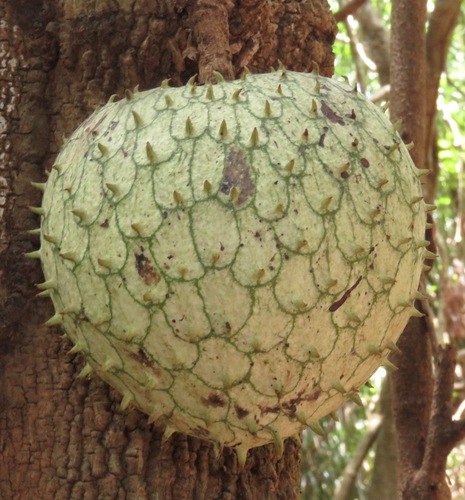
iNaturalist· cc-by-nc
(c) Graeme White, some rights reserved (CC BY-NC), uploaded by Graeme White
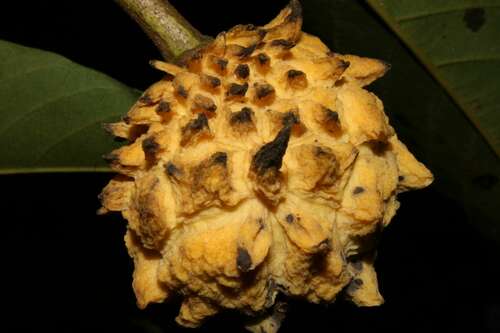
iNaturalist· cc-by-nc
(c) Troos van der Merwe, some rights reserved (CC BY-NC)
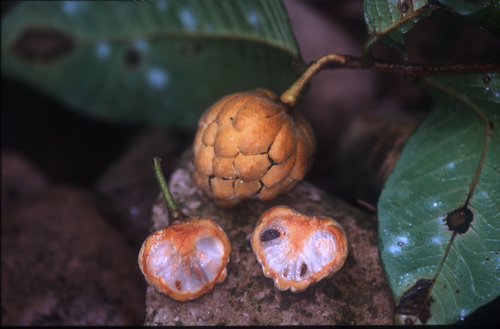
iNaturalist· cc-by-nc
(c) Troos van der Merwe, some rights reserved (CC BY-NC)
Description
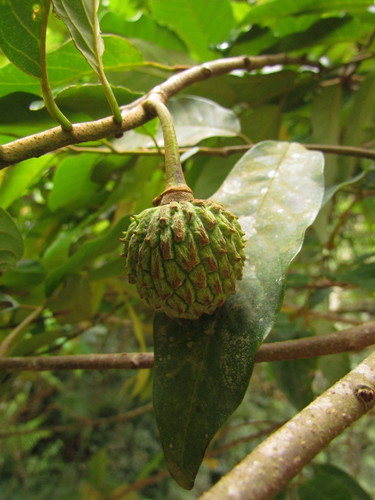
A shrub or small tree. It is often very branched and straggly. It grows 9 m tall. The bark is tough and light brown. The leaves are alternate. They are in 2 rows. They are simple and oblong. They are 6-11 cm long by 2-3.5 cm wide. They are bright shiny green above and paler underneath. They often have notches along the edge. The flowers are of both sexes. The flowers are creamy white and 1.2 cm across. There are reddish-brown bracts below the flower. The fruit have 10 separate carpels and are 2.5 cm long by 1 cm wide. They are purplish-black when ripe. They are succulent.
Edible Uses
The ripe fruit are eaten fresh or used to make a drink.
Traditional Uses
The ripe fruit are eaten. They are also used to make a drink.
This uses section is brief — help expand it
Distribution
A tropical plant. It grows in bush and thickets in hot dry river valleys. It can grow in arid places. In Zimbabwe it grows up to 900 m above sea level.
Where It Grows
Africa, East Africa, Malawi, Mozambique, South Africa, Southern Africa, Tanzania, Zambia, Zimbabwe,
Synonyms
Also Known As
Horombgwa, Muhodzongwa, Mukoronga, Mukorongwa, Munzinda, Mupodzongo, Nkalango
References (14)
- Bruschi, P., et al, 2014, Traditional use of plants in a rural community of Mozambique and possible links with Miombo degradation and harvesting sustainability. Journal of Ethnobiology and Ethnomedicine. 2014, 10:59
- Fowler, D. G., 2007, Zambian Plants: Their Vernacular Names and Uses. Kew. p 8
- Fox, F. W. & Young, M. E. N., 1982, Food from the Veld. Delta Books. p 84
- Grivetti, L. E., 1980, Agricultural development: present and potential role of edible wild plants. Part 2: Sub-Saharan Africa, Report to the Department of State Agency for International Development. p 71
- Palgrave, K.C., 1996, Trees of Southern Africa. Struik Publishers. p 166
Show all 14 references Hide references
- Peters, C. R., O'Brien, E. M., and Drummond, R.B., 1992, Edible Wild plants of Sub-saharan Africa. Kew. p 54
- Plowes, N. J. & Taylor, F. W., 1997, The Processing of Indigenous Fruits and other Wildfoods of Southern Africa. in Smartt, L. & Haq. (Eds) Domestication, Production and Utilization of New Crops. ICUC p 188
- Royal Botanic Gardens, Kew (1999). Survey of Economic Plants for Arid and Semi-Arid Lands (SEPASAL) database. Published on the Internet; http://www.rbgkew.org.uk/ceb/sepasal/internet [Accessed 28th March 2011]
- Scudder, 1971,
- Tredgold, M.H., 1986, Food Plants of Zimbabwe. Mambo Press. p 95
- Wild, 1975,
- Williamson, J., 2005, Useful Plants of Malawi. 3rd. Edition. Mdadzi Book Trust. p 68
- World Checklist of Useful Plant Species 2020. Royal Botanic Gardens, Kew
- www.zimbabweflora.co.zw 2011