Citrus hystrix
(L.) D.C.
Wild lime, Kaffir lime
iNaturalist· cc-by-nc
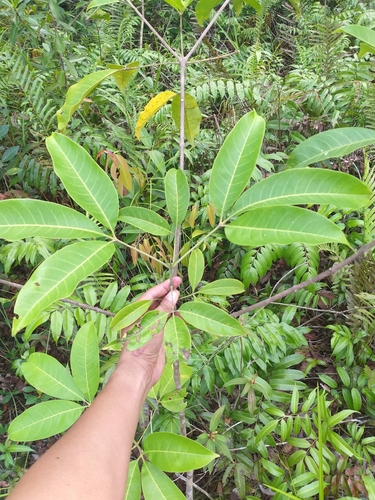
(c) Katja Schulz, some rights reserved (CC BY-NC)
iNaturalist· cc-by-nc
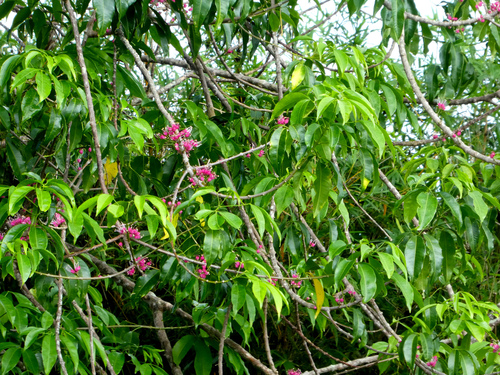
(c) first_jollity, some rights reserved (CC BY-NC)
iNaturalist· cc-by-nc-sa
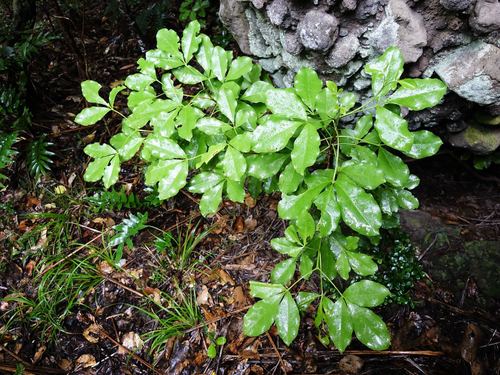
(c) Tony Rodd, some rights reserved (CC BY-NC-SA)
Summary
Evergreen shrub growing 6 m tall by 3 m wide at a medium rate. Hardy to UK zone 10. Flowers are small, fragrant, four to five-petalled and white, pollinated by insects. Self-fertile. Tolerates light sandy, medium loamy, and heavy clay soils with good drainage. Grows in mildly acidic, neutral, and mildly alkaline soils. Requires full sun and prefers moist conditions.
Description
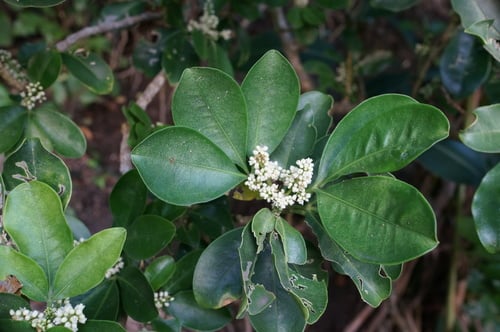
A low shrubby tree up to 6 or 8 m high. The trunk is thin and crooked. It has slender sharp thorns. The leaf petiole has very large lobes. The leaf is oval. The leaves can be 8-15 cm long by 3-5 cm wide including the leafy stalks. The leaves are dark green and shiny above and pale and matt underneath. The flowers are small and white. The fruit are small (8 cm across) with a rough, thick skin and very little edible pulp inside. They are very acid. The peel of the fruit is very fragrant.
Edible Uses
Kaffir lime leaves are used as a flavouring and to make teas. They have a distinct lime flavour and can be finely sliced and added raw to salads or incorporated into cooked dishes, lending a pleasant citrus note to soups, curries, rice, stir-fries, fish cakes, and marinades. Leaves can be sourced from homegrown plants or bought fresh or dried at Asian or specialty grocers. The fruit is edible raw; it is rough-skinned with a bitter flavour and 5–7cm in diameter. It produces only a small amount of juice, but this is very powerful and can be added to other fruit juices to make them taste more vibrant. The fruit is also used to make preserves. The rind is used as a flavouring in cooked foods, and can be candied or dried for use in curry pastes. The four-to-five-petalled white flowers are fragrant and edible.
Traditional Uses
The leaves and fruit are used to make drinks or to flavour food. They are added to soups and curries. The leaves are pounded into a jelly and mixed with hot chili pastes. The fruit are eaten crystallised. The juice of the fruit is used for flavouring. The lemon scented fruit are eaten with fish.
Medicinal Uses
The fruit is used medicinally, primarily as an insecticide for washing the hair and treating the feet to kill land leeches. Citrus species are rich in vitamin C, flavonoids, acids, and volatile oils, and research into their active ingredients is ongoing. They also contain coumarins such as bergapten, which sensitizes the skin to sunlight; bergapten is sometimes added to tanning preparations to promote pigmentation, though it can cause dermatitis or allergic reactions in some people. More recent applications include use as sources of antioxidants and chemical exfoliants in specialized cosmetics.
Distribution
A tropical plant. It mainly occurs in lowland areas in the tropics. It suits hardiness zones 10-12. In Yunnan.
Where It Grows
Africa, Asia, Australia, Brazil, Cambodia, China, Cuba, East Africa, East Timor, Europe, Fiji, France, Hawaii, India, Indochina, Indonesia, Japan, Laos, Madagascar, Malaysia, Mauritius, Mediterranean, Middle East, Morocco, Myanmar, North Africa, Northeastern India, Pacific, Papua New Guinea, PNG, Philippines, Samoa, Saudi Arabia, SE Asia, South America, Spain, Sri Lanka, Tasmania, Thailand, Timor-Leste, USA, Vanuatu, Vietnam, West Indies,
Cultivation
Kaffir lime is a thorny, multi-stemmed, evergreen shrub or small tree. Three main climates are suitable for commercial citrus production - tropical climates, subtropical with winter rain in the Mediterranean and semitropical with summer rainfall in Florida and southern Brazil. Kaffir lime grows well in sandy, well-drained soils in full sun to light shade. Deep, fertile soils generally produce the best fruit crops. Best overall performance occurs in full sun in locations sheltered from strong winds. The optimal temperatures for citrus cultivation range between 25 - 30°c, with the coldest month having an average minimum of at least 15°c. Growth generally ceases below 13°c and above 38°c. If there are dry periods of more than three months, then irrigation will be necessary. Kaffir lime can tolerate occasional, short-lived frosts. An easily grown plant preferring deep, well-drained but moisture-retentive loamy soil in full sun. Kaffir lime prefers a pH in the range of 5 - 6. Self Pollinating. Suitable for pots. Can be pruned to 2m.
Propagation
Sow fresh seed in containers as soon as ripe after thoroughly rinsing. Sow stored seed in containers as soon as possible. Germination usually takes place within 2–3 weeks at 13°C. Seedlings are prone to damping off and must be watered carefully and kept well ventilated. Seed is usually polyembryonic — two or more seedlings arise from each seed, genetically identical to the parent and typically free of any virus present in the parent. Prick out into individual pots when large enough to handle, and grow on until at least 10cm tall before planting into permanent positions. Half-ripe cuttings can be taken in July–August in a frame; this species roots easily from cuttings. Layering is also an option.
Other Uses
Extracts from the skin and juice act as an insecticide for washing the hair and treating the feet to kill land leeches. The fruits are rich in saponins, lather freely in water, and are used in hair shampoos and for washing clothes. In Cambodia, lustral water mixed with slices of the fruit is used in religious ceremonies. The fragrant leaves also contain saponins and serve as a hair wash. Two distinct essential oils are obtained — one from the leaves, another from the fruit peel — and kaffir lime oil is used in the pharmaceutical, agronomic, food, sanitary, cosmetic, and perfume industries, as well as extensively in aromatherapy.
Production
The tree flowers throughout the year but has most ripe fruit about June and July.
Other Information
A citrus of only minor importance in Papua New Guinea, but cultivated is some coastal areas.
Notes
There are 20 Citrus species. Several hybrids have been formed. It contains alpha-tocopherol (Vitamin E) content of 66.00 mg per 100 g.
Nutrition
| Part | Moisture | kJ | kcal | Protein | Vit A | Vit C | Iron | Zinc |
|---|---|---|---|---|---|---|---|---|
| Leaves | 65.3 | 552 | 137 | 5.5 | — | — | 3.3 | 0.5 |
| Fruit | 90.8 | — | 38 | 0.6 | — | — | 0.6 | — |
Synonyms
Also Known As
Bai magrood, Caffre lime, Fatt-fung-kam, Ichang lime, Jeruk purut, Jeruk sambal, Kabuyau, Kahpiri dehi, Karokaro, Kolobot, Khatta nabbu, Krauch soeuch, Kro'ch sae'ch, Kudala-dehi, Kulubot, La chanh, Leech lime, Lemon titi'u, Limau purut, Mahkroot, Ma kruut, Makrut, Mauritius papeda, Odu dehi, Papeda, Shauk-cho, Shauk-nu, Shauk-waing, Shouk-pote, Soco ni vavalagi, Soh-kyniet, Som makrut, Swangi, Te remem, Voangabe
References (60)
- AAK, 1980, Bertanam Pohon Buah-buahan. Penerbitan Yayasan Kanisius, Jogyakarta. p 38
- Ambasta, S.P. (Ed.), 2000, The Useful Plants of India. CSIR India. p 128
- Anderson, E. F., 1993, Plants and people of the Golden Triangle. Dioscorides Press. p 206
- Arora, R. K., 2014, Diversity in Underutilized Plant Species - An Asia-Pacific Perspective. Bioversity International. p 62 (As Citrus combara)
- Ashton, M. S., et al 1997, A Field Guide to the Common Trees and Shrubs of Sri Lanka. WHT Publications Ltd. pdf p 345
Show all 60 references Hide references
- Blench, R., 2004, Fruits and Arboriculture in the Indo-Pacific Region. Indo-Pacific Prehistory Association Bulletin 24. (Taipei Papers Volume 2) p 36
- Bremness, L., 1994, Herbs. Collins Eyewitness Handbooks. Harper Collins. p 46
- Brown, D., 2002, The Royal Horticultural Society encyclopedia of Herbs and their uses. DK Books. p 172
- Brown, W.H., 1920, Wild Food Plants of the Philippines. Bureau of Forestry Bulletin No. 21 Manila. p 74
- Burkill, I.H., 1966, A Dictionary of the Economic Products of the Malay Peninsula. Ministry of Agriculture and Cooperatives, Kuala Lumpur, Malaysia. Vol 1 (A-H) p 574
- Cat. pl. horti monsp. 97. 1813
- Chin, H.F., & Yong, H.S., 1996, Malaysian Fruits in Colour. Tropical press, Kuala Lumpur p 52
- Ching, L. S. & Mohamed, S., 2001, Alpha-Tocopherol Content in 62 Edible Tropical Plants. J. Agric. Food Chem. 2001, 49, 3101−3105
- Coronel, R.E., 1982, Fruit Collections in the Philippines. IBPGR Newsletter p 6
- Cowie, I, 2006, A Survey of Flora and vegetation of the proposed Jaco-Tutuala-Lore National Park. Timor-Lests (East Timor) www.territorystories.nt/gov.au p 52
- Creasy, R., 2000, The Edible Asian Garden. Periplus p 45
- Cundall, P., (ed.), 2004, Gardening Australia: flora: the gardener's bible. ABC Books. p 383
- Dobriyal, M. J. R. & Dobriyal, R., 2014, Non Wood Forest Produce an Option for Ethnic Food and Nutritional Security in India. Int. J. of Usuf. Mngt. 15(1):17-37
- Elevitch, C.R.(ed.), 2006, Traditional Trees of the Pacific Islands: Their Culture, Environment and Use. Permanent Agriculture Resources, Holualoa, Hawaii. p 245
- Etherington, K., & Imwold, D., (Eds), 2001, Botanica's Trees & Shrubs. The illustrated A-Z of over 8500 trees and shrubs. Random House, Australia. p 215
- Facciola, S., 1998, Cornucopia 2: a Source Book of Edible Plants. Kampong Publications, p 215
- Foo, J.T.S. (ed), 1996, A Guide to Common Vegetables. Singapore Science Foundation. p 126
- Food Composition Tables for use in East Asia FAO http://www.fao.org/infoods/directory No. 830
- French, B.R., 1986, Food Plants of Papua New Guinea, A Compendium. Asia Pacific Science Foundation p 227
- Hemphill, I, 2002, Spice Notes. Macmillan. p
- Hutton, W., 1997, Tropical Herbs and Spices of Indonesia. Periplus. p 39
- Jardin, C., 1970, List of Foods Used In Africa, FAO Nutrition Information Document Series No 2.p 128
- Jeeva, S., 2009, Horticultural potential of wild edible fruits used by the Khasi tribes of Meghalaya. Journal or Horticulture and Forestry Vol. 1(9) pp. 182-192
- Kiple, K.F. & Ornelas, K.C., (eds), 2000, The Cambridge World History of Food. CUP p 1794
- Lorenzi, H., Bacher, L., Lacerda, M. & Sartori, S., 2006, Brazilian Fruits & Cultivated Exotics. Sao Paulo, Instituto Plantarum de Estuados da Flora Ltda. p 533
- Martin, F.W. & Ruberte, R.M., 1979, Edible Leaves of the Tropics. Antillian College Press, Mayaguez, Puerto Rico. p 217
- Martin, M.A., 1971, Introduction L'Ethnobotanique du Cambodge. Centre National de la Recherche Scientifique. Paris.
- Meded. Lands Plantentuin 19:639, 370. 1898 (As Citrus celebica)
- Medhi, P. & Borthakur, S. K., 2012, Phytoresources from North Cachur Hills of Assam -3: Edible plants sold at Hflong market. Indian Journal of Natural Products and Resources. 3(1) pp 84-109
- Miguel, E., et al, 1989, A checklist of the cultivated plants of Cuba. Kulturpflanze 37. 1989, 211-357
- Norrington, L., & Campbell, C., 2001, Tropical Food Gardens. Bloomings Books. p 66
- Ochse, J. J. et al, 1931, Vegetables of the Dutch East Indies. Asher reprint. p 647
- Owen, S., 1993, Indonesian Food and Cookery, INDIRA reprints. p 60
- Peekel, P.G., 1984, (Translation E.E.Henty), Flora of the Bismarck Archipelago for Naturalists, Division of Botany, Lae, PNG. p 272, 273
- Philipp. Agric. Rev. 8:20, t. 5c, 6b. 1915 (As Citrus micrantha)
- Phon, P., 2000, Plants used in Cambodia. © Pauline Dy Phon, Phnom Penh, Cambodia. p 158
- Priyadi, H., et al, Five hundred plant species in Gunung Halimun Salak National Park West Java. A checklist including Sundanese names, distribution and use. CIFOR, FFPRI, SLU p 66
- PROSEA handbook Volume 13 Spices. p 275
- PROSEA (Plant Resources of South East Asia) handbook, Volume 2, 1991, Edible fruits and nuts.
- Recher, P, 2001, Fruit Spirit Botanical Gardens Plant Index. www.nrg.com.au/~recher/ seedlist.html p 1
- Sawian, J. T., et al, 2007, Wild edible plants of Meghalaya, North-east India. Natural Product Radiance Vol. 6(5): p 414
- Seidemann J., 2005, World Spice Plants. Economic Usage, Botany, Taxonomy. Springer. p 107
- Singh, H.B., Arora R.K.,1978, Wild edible Plants of India. Indian Council of Agricultural Research, New Delhi. p 53
- Solomon, C., 2001, Encyclopedia of Asian Food. New Holland. p 193
- Staples, G.W. and Herbst, D.R., 2005, A tropical Garden Flora. Bishop Museum Press, Honolulu, Hawaii. p 507
- Sukarya, D. G., (Ed.) 2013, 3,500 Plant Species of the Botanic Gardens of Indonesia. LIPI p 201, 611
- Sukenti, K., et al, 2016, Ethnobotanical study on local cuisine of the Sasak tribe in Lombok Island, Indonesia. Journal of Ethnic Foods. 3 (2016) 189-200 p 198
- Tanaka,
- van Wyk, B., 2005, Food Plants of the World. An illustrated guide. Timber press. p 139
- Walter, A. & Lebot, V., 2007, Gardens of Oceania. ACIAR Monograph No. 122. CD-ROM minor species p 8
- Wiersema, J. H. & Leon, B., 2013, World Economic Plants. A Standard Reference CRC Press. 2nd Ed. p 180
- Woodward, P., 2000, Asian Herbs and Vegetables. Hyland House. p 54
- World Checklist of Useful Plant Species 2020. Royal Botanic Gardens, Kew
- Zawiah, N. & Othaman, H., 2012, 99 Spesies Buah di FRIM. Institut Penyelidikan Perhutanan Malaysia. p 84
- Zeven, A. C. & de West, J. M. J., 1982, Dictionary of cultivated plants and their regions of diversity. Wageningen. p 62