Citrus amblycarpa
(Hassk.) Ochse
Leprous lime
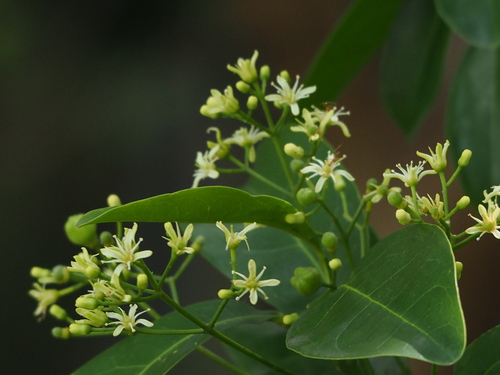
iNaturalist· cc-by-nc
(c) Leticia OS, some rights reserved (CC BY-NC)
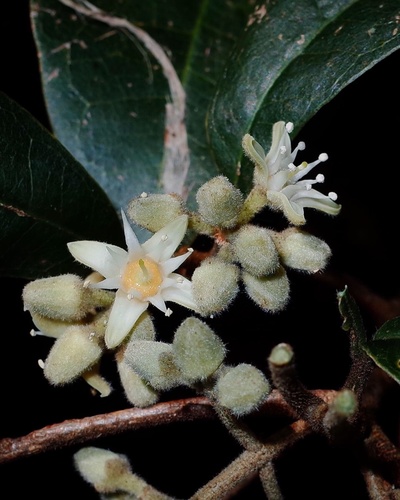
iNaturalist· cc-by-nc
(c) Leticia OS, some rights reserved (CC BY-NC)
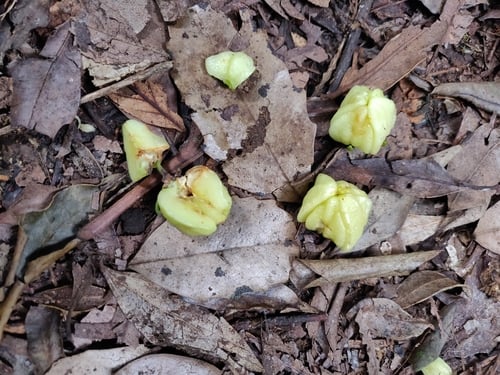
iNaturalist· cc-by-nc
(c) Leticia OS, some rights reserved (CC BY-NC)
Description
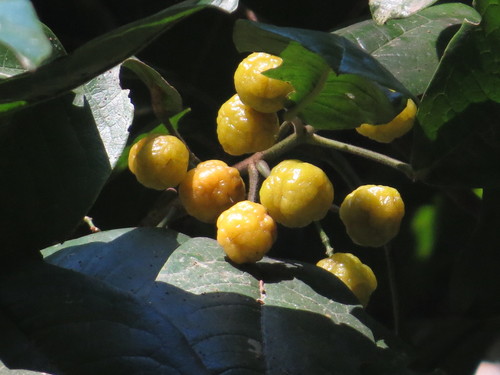
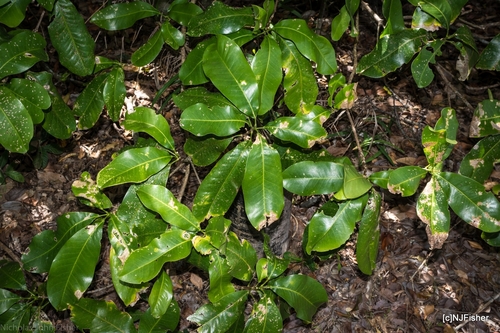
A shrub or low tree. It grows up to 7 m tall. The branches are almost without spines. The leaves are alternate and have only one lobe. The leaf stalk is 1 cm long. The blade is oval and 4-8 cm long by 2-4 cm wide. There are shallow rounded teeth along the edge. The flowers occur singly in the axils of leaves or in groups of 3-5 at the ends of branches. They are white and 2 cm across. They have a smell. The fruit are a flattened round berry. They are 1.5-3.5 cm across. They are shiny dark green when young and turn yellow-green when ripe. The skin is lumpy. The flesh is yellow and sour but with a sweet smell. The seed are long and pear shaped. They are 1 cm long by 0.5 cm wide.
Edible Uses
The leaves and fruit are used as flavorings.
Traditional Uses
The juice of the fruit has a sweet smell and is used to flavour dishes. The leaves are used as a flavouring.
This uses section is brief — help expand it
Distribution
A tropical plant. It grows from sea level up to 350 m altitude in Java.
Where It Grows
Asia, Indochina, Indonesia, SE Asia, Suriname, Thailand,
Other Information
Fruit are for sale in markets. It is a cultivated food plant.
Notes
There are 16-20 Citrus species. Several hybrids have been formed.
Synonyms
Also Known As
Dieruk lemon, Djeroek limo sambal, Djeruk limau, Jeruk limau, Jeruk limo, Jeruk sambal, Makrut, Vjerook leemo
References (11)
- Arora, R. K., 2014, Diversity in Underutilized Plant Species - An Asia-Pacific Perspective. Bioversity International. p 62
- Facciola, S., 1998, Cornucopia 2: a Source Book of Edible Plants. Kampong Publications, p 215
- Ind. vrucht. 217. 1927
- Hemphill, I, 2002, Spice Notes. Macmillan. p 212
- Martin, F.W. & Ruberte, R.M., 1979, Edible Leaves of the Tropics. Antillian College Press, Mayaguez, Puerto Rico. p 217
Show all 11 references Hide references
- Ochse, J. J. et al, 1931, Vegetables of the Dutch East Indies. Asher reprint. p 643
- PROSEA handbook Volume 13 Spices. p 250
- Seidemann J., 2005, World Spice Plants. Economic Usage, Botany, Taxonomy. Springer. p 105
- Solomon, C., 2001, Encyclopedia of Asian Food. New Holland. p 193, 220
- Sukenti, K., et al, 2016, Ethnobotanical study on local cuisine of the Sasak tribe in Lombok Island, Indonesia. Journal of Ethnic Foods. 3 (2016) 189-200 p 198
- Wiersema, J. H. & Leon, B., 2013, World Economic Plants. A Standard Reference CRC Press. 2nd Ed. p 179