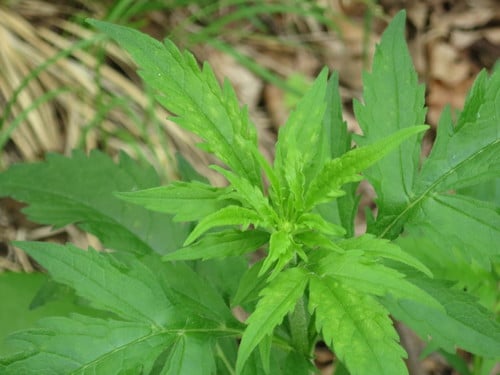
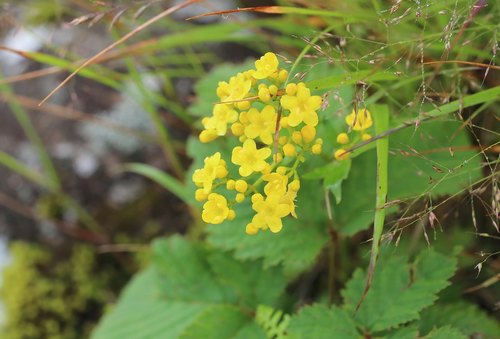
Lonicera involucrata
(Richardson) Banks ex Spreng.
Bearberry honeysuckle
iNaturalist· cc-by-nc
(c) aekurtz, some rights reserved (CC BY-NC), uploaded by aekurtz
iNaturalist· cc-by-nc
(c) Andrey Zharkikh, some rights reserved (CC BY-NC), uploaded by Andrey Zharkikh
iNaturalist· cc-by-nc
(c) Sadie Hickey, some rights reserved (CC BY-NC), uploaded by Sadie Hickey
Summary
Source: WikipediaLonicera involucrata, the bearberry honeysuckle, bracted honeysuckle, twinberry honeysuckle, Californian Honeysuckle, twin-berry, or black twinberry, is a species of honeysuckle native to northern and western North America.
Description
A deciduous shrub reaching 1.2 m (4ft) tall at medium rate. Flowers in May; seeds ripen July to September. Hardy to UK zone 4, not frost tender. Hermaphroditic flowers pollinated by insects. Grows in light, medium, or heavy soils with mildly acid to basic pH. Requires full sun and prefers moist soil. Tolerates strong winds but not maritime exposure.
Edible Uses
The fruit can be eaten raw or dried and has a pleasant taste, though it is not flavorful enough to be widely sought. One recorded sample had an incredibly bitter taste. The fruit is about 8mm in diameter.
Medicinal Uses
Twinberry was used medicinally by a number of native North American Indian tribes across a range of complaints, though it sees little or no use in modern herbalism. The bark is disinfectant, galactogogue, ophthalmic, and pectoral. A decoction of the bark is used for coughs and as an eyewash, and has also been applied to a woman's breasts to encourage milk flow. The bark has been used as a dressing on burns. The leaves are antipruritic and ophthalmic; chewed leaves are made into a poultice and applied to venereal sores, itchy skin, and boils, and a decoction of the leaves is used as an eyewash. The fruits are antidandruff, emetic, laxative, and pectoral. An infusion of the fruit treats chest and stomach complaints and is used to cleanse the body. Mashed fruit rubbed into the scalp has been used to treat dandruff.
Known Hazards
The berries are probably inedible by, and possibly poisonous to, humans despite sometimes being reported otherwise. Pacific Northwest Coast indigenous groups referred to them as 'monster food' and 'crow berry' for this reason.
Distribution
It is a temperate plant.
Where It Grows
North America, USA,
Propagation
Seed is best sown as soon as it is ripe in a cold frame. Stored seed requires 2 months of cold stratification and should then be sown in a cold frame as soon as possible. Prick seedlings into individual pots when large enough to handle and grow on in the greenhouse for at least their first winter, then plant out in late spring or early summer after the last expected frosts. Take half-ripe cuttings 7–10cm long with or without a heel in July/August in a frame; good success rate. Cuttings of mature wood from the current season's growth, 15–20cm with or without a heel, can be taken in November in a cold frame; good success rate. Layer in autumn.
Other Uses
A purple dye is obtained from the fruit, which turns grey when tin is used as a mordant. The berries are also rubbed onto the scalp as a hair tonic said to prevent greyness.
References (1)
- Kermath, B. M., et al, 2014, Food Plants in the Americas: A survey of the domesticated, cultivated and wild plants used for Human food in North, Central and South America and the Caribbean. On line draft. p 497