Desmodium incanum
DC.
Ironweed, Kaimi-clover
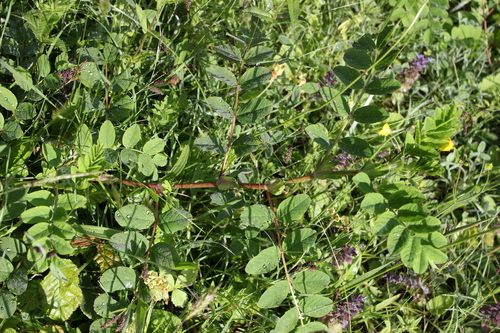
iNaturalist· cc-by-nc
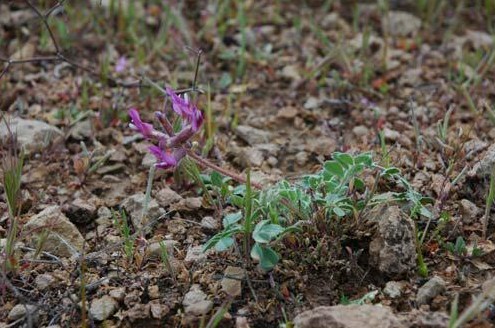
(c) faluke, some rights reserved (CC BY-NC), uploaded by faluke
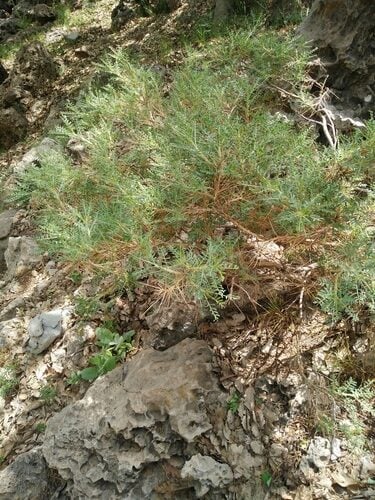
iNaturalist· cc-by-nc
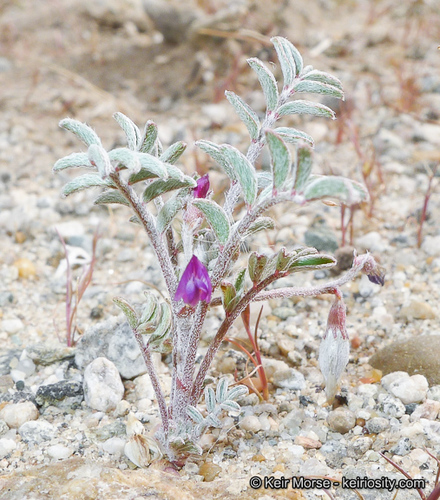
(c) Joe MDO, some rights reserved (CC BY-NC)
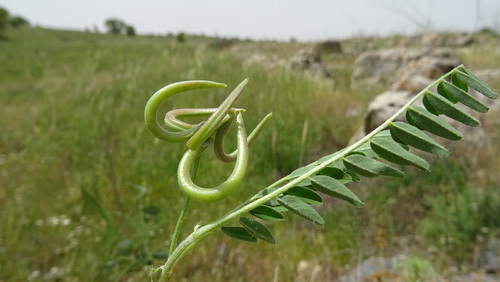
iNaturalist· cc-by-nc-sa
(c) Cody Hough, some rights reserved (CC BY-NC-SA)
Summary
Source: WikipediaThe Desmodium incanum of many older sources is actually Desmodium laxiflorum; see below. Desmodium incanum, also known as creeping beggarweed, Spanish clover, Spanish tick-trefoil or hitchhikers is a perennial plant native to Central and South America. In Hawaiʻi it is known as kaʻimi or kaimi clover from the Hawaiian for "seeker". Initially introduced as forage crop around the world, it has spread to many places although it is no longer an important fodder crop. It is considered a weed both within and outside its native range. It has spread through Florida and across the southern USA into southern Texas and across many Pacific islands, including Hawaiʻi. The plant has branched runners for reproduction. Its leaves are elliptic in shape and are hairy, and its flowers are pink to rose in color. Very frustrating in agriculture are its seedpods, which when ripe easily break off from the plant. They are also covered in sticky hairs (trichomes) that stick to any rough surface such as skin and hairs of animals and clothing thus aiding spreading. D. incanum is valuable for its ability to fix Nitrogen and thus increase soil fertility, thus it is commonly used as an intercrop. There has been long-standing confusion about the correct scientific name. This was long held to be Desmodium canum, and therefore for quite some time D. incanum was believed to be the correct name for the plant today called Desmodium laxiflorum.
Description
A herb. It keeps growing from year to year. It can be erect or lie over. The leaves have 3 leaflets. The flowers are purple.
This description is brief — help expand it
Edible Uses
The leaves and stems are made into tea.
Traditional Uses
The leaves and stems are made into tea.
This uses section is brief — help expand it
Medicinal Uses
The whole plant is used in the treatment of haemorrhages. Combined with congo pump (Cecropia sp.) and/or Leonotis nepetifolia, it is used to treat kidney defects. Combined with Asclepias curassavica and Phyllanthus amarus, it is used to treat womb ailments. Applied externally, the plant is used to treat wounds and cuts
Distribution
It is a subtropical plant. In Argentina it grows from sea level to 1,400 m above sea level.
Where It Grows
American Samoa, Argentina, Australia, Belize, Bolivia, Brazil, Cameroon, Caribbean, Central African Republic, CAR, Central America, Colombia, Congo DR, Congo R, Cook Is., Costa Rica, Cuba, Dominican Republic, Ecuador, El Salvador, Equatorial Guinea, Fiji, French Guiana, Gabon, Guinea, Guyana, Haiti, Hawaii, Honduras, Ivory Coast, Jamaica, Liberia, Madagascar, Mali, Marquesas, Mauritius, Mexico, New Caledonia, Nicaragua, Niue, Norfolk Is., North America, Pacific, Panama, Papua New Guinea, PNG, Paraguay, Peru, Puerto Rico, Reunion, Rotuma, Seychelles, Sierra Leone, South Africa, South America, St Helena, Suriname, Tanzania, Trinidad-Tobago, Tuvalu, Uganda, Uruguay, USA, Vanuatu, Venezuela, West Indies,
Cultivation
A plant of the moist tropics, where it is found at elevations up to 1,700 metres, though it does best below 300 metres. It grows best in areas where annual daytime temperatures are within the range 25 - 32°c, but can tolerate 7 - 36°c. When dormant, the plant can survive temperatures down to about -13°c, but young growth can be severely damaged at -1°c. It prefers a mean annual rainfall in the range 1,500 - 3,100mm, but tolerates 1,000 - 4,000mm. Plants can persist and even spread in areas receiving 1000mm. Prefers a sunny position, but can tolerate quite dense shade. Prefers a fertile, neutral to slightly alkaline soil, but may be grown on a wide range of soil types from sands to light clays. Tolerant of low-fertility soils. Prefers a well-drained soil, but can tolerate temporary inundation of the soil. Prefers a pH in the range 5 - 7, tolerating 4 - 8. One of the commonest weedy plants of many parts of the Central American lowlands, it has escaped from cultivation and become a weed in many areas outside its native range. Because of the abundant small uncinate hairs on most species, the seedpods cling most tenaciously to clothing, to any part of the human body, and also to the feathers and hair of various animals, thus ensuring a wide dispersal of the plants. In regions where it is naturalized, it is particularly common along roadsides, wasteland and other disturbed ground. There are conflicting reports on whether or not this species has a symbiotic relationship with certain soil bacteria, so it is unclear as to whether it fixes atmospheric nitrogen. Flowers are produced in about 90 days from seed s in north Queensland and in 51 - 81 days in Hawaii.
Propagation
Seed - best sown as soon as it is ripe. Stored seed develops a hard seedcoat and may benefit from scarification before sowing in order to speed up and improve germination. This can usually be done by pouring a small amount of nearly boiling water on the seeds (being careful not to cook them!) and then soaking them for 12 - 24 hours in warm water. By this time they should have imbibed moisture and swollen - if they have not, then carefully make a nick in the seedcoat (being careful not to damage the embryo) and soak for a further 12 hours before sowing. The seed usually germinates within 1 - 4 months at 25°c. Prick out the seedlings into individual pots once they are large enough to handle and grow them on until large enough to plant out. Cuttings of half-ripe wood with a heel. Division. Larger clumps can be replanted direct into their permanent positions, though it is best to pot up smaller clumps and grow them on until they are rooting well. Root cuttings.
Synonyms
Also Known As
Ambrosia, Carrapicho
References (4)
- Franklin, J., Keppel, G., & Whistler, W., 2008, The vegetation and flora of Lakeba, Nayau and Aiwa Islands, Central Lau Group, Fiji. Micronesica 40(1/2): 169–225, 2008
- Kermath, B. M., et al, 2014, Food Plants in the Americas: A survey of the domesticated, cultivated and wild plants used for Human food in North, Central and South America and the Caribbean. On line draft. p 302
- Kew Plants of the World Online
- Thaman, R. R, 2016, The flora of Tuvalu. Atoll Research Bulletin No. 611. Smithsonian Institute p 90