Cissus verticillata
(L.) Nicolson & C. E. Jarvis
Possum grape
iNaturalist· cc-by-nc
(c) sloanheartsill, some rights reserved (CC BY-NC), uploaded by sloanheartsill
iNaturalist· cc-by-nc
(c) Barry Sullender, some rights reserved (CC BY-NC), uploaded by Barry Sullender
iNaturalist· cc-by
(c) Leonel Roget, some rights reserved (CC BY), uploaded by Leonel Roget
Summary
Source: WikipediaCissus verticillata, the princess vine or seasonvine, is an evergreen perennial vine in the grapevine family Vitaceae. It grows primarily in tropical regions near sea level, including many locations in the Caribbean region.
Description
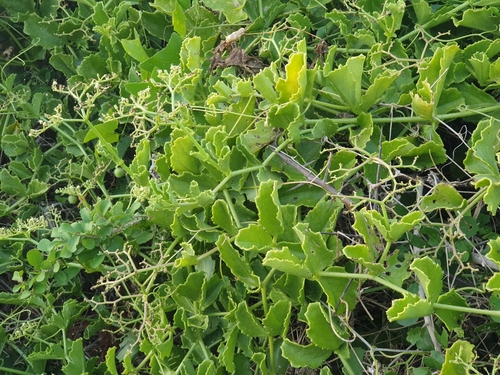
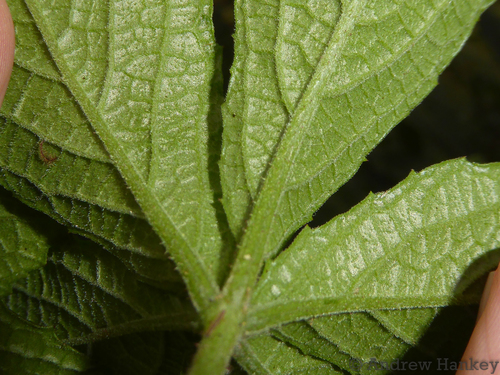
A vine. It can be 10 m long. It climbs by means of tendrils. The stems are fleshy and cylinder shaped but become flattened when mature. They can be 5 cm across. It is swollen at the nodes. The leaves are alternate and 5-12 cm long by 4-7 cm wide. The leaves are heart shaped and have teeth along the edge. Leaves can have lobes. The flowers are in groups opposite the leaves. They are yellow to pink. The fruit are round and up to 1 cm across. They are shiny and dark purple to black. There are 1 or 2 seeds.
Edible Uses
Both the roots and fruit are edible.
Medicinal Uses
Historical folk medicine recommendations [for the use of this plant] include [for] "weakness of the stomach", fevers and antiepileptic action. The root bark was also chewed "to strengthen teeth".
Distribution
It is a subtropical plant. In Argentina it grows from sea level to 2,500 m above sea level.
Where It Grows
Antilles, Argentina, Aruba, Asia, Bahamas, Bangladesh, Belize, Bermuda, Bolivia, Brazil*, Caribbean, Central America, Chile, Colombia, Cook Is., Costa Rica, Cuba, Dominican Republic, Ecuador, El Salvador, French Guiana, Guatemala, Guyana, Haiti, Hawaii, Honduras, India, Jamaica, Leeward Is., Mexico, Nicaragua, North America, Panama, Paraguay, Peru, Puerto Rico, South America, Suriname, Taiwan, Trinidad-Tobago, Uruguay, USA, Venezuela, West Indies,
Cultivation
Called 'picamano' in Honduras and 'bejuco loco' in Tabasco. This is one of the most common and widely distributed of tropical American plants. It exhibits a great deal of variation in pubescence and leaf form, as a result of which numerous varieties have been named. Perhaps someone may find a basis for separating satisfactorily some of these forms, but with present material the lines of division are vague.
Other Uses
The stems and roots are thick, tough and very flexible. They are often used as cordage and, in Costa Rica, baskets are made from them. The leaves, when macerated in water, give a suds like that of soap, which is sometimes utilized for washing clothes.
Synonyms
Also Known As
Anil-trepador, Bejuco de caro, Caavurana, Carabo coati, Caro, Cipo-anil, Cipo-puca, Diabetil, Insulina, Lambrali, Parreira-brava, Pinna koop, Puddin vine, Quebra-barreira, Tinta-de-gentio, Tripa de vaca, Uva-do-mato
References (13)
- Alimenticias - FloraSBS
- Brack, P., et al, 2020, Frutas nativas do Rio Grande do Sul, Brasil: riqueza e potencial alimentício. Native fruits of Rio Grande do Sul, Brazil: richness and potential as food. Rodriguésia 71: e0310201
- Kermath, B. M., et al, 2014, Food Plants in the Americas: A survey of the domesticated, cultivated and wild plants used for Human food in North, Central and South America and the Caribbean. On line draft. p 233
- Kew Plants of the World Online
- Kinupp, V. F., 2007, Plantas alimenticias nao-convencionais da regiao metropolitana de Porto Alegre, RS, Brazil p 107
Show all 13 references Hide references
- Maas, P.J. M., Non-Timber Forest Products of the North-West District of Guyana Part 2. The 85 most important NTFP species. p 60
- Rashid, M. H., et al, 2013, Inventory of Threatened Plants of Bangladesh and their Conservation Management. International Journal of Environment. Vol. 3 No. 1 p 156
- Roa, J. A. G. & Boada, D. S. G., 2018, Fundación para el Fortalecimiento de la Fruticultura y Plantas Alimenticias no Convencionales en Colombia.
- Scarpa, G. F., 2009, Wild food plants used by the indigenous peoples of South American Gran Chaco: A general synopsis and intercultural comparison. Journal of Applied Botany and Food Quality 83:90-101
- Segura, S., et al, 2018, The edible fruit species in Mexico. Genet Resour Crop Evol (2018) 65:1767–1793
- www.colecionandofrutas.org
- Yang, R, et al, 2008, Content and distribution of flavonoids among 91 edible plant species. Asia Pac J Clin Nutr 2008;17(S1):275-279 (As Cissus sicyoides)
- Zambrana, P, et al, 2017, Traditional knowledge hiding in plain sight – twenty-first century ethnobotany of the Chácobo in Beni, Bolivia. Journal of Ethnobiology and Ethnomedicine (2017) 13:57 (As Cissus sicyoides)