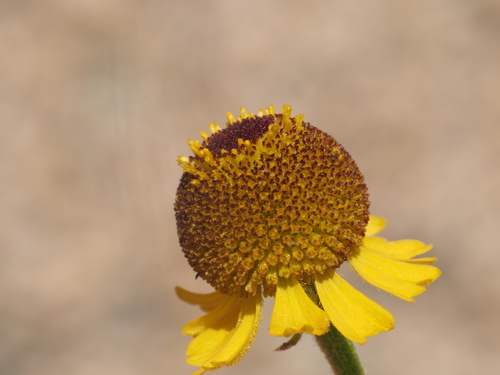
Cirsium pallidum
Wooton. & Standl.
Pale thistle
iNaturalist· cc-by-nc
(c) Kenneth Bader, some rights reserved (CC BY-NC)
iNaturalist· cc-by-nc
(c) Di Ran, some rights reserved (CC BY-NC)
iNaturalist· cc-by-nc
(c) Sequoia Janirella Wrens, some rights reserved (CC BY-NC)
Summary
Source: WikipediaA biennial thistle growing to 1 m tall by 0.5 m wide, hardy to UK zone 5. Hermaphroditic, pollinated by bees, flies, moths, butterflies, and beetles. Self-fertile and suitable for light, medium, or heavy soils with mildly acid to basic pH. Requires full sun and prefers moist soil. Flowers mid- to late summer at high elevations; seeds mature late summer through early autumn.
Description
A biennial thistle growing to 1 m tall by 0.5 m wide, hardy to UK zone 5. Hermaphroditic, pollinated by bees, flies, moths, butterflies, and beetles. Self-fertile and suitable for light, medium, or heavy soils with mildly acid to basic pH. Requires full sun and prefers moist soil. Flowers mid- to late summer at high elevations; seeds mature late summer through early autumn.
Edible Uses
A seed-focused edible thistle, useful primarily for its nutritious, toastable seeds. Edible Uses & Rating: The seeds are the primary edible part and represent the main value of this species. Roots are not considered edible and are generally lacking in the thick, starchy taproots seen in biennial thistles. Stems and leaves are technically edible but are impractical due to spines and poor texture. As a food plant, Parry’s thistle ranks as a moderate-quality wild food, valuable mainly as a seed source. Taste, Processing & Kitchen Notes: Parry’s thistle seeds are enclosed within hard cypselae topped with feathery pappi. When raw, the flavor is bland to mildly bitter. Toasting significantly improves palatability by weakening the shells and reducing bitter resins. Toasted seeds develop a nutty, roasted flavor and can be eaten whole, with the shells either swallowed or spat out. Boiling produces a soft, porridge-like consistency, especially if shells are included, yielding a bran-like texture. Seasonality (Phenology): Flowering typically occurs in mid- to late summer at high elevations. Seeds mature from late summer into early autumn and may persist on the plant for several weeks, extending the harvest window. Safety & Cautions (Food Use): Spines are sharp and require careful handling. Gloves are recommended during harvest. As with all thistles, proper identification is essential. Harvest & Processing Workflow: Harvest seed heads once they dry and begin to loosen. Remove pappi by rubbing or winnowing. Toast seeds gently in a covered pan to prevent scattering. Consume whole or grind lightly after cooking. Cultivar/Selection Notes: No cultivars are known. Look-Alikes & Confusion Risks: Parry’s thistle resembles other montane Cirsium species. Confusion is generally harmless, as most native thistles have similar edible uses, but avoid non-Cirsium thistle-like plants such as knapweeds (Centaurea). Traditional / Indigenous Use Summary: Seeds were reportedly gathered by Navajo and other southwestern Indigenous groups, though documentation is limited. The focus on seeds rather than roots distinguishes this species from many other thistles. Seed - cooked. It can be eaten boiled or ground into a powder and used with cereal flours to make bread etc. Parry’s thistle (Cirsium parryi), also called Mogollon, Cloudcroft, Gila, or pale thistle, is native to the mountains of the southwestern United States. Unlike most thistles, which have edible roots, stems, or receptacles, the only reported edible part of this species is its seeds. The seeds are enclosed in dry fruits (cypselae) topped with hairy plumes. They are a concentrated source of calories, though often bitter from resins. Traditionally, thistle seeds could be toasted to mask bitterness, eaten whole in their shells, or boiled into a mush. While they are small and tedious to gather, Parry’s thistle seeds—like those of other thistles—were valued for their energy content, especially in survival or subsistence contexts. Other parts of this species are not reported as food, making it unusual within its genus, where roots and stems are often useful.
Traditional Uses
The seeds are cooked and eaten and also made into flour.
This uses section is brief — help expand it
Medicinal Uses
The roots are diuretic.
Known Hazards
Spines are sharp and require careful handling. Gloves are recommended during harvest. As with all thistles, proper identification is essential.
Distribution
It is a temperate plant.
Where It Grows
North America, USA,
Cultivation
Parry’s thistle is a specialized montane thistle offering nutritious seeds rather than roots. While not as versatile as other thistles, it remains a dependable wild food in mountain regions. Growing Conditions: Parry’s thistle prefers cool, moist mountain environments with well-drained soils. It commonly occurs in open meadows, forest clearings, and montane slopes, often associated with ponderosa pine, fir, or spruce communities. Habitat & Range: This species is native to the mountainous regions of Arizona, New Mexico, and adjacent areas of Colorado. It is most common at mid- to high elevations in the Mogollon Rim, Gila Mountains, and similar ranges. Size & Landscape Performance: Plants usually reach 50–80 cm in height but may grow taller in favorable conditions. It occurs as scattered individuals or small groups rather than dense stands. Cultivation (Horticulture): Parry’s thistle is not cultivated and has no ornamental or agricultural value. It is primarily of interest to foragers and botanists. Pests & Problems: Parry’s thistle is relatively pest-free. Harsh mountain climates and spines deter most herbivores. Pollination: Pollinated by bees and other generalist insects adapted to high-elevation environments. Identification & Habit: Parry’s thistle typically forms a basal rosette of large, deeply lobed leaves during its first growing season. Leaves are pale green to grayish and armed with stout spines along the margins. In its reproductive stage, the plant produces one or more erect flowering stems bearing large, showy flower heads. The flowers are usually pale lavender to whitish-purple, giving rise to the common name “pale thistle.” The involucral bracts are strongly spined, and the overall plant has a lighter, more silvery appearance than many lowland thistles.
Propagation
Sow seed in early spring or autumn in situ. Germination usually takes place within 2–8 weeks at 20°C. Can also be propagated by division in spring or autumn.
Other Uses
The seed, as with all thistle species, yields a good oil by expression. No details of potential yields are given.
Notes
There are about 150-250 Cirsium species. They grow in temperate regions.
Synonyms
Also Known As
Parry’s thistle (Cirsium parryi), also called Mogollon, Cloudcroft, Gila, or pale thistle
References (2)
- Kermath, B. M., et al, 2014, Food Plants in the Americas: A survey of the domesticated, cultivated and wild plants used for Human food in North, Central and South America and the Caribbean. On line draft. p 231
- Plants for a Future database, The Field, Penpol, Lostwithiel, Cornwall, PL22 0NG, UK. http://www.scs.leeds.ac.uk/pfaf/