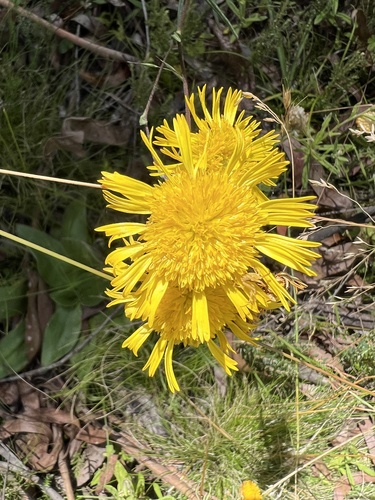
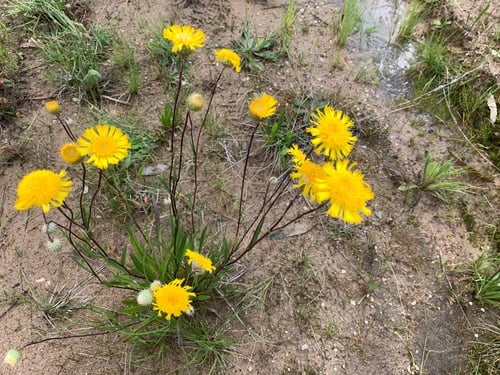
Crepis capillaris
(L.) Wallr.
Smooth hawksbeard
iNaturalist· cc-by
(c) Jacqui Geux, some rights reserved (CC BY), uploaded by Jacqui Geux
iNaturalist· cc-by-nc
(c) Finn McGhee, some rights reserved (CC BY-NC)
Summary
Source: WikipediaCrepis capillaris, the smooth hawksbeard, is a species of flowering plant in the tribe Cichorieae within the family Asteraceae, and is native to Europe. It has become naturalized in other lands and is regarded as a weed in some places. Crepis capillaris is a low, annual plant common in disturbed ground and open habitats, such as thin grassland, lawns, spoil heaps, rocky banks and on roadsides, the stems often trailing along the ground but sometimes erect, the leaves sometimes forming a rosette. It flowers from June to December in the Northern Hemisphere, producing an array of numerous small flower heads. Each head has as many as 60 yellow ray florets but no disc florets.
Description
An erect herb. It can grow each year from seed or take 2 years to complete its life-cycle. It grows 75 cm high. The upper leaves clasp the stem. The flowers are yellow.
Edible Uses
The leaves are eaten raw or cooked and are commonly used in stews and soups.
Traditional Uses
The leaves are eaten both raw and cooked. They are used in stews and soups.
This uses section is brief — help expand it
Distribution
It grows in warm temperate places. In Argentina it grows up to 1,500 m above sea level. Tasmania Herbarium.
Where It Grows
Argentina, Australia, Balkans, Bosnia, Canada, Chile, Easter Island, Europe, Falklands, Hawaii, Ireland, Italy, Luxembourg, Mediterranean, North America, Pacific, Slovenia, South Africa, South America, Spain, Switzerland, Tasmania, Uruguay,
Synonyms
Also Known As
Almiron, Cassella, Cassellora, Crepide capillaire, Lasasti dimek, Tassela, Tassellora
References (11)
- Blanco-Salas, J., et al, 2019, Wild Plants Potentially Used in Human Food in the Protected Area “Sierra Grande de Hornachos” of Extremadura (Spain). Sustainability 2019, 11, 456
- Erst. Beitr. Fl. hercyn. 287. 1840 (Linnaea 14:657. 1841)
- Facciola, S., 1998, Cornucopia 2: a Source Book of Edible Plants. Kampong Publications, p 37
- Kew Plants of the World onLine
- Paoletti, M.G., Dreon, A.L., and Lorenzoni, G.G., 1995, Pistic, Traditional Food from Western Friuli, NE Italy. Economic Botany 49(1) pp 26-30
Show all 11 references Hide references
- Paczkowska, G. & Chapman, A.R., 2000, The Western Australian Flora. A Descriptive Catalogue. Western Australian Herbarium. p 161
- Pieroni, A., 1999, Gathered wild food plants in the Upper Valley of the Serchio River (Garfagnana), Central Italy. Economic Botany 53(3) pp 327-341
- Redzic, S., 2010, Use of Wild and Semi-Wild Edible Plants in Nutrition and Survival of People in 1430 Days of Siege of Sarajevo during the War in Bosnia and Herzegovina (1992–1995). Coll. Antropol 34 (2010) 2:551-570
- Tasmanian Herbarium Vascular Plants list p 6
- Upson, R., & Lewis R., 2014, Updated Vascular Plant Checklist and Atlas for the Falkland Islands. Falklands Conservation and Kew.
- Zizka, G., 1991, Flowering Plants of Easter Island. Palmarum Hortus Francofurtensis