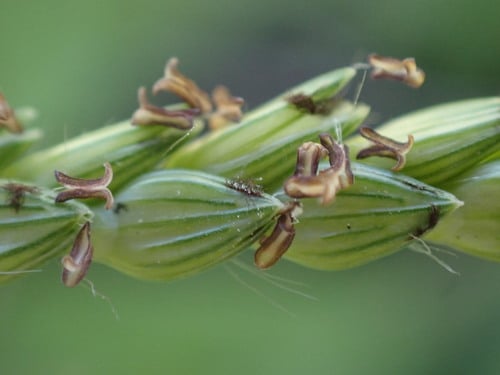
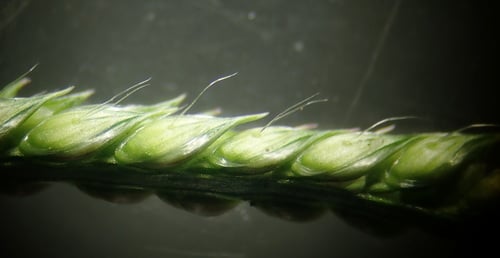
Gigantochloa ligulata
Gamble
iNaturalist· cc-by-nc
(c) Ingkayut Sa-ar, some rights reserved (CC BY-NC), uploaded by Ingkayut Sa-ar
gbif· cc0
President and Fellows of Harvard College
Description
A bamboo. It grows 6-7 m tall. The stems are 2-3 cm across. The young internodes and stout dark hairs and soft white hairs. The stems are green and can be streaked with lighter green. The culm sheaths are 22 cm long and thin.
Edible Uses
Young shoots - cooked. Considered as delicious in northern Peninsular Malaysia. Although small, they are of good edible quality.
Distribution
It is a tropical plant. In Thailand it grows up to 600 m above sea level. It is usually in disturbed sites.
Where It Grows
Asia, Indochina, Malaysia, SE Asia, Thailand,
Cultivation
The plant is found mainly on sandy soils in the wild. A mature clump usually contains 30 - 40 culms (though this can range from 15 - 70), and usually produces 13 - 15 young shoots per year. Bamboos have an interesting method of growth. Each plant produces a number of new stems annually - these stems grow to their maximum height in their first year of growth, subsequent growth in the stem being limited to the production of new side branches and leaves. In the case of some mature tropical species the new stem could be as much as 30 metres tall, with daily increases in height of 30cm or more during their peak growth time. This makes them some of the fastest-growing species in the world. Bamboos in general are usually monocarpic, living for many years before flowering, then flowering and seeding profusely for a period of 1 - 3 years before usually dying. Bamboos in general are usually monocarpic, living for many years before flowering, then flowering and seeding profusely for a period of 1 - 3 years before usually dying. This pattern can vary - sometimes flowering is sporadic, with plants flowering annually and not dying; at other times it is gregarious with all the plants in a specific species coming into flower at the same time. Sporadic flowering in this species is quite often seen, but gregarious flowering of whole clumps has rarely been reported and gGregarious flowering of many clumps over large areas has never been observed. The flowering cycle is still not properly known, but in a case of gregarious flowering in Kedah the flowering period lasted 6 months, after which the clump died. This is a very variable species that still needs further investigation. Roughly, two groups of specimens can be distinguished (unnamed): one with medium-sized, thick-walled culms with 2 perfect florets in the pseudospikelets and another with larger culms, larger culm-sheath ligules and 3 - 4 perfect florets in the pseudospikelets (the vernacular names for the latter group in Peninsular Malaysia are: buloh bilalai, buloh gala, buloh mata rusa).
Propagation
Seed - About 8 weeks after sowing, the first culm of a seedling is 13cm tall with 5 - 6 expanded leaves.
Other Uses
The slender, thick-walled culms are used to frame chairs, tables and screens, as walking sticks and as poles for vegetable support. They are used for rural construction, agricultural implements and as raw material for paperpulp. Although the culms are thick-walled or often even solid, they can be bent easily.
Other Information
It is cultivated.
Also Known As
Buloh bilalai, Buloh tikus, Buluh tumpat, Phai lai, Phai nae, Phai pau lai, Phai tam phra
References (3)
- Arora, R. K., 2014, Diversity in Underutilized Plant Species - An Asia-Pacific Perspective. Bioversity International. p 103
- Azmy, H. M. & Appanah. S., Bamboo resources conservation and utilization in Malaysia. www.bioversityinternational.org
- Zeven, A. C. & de West, J. M. J., 1982, Dictionary of cultivated plants and their regions of diversity. Wageningen. p 53