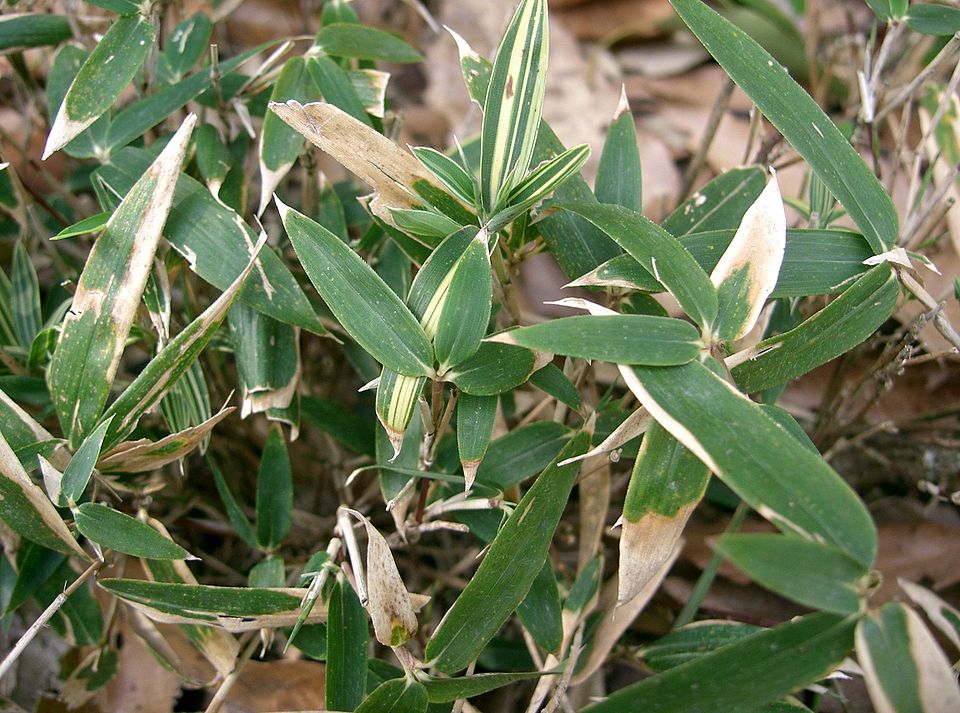
Saccharum arundinaceum
Retz.
Teberau
iNaturalist· cc-by-nc
(c) djwu, some rights reserved (CC BY-NC)
iNaturalist· cc-by-nc
(c) symlpocos, some rights reserved (CC BY-NC)
iNaturalist· cc-by-nc
(c) Hong, some rights reserved (CC BY-NC)
Description
A grass. It grows 3.6 m tall. The stems are 2.5 cm wide. The leaves are narrow and 1.8 m long by 5 cm wide. They have a stout midrib. The flowering shoots are compact and 90 cm long. They have silky hairs and are white to pink.
Edible Uses
The young shoots and leaf buds are eaten in salads.
Traditional Uses
The young shoots or leaf buds are eaten in salads.
This uses section is brief — help expand it
Medicinal Uses
The plant is used medicinally.
Distribution
It is a tropical plant. It grows along river banks. It is often on sandy soil. In Sichuan and Yunnan.
Where It Grows
Asia, Bhutan, Cambodia, China, Himalayas, India, Indochina, Indonesia, Laos, Malaysia, Myanmar, SE Asia, Singapore, Sri Lanka, Taiwan, Thailand, Tibet, Vietnam,
Cultivation
A plant of the subtropics to tropics, it can also succeed in warm temperate areas. Plants can withstand periodic inundation. A vigorous plant, it can spread and become invasive.
Other Uses
The leaf sheathes are a source of fibre, known as 'Munj fibre'. Strong and elastic, it has the wonderful power of enduring moisture without decaying. It is used for making cloth, cordage, ropes, mats etc. The mats are reported to be proof against white ants, but are hard on shoe-leather, harsh to the foot and fatiguing when walked on for any length of time. The leaf blades, and also the flowering stems, are used for thatching. The stems are used for making chairs, stools, baskets, screens etc. The leaf blades are used as a material for making paper. The internodal part of the culm is hardened and then cut into implements for writing. The culms are used like bamboo for construction purposes. Often planted as a hedge around betel pepper gardens. It is frequently planted in lines or dividing hedges, especially in low-lying localities subject to periodic inundation.
Synonyms
Also Known As
Bok-kaing, Paung-sa, Phaung-kaing, Pyaung-kaing, Sit-kaing, Tebu salah
References (1)
- World Checklist of Useful Plant Species 2020. Royal Botanic Gardens, Kew