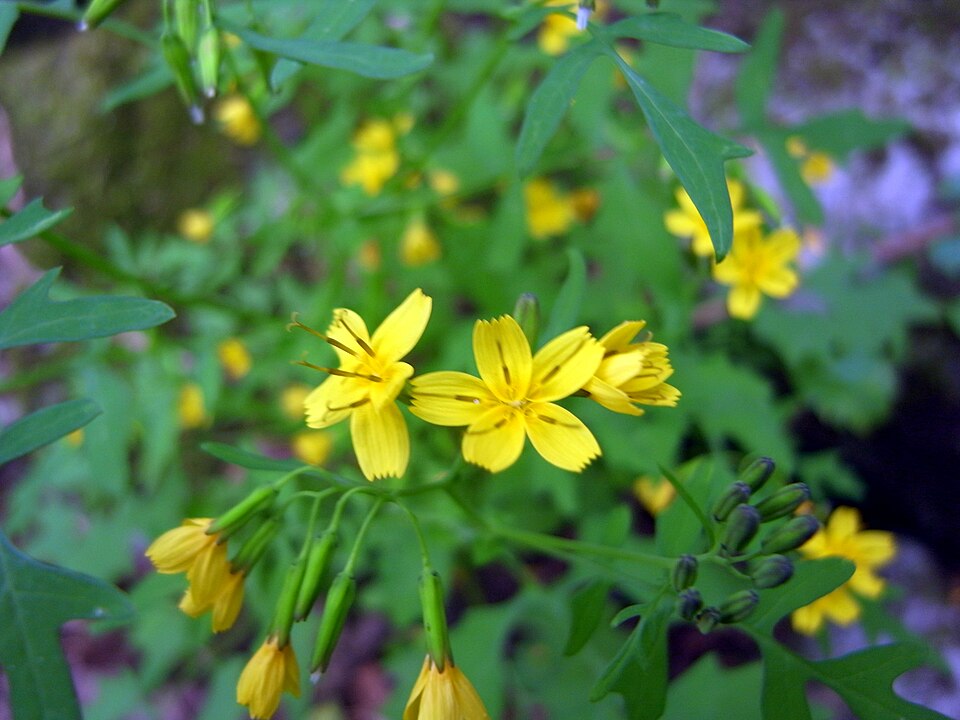
Cirsium brevistylum
Cronq.
Indian thistle
iNaturalist· cc-by-nc
(c) Stewart Wechsler, some rights reserved (CC BY-NC)
iNaturalist· cc-by-nc
(c) Stewart Wechsler, some rights reserved (CC BY-NC)
iNaturalist· cc-by-nc
(c) Stewart Wechsler, some rights reserved (CC BY-NC)
Summary
Source: WikipediaCirsium brevistylum is a species of thistle known by the common names Indian thistle and clustered thistle. It is native to western North America having been found in southwestern British Columbia, Washington, Oregon, Idaho, Montana, and California. Cirsium brevistylum grows in moist areas in many types of habitat, from mountain forests to chaparral and coastal marshes. This native thistle is annual or biennial, reaching 200 cm (79 in) in height and known to exceed 300 cm (9.8 ft) at times. There is usually a single stem which may branch toward the top and is coated in hairs and webby fibers. The leaves are deeply cut into many lobes lined with twisted teeth, the longest leaves near the base of the plant reaching about 25 centimeters long. The leaves are borne on winged petioles with many spines. The inflorescence bears one to many flower heads, both at the ends of the stem branches and in the leaf axils. The flower head reaches about 3 centimeters long by 4 wide and is lined with cobwebby, bristly, spine-tipped phyllaries. The flower head is packed with white or pink flowers about 2 centimeters long. The fruit is a brown achene a few millimeters long topped with a pappus one to two centimeters in length.
Description
A herb. It is a robust thistle. It grows 90-250 cm high. It can grow fro 2 years or continue to grow for a few years. It has a thick taproot. The leaves in the first years from a ring near the base. The flower stems grow in the second year. The leaves and flower heads are spiny. The flowers are purplish-red.
Edible Uses
The root can be peeled and eaten raw or cooked, and is considered one of the more palatable thistle roots. The thick, carrot-like taproot is likely rich in inulin, a starch indigestible to humans that passes through the digestive system unchanged and may ferment in some people, causing flatulence. The stem can be eaten after peeling and is also among the more palatable parts of any thistle. The flowerheads have been chewed to obtain the nectar. Seed oil can be extracted by expression.
Traditional Uses
The taproot is eaten raw or steamed.
This uses section is brief — help expand it
Medicinal Uses
None known.
Distribution
It is a temperate plant. It grows in moist clearings and in valleys.
Where It Grows
Canada, North America, USA,
Cultivation
We have very little information on this species and do not know if it will be hardy in Britain, though judging by its native range it should succeed outdoors in many parts of this country. The plant is a short-lived perennial, and is often biennial. The following notes are based on the general needs of the genus. An easily grown plant, succeeding in any ordinary garden soil in a sunny position.
Propagation
Sow seed in early spring or autumn in situ. Germination usually occurs within 2–8 weeks at 20°C.
Other Uses
The seeds yield a good oil by expression, as with all thistle species, though no yield details are available. The seed floss has been spun together with the inner bark of yellow cedar (Chamaecyparis notkatensis) to make clothing for babies.
Notes
There are about 150-250 Cirsium species. They grow in temperate regions.
References (4)
- MacKinnon, A., et al, 2009, Edible & Medicinal Plants of Canada. Lone Pine. p 368
- Plants for a Future database, The Field, Penpol, Lostwithiel, Cornwall, PL22 0NG, UK. http://www.scs.leeds.ac.uk/pfaf/
- Tozer, F., 2007, The Uses of Wild Plants. Green Man Publishing. p 69
- Turner, N., 1995, Food Plants of Coastal First Peoples. Royal BC Museum Handbook p 60