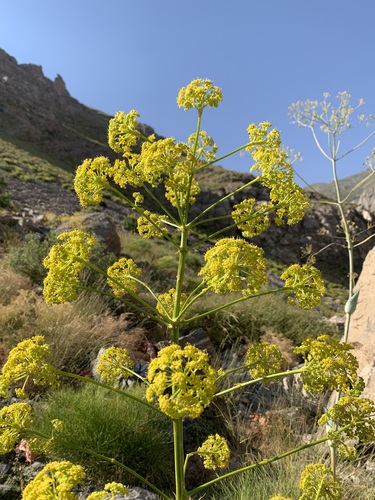
Ciclospermum leptophyllum
(Pers.) Sprague
Slender celery
iNaturalist· cc-by-nc
(c) lesleyvh, some rights reserved (CC BY-NC)
iNaturalist· cc-by-nc
(c) lesleyvh, some rights reserved (CC BY-NC)
iNaturalist· cc-by-nc
(c) Ivelisse Irizarry, some rights reserved (CC BY-NC)
Description
A slender erect herb. It grows 60 cm high. The leaves are divided along the stalk 2-4 times. It is like Apium prostratum but the leaf segments are narrow. The final segments are narrow and 5-15 mm long by 0.5-1 mm wide. The flower umbels can be simple or compound and with or without stalks. The fruit are rounded and 1.5-3 mm long.
Edible Uses
Both the leaves and stalks are edible.
Distribution
It is a tropical plant. It grows along the banks of streams.
Where It Grows
Africa, Australia, Brazil, Central America, Dominican Republic, Eswatini, Haiti, Hawaii, Norfolk Island, Pacific, South Africa, Southern Africa, Swaziland, Tonga, West Indies,
Notes
There are 2 or 3 Ciclospermum species.
Synonyms
References (10)
- Bodkin, F., 1991, Encyclopedia Botanica. Cornstalk publishing, p 91 (As Apium leptophyllum)
- Checklist of NT Vascular Plant Species. January 2003. Elliot, W.R., & Jones, D.L., 1982, Encyclopedia of Australian Plants suitable for cultivation. Vol 2. Lothian. p 215 (As Apium leptophyllum)
- Flora of Australia Volume 49, Oceanic Islands 1, Australian Government Publishing Service, Canberra. (1994) p 270
- Hussey, B.M.J., Keighery, G.J., Cousens, R.D., Dodd, J., Lloyd, S.G., 1997, Western Weeds. A guide to the weeds of Western Australia. Plant Protection Society of Western Australia. p 80
- Lazarides, M. & Hince, B., 1993, Handbook of Economic Plants of Australia, CSIRO. p 22 (As Apium leptophyllum)
Show all 10 references Hide references
- Lazarides, M. & Hince, B., 1993, Handbook of Economic Plants of Australia, CSIRO. p 60
- Long, C., 2005, Swaziland's Flora - siSwati names and Uses http://www.sntc.org.sz/flora/
- Low, T., 1992, Bush Tucker. Australia’s Wild Food Harvest. Angus & Robertson. p 180
- Swaziland's Flora Database http://www.sntc.org.sz/flora
- Yuncker, T.G., 1959, Plants of Tonga, Bernice P. Bishop Museum, Hawaii, Bulletin 220. p 208 (As Apium leptophyllum)