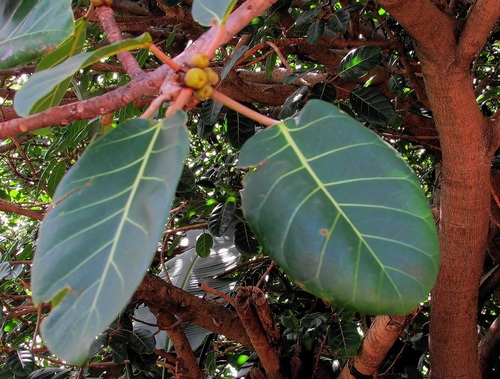
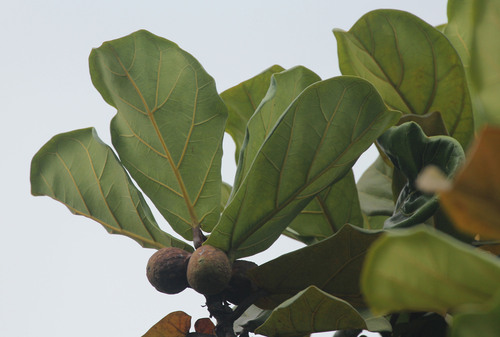
Artocarpus nitidus subsp. lingnanensis
(Merr.) F. M. Jarrett
Betau jackfruit tree
gbif· cc-by-nc
University of Cincinnati, Margaret H. Fulford Herbarium - Vascular Plants (CINC)
gbif· cc-by
Royal Botanic Gardens, Kew
gbif· cc-by
Royal Botanic Gardens, Kew
Description
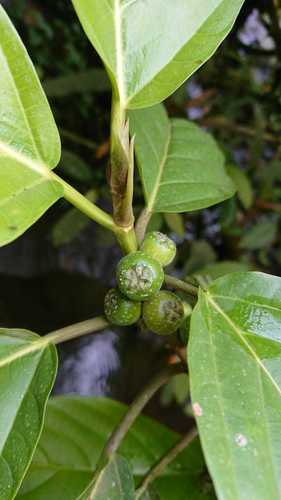
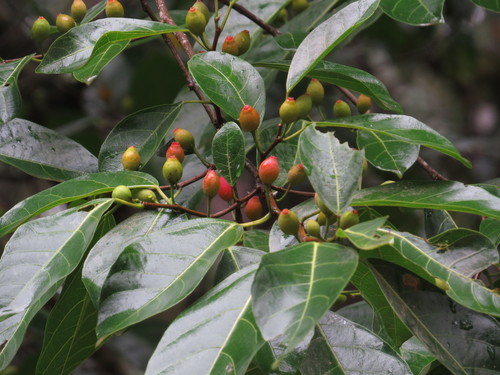
A tree. It grows 17-35 m tall. It can have buttresses. The leaf blade is narrowly oval and 7-15 cm long by 3-7 cm wide. They are thinly leathery with a wedge shaped base. There can be irregular shallow teeth along the edge. Male and female flowers are separate. The fruit are red when ripe.
Edible Uses
Several species in the genus bear edible fruit and are commonly cultivated: Breadfruit (Artocarpus altilis), Cempedak (Artocarpus integer), Jackfruit (Artocarpus heterophyllus), Kwai Muk (Artocarpus parvus), Lakoocha (Artocarpus lakoocha), Pudau (Artocarpus kemando), Anjily (a.k.a. Jungle Jack) (Artocarpus hirsutus), Chaplaish (Artocarpus chama), and Marang (Artocarpus odoratissimus). Breadfruit and jackfruit are cultivated widely in the tropical Southeast Asia. Other species are cultivated locally for their timber, fruit or edible seeds. Anjily, A. hirsutus, is grown for fruit and timber in the Western Ghats.
Traditional Uses
The fruit are eaten raw.
This uses section is brief — help expand it
Distribution
It is a tropical plant. It grows in mixed forests in southern China. In Indonesia it grows in evergreen forests up to 1,600 m above sea level. In Yunnan in China it grows between 800-1300 m altitude. It grows in secondary forest. In Rockhampton Botanical Gardens.
Where It Grows
Asia, Australia, Cambodia, China, Indochina, Indonesia, Malaysia, Pacific, Papua New Guinea, PNG, Philippines, SE Asia, Solomon Islands, Thailand, USA, Vietnam,
Cultivation
Plants can be grown from seed.
Other Information
It is a cultivated plant.
Synonyms
Also Known As
Kwai muk, Maeloozha, Pohon nangka betau, Sambour, Sampor
References (5)
- Flora of China Vol. 5. p 33
- Jin, Chen et al, 1999, Ethnobotanical studies on Wild Edible Fruits in Southern Yunnan: Folk Names: Nutritional Value and Uses. Economic Botany 53(1) pp 2-14 (As Artocarpus lingnanensis)
- Rollins, C. B., 1987, The Role of the Fruit & Spice Park in Popularization and Dissemination of Tropical Fruit in South Florida. Proc. Fla. State Hort. Soc. 100:323-327
- Sukarya, D. G., (Ed.) 2013, 3,500 Plant Species of the Botanic Gardens of Indonesia. LIPI p 138
- Turreira Garcia, N., et al, 2017, Ethnobotanical knowledgeof the Kuy and Khmer people in Prey Lang, Cambodia. Cambodian Journal of Natural History 2017 (1): 76-101