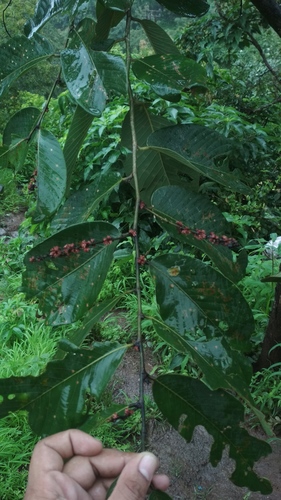
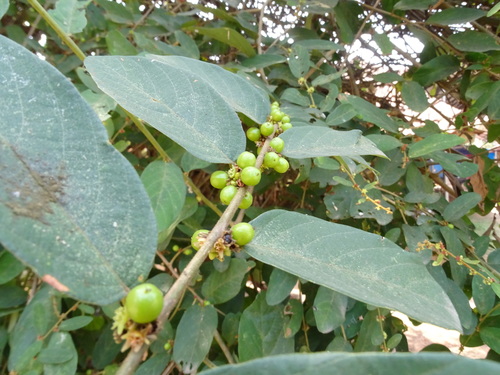
Aporosa cardiosperma
(Gaertn.) Merr.
iNaturalist· cc-by
(c) Siddarth Machado, some rights reserved (CC BY), uploaded by Siddarth Machado
Summary
Source: WikipediaAporosa cardiosperma is a species of plant in the family Phyllanthaceae. It is endemic to South-West India and Sri Lanka. The fruit has two seeds covered with sour gelatinous pulp that is fed on by birds (and edible for humans) which disperse the seeds. In the Western Ghats of India, the thin stems of the tree are often galled by Cecidomyiidae. An echinate gall formation has also been noted in Kerala. A herbal concoction of the leaves is used in traditional remedies for jaundice and other conditions. Antioxidant and hypoglycemia inducing properties of its extracts have been noted in laboratory studies.
Description
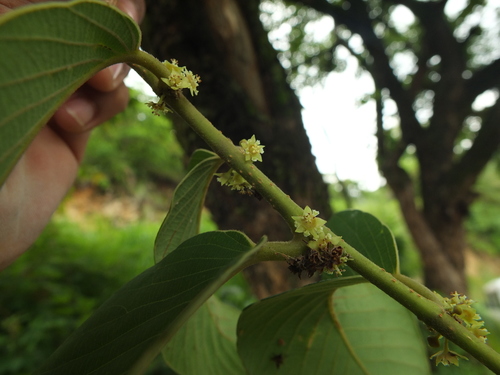
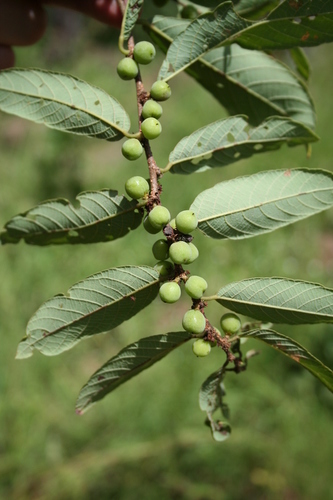
An evergreen tree. It grows 20 m tall. The leaves are simple. They are 8-18 cm long by 3-8 cm wide. Male and female flowers are separate on the same plant. Male flowers are yellow and can occur separately or in clusters in a spike. The fruit are yellow when ripe. The fruit is a capsule 10-12 mm across. The fruit is small and berry-like. It is edible. There is one brown seed.
Edible Uses
The young leaves are eaten. The ripe fruit are eaten raw, specifically the fleshy aril layer surrounding the seed.
Traditional Uses
The young leaves are eaten. The ripe fruit are eaten raw. It is the aril of fleshy layer around the seeds that is eaten.
This uses section is brief — help expand it
Distribution
It is a tropical plant. It grows in evergreen forests and on the plains.
Where It Grows
Asia, India, Sri Lanka,
Production
In southern India plants flower and fruit December to June.
Nutrition
| Part | Moisture | kJ | kcal | Protein | Vit A | Vit C | Iron | Zinc |
|---|---|---|---|---|---|---|---|---|
| Fruit | 92.4 | — | 34.4 | 0.02 | — | — | 3.7 | — |
| Leaves | — | — | — | — | — | — | — | — |
Synonyms
Also Known As
Chappu palam, Etti, Kambokka, Kampotta, Sali, Salle, Saroli hannu, Sulla, Thali, Valaka, Vetti, Vettikan, Vettil
References (11)
- Ajesh, T. P., et al, 2012, Ethnobotanical Documentation of Wild Edible Fruits used by Muthuvan Tribes of Idukki, Kerala-India. International Journal of Pharma and Bio Sciences 3(3): 479-487
- Ambasta S.P. (Ed.), 2000, The Useful Plants of India. CSIR India. p 48 (As Aporosa lindleyana)
- Ashton, M. S., et al 1997, A Field Guide to the Common Trees and Shrubs of Sri Lanka. WHT Publications Ltd. p 194 (Also as Aporosa lindleyana)
- Binu, S., 2010, Wild edible plants by the tribals in Pathanamthitta district, Kerala. Indian Journal of Traditional Knowledge. 9(2): 309-312 (As Aporosa lindleyana)
- Chandrashekara, U. M., 2009, Tree species yielding edible fruit in the coffee-based homegardens of Kerala, India: their diversity, uses and management. Food Sec. 1:361-370 (As Aporosa lindleyana)
Show all 11 references Hide references
- Hedrick, U.P., 1919, (Ed.), Sturtevant's edible plants of the world. p 65 (As Aporosa lindleyana)
- Khaple, A. K. et al, Population Studies of Wild Edible Fruit Tree Species in Kodagu. International Journal of Life Sciences Vol. 1 No 3. pp 48-55 (As Aporosa lindleyana)
- Nazarudeen, A., 2010, Nutritional composition of some lesser-known fruits used by the ethnic communities and local folks of Kerala. Indian Journal or Traditional Knowledge. Vol. 9(2): 398-402 (As Aporusa lindleyana)
- Ramachandran, V.S., 1987, Further Notes on the Ethnobotany of Cannanore District, Kerala. J. Econ. Tax. Bot. Vol. 11 No. 1 pp 47- (As Aporosa lindleyana)
- Ramachandran,V. S., & Udhayavani, C., 2013, Knowledge and uses of wild edible plants by Paniyas and Kurumbas of Western Nilgiris, Tamil Nadu. Indian Journal of Natural Products and Resources. 4(4) December 2013, pp 412-418
- Ravikrishna, S., 2011, Ethno-medico-botanical survey on Wild Edible fruits of Udupi Taluq, Udupi p 54 (As Aporusa lindeleyana)