Casuarina glauca
Sieber. ex Spreng.
Swamp sheoak, Grey Buloke
iNaturalist· cc-by-nc
(c) Russell Barrett, some rights reserved (CC BY-NC), uploaded by Russell Barrett
iNaturalist· cc-by-nc
(c) Russell Barrett, some rights reserved (CC BY-NC), uploaded by Russell Barrett
iNaturalist· cc-by-sa
(c) Douglas Goldman, some rights reserved (CC BY-SA), uploaded by Douglas Goldman
Summary
Source: WikipediaCasuarina glauca, commonly known as swamp she-oak, swamp buloke, swamp she-oak, marsh sheoak, grey she-oak, grey she-oak, native pine, or guman by the Gadigal people, is a species of flowering plant that is endemic to eastern Australia. It is a dioecious tree that often forms root suckers and has fissured and scaly bark, spreading or drooping branchlets, the leaves reduced to scales in whorls of 12 to 20, the fruit 9–18 mm (0.35–0.71 in) long containing winged seeds (samaras) 3.5–5.0 mm (0.14–0.20 in) long.
Description
A small sturdy tree. It grows 2-10 m tall and spreads 2-10 m wide. It often has root suckers. The small branches are 10-35 cm long. They are 0.9-1.5 mm wide. They have 12-17 ridges along them. There are tooth like leaves at the nodes. The leaves are 0.5-0.9 mm long. The leaves are grey-green. The flowers are reddish-brown. The cones are small. They are 9-18 mm long and 8-13 mm wide.
Edible Uses
The needle-like leaves are chewed to relieve thirst.
Traditional Uses
The gum is edible. The small seeds are edible.
This uses section is brief — help expand it
Medicinal Uses
None known
Known Hazards
There is a report that the pollen might be allergenic.
Distribution
It grows in temperate and subtropical regions. It needs well drained soils but likes wet soil. It can grow in full sun and in coastal areas. It can stand heavy frosts. It suits hardiness zones 9-12. Arboretum Tasmania.
Where It Grows
Australia, Dominican Republic, Hawaii, Norfolk Island, Pacific, Tasmania, USA, West Indies,
Cultivation
Requires a well-drained moisture-retentive soil in full sun. Succeeds in most soils in Australian gardens, including saline ones, and is tolerant of salt spray. Plants are reported to tolerate high pH, limestone soils, low pH, salt and sand dunes, water-logging, weeds, and wind. Reported to tolerate an annual precipitation in the range of 50 to 400cm, estimated annual temperature range of 18 to 28°C, and a pH of 5 to 8. Plants have grown in Israel under a soil crust of salt (50,000 ppm). Rarely tolerates temperatures lower than -3°C. Tolerates temperatures down to at least -7°c in Australian gardens, and plants are said to tolerate frost in South Africa, although this cannot be translated directly to British gardens due to our cooler summers and longer, colder and wetter winters. It might succeed outdoors in the mildest areas of the country. Spreading by means of root suckers, this species has become a pest in some parts of Florida. Closely related to C. cunninghamiana, though somewhat less hardy, it often hybridises in the wild with that species. In fine-textured clays, even in waterlogged soils, C. glauca can develop a deep root system, while C. cunninghamiana and C. equisetifolia develop shallow roots and grow poorly. This species has a symbiotic relationship with certain soil micro-organisms, these form nodules on the roots of the plants and fix atmospheric nitrogen. Some of this nitrogen is utilized by the growing plant but some can also be used by other plants growing nearby. Although Nitrogen nodulation is most successful at pH 6 to 8, some natural stands are well nodulated in acid soils (pH ca 4). In garden design, as well as the above-ground architecture of a plant, root structure considerations help in choosing plants that work together for their optimal soil requirements including nutrients and water.
Propagation
Sow seed in late winter to early summer in a greenhouse, barely covering it. Prick seedlings into individual pots when large enough to handle and grow on under cover for at least their first winter. Plant out into permanent positions in late spring or early summer after the last expected frost. There are between 700,000 and 970,000 seeds per kilogram. Cuttings of half-ripe wood can be taken in July or August and rooted in a frame.
Other Uses
The plant suckers freely and forms an effective windbreak. It has been used to reclaim eroded land, including mountainsides, and to establish shelterbelts. It spreads vigorously via suckers and has become a noxious weed in some areas; its planting is banned in parts of Florida. Ditches are sometimes dug on both sides of a shelterbelt planting to contain its spread. The wood is tough and is considered superior to hickory for axe handles. The brownish, attractively marked timber is used for fencing rails, shingles, saltwater pilings, poles, charcoal, and fuel. Casuarina species have very dense wood with a specific gravity of 0.8–1.2 and a calorific value of approximately 5,000 kcal/kg. The wood splits easily, burns slowly with little smoke or ash, and can be burned green — an important advantage in fuel-scarce areas. From their fourth year, trees shed approximately 4 tons of cones per year, which also make good pellet-sized fuel.
Notes
There are about 17 Casuarina species. It can become invasive.
Also Known As
scaly oak (Australia). English: black casuarina (Australia); black she-oak (Australia); Brazilian oak (Australia); gray she-oak (Australia); grey buloke; grey she-oak (Australia); longleaf casuarina; scaly bark beefwood (Australia); suckering Australian pine; suckering casuarina (Australia); swamp oak (Australia); swamp she-oak (Australia). Spanish: casuarina; pino de Australia. French: pin d'Australie. Bahamas: suckerling Australian pine. Malaysia: ru paya.
References (14)
- Caton, J.M. & Hardwick, R. J., 2016, Field Guide to Useful Native Plants from Temperate Australia. Harbour Publishing House. p 48
- Cundall, P., (ed.), 2004, Gardening Australia: flora: the gardener's bible. ABC Books. p 341
- Doran, J.C., & Turnbull, J.W. (Eds), 1997, Australian Trees and Shrubs: species for land rehabilitation and farm plantings in the tropics. ACIAR Monograph No 24. p 268
- Etherington, K., & Imwold, D., (Eds), 2001, Botanica's Trees & Shrubs. The illustrated A-Z of over 8500 trees and shrubs. Random House, Australia. p 190
- Flora of Australia Volume 49, Oceanic Islands 1, Australian Government Publishing Service, Canberra. (1994) p 72
Show all 14 references Hide references
- Greig, D., 1996, Flowering Natives for Home Gardens. Angus & Robertson. p 112
- Lord, E.E., & Willis, J.H., 1999, Shrubs and Trees for Australian gardens. Lothian. p 14
- Marinelli, J. (Ed), 2004, Plant. DK. p 448
- Melzer, R. & Plumb, J., 2011, Plants of Capricornia. Belgamba, Rockhampton. p 92
- Molyneux, B & Forrester, S., 1997, The Austraflora A-Z of Australian Plants. Reed. p 65
- Plants for a Future database, The Field, Penpol, Lostwithiel, Cornwall, PL22 0NG, UK. http://www.scs.leeds.ac.uk/pfaf/
- Sainty, G.R. & Jacobs, S.W.L., 1981, Waterplants of New South Wales. Water Resources Commission. NSW p 87
- Syst. veg. 3:803. 1826
- World Checklist of Useful Plant Species 2020. Royal Botanic Gardens, Kew
More from Casuarinaceae
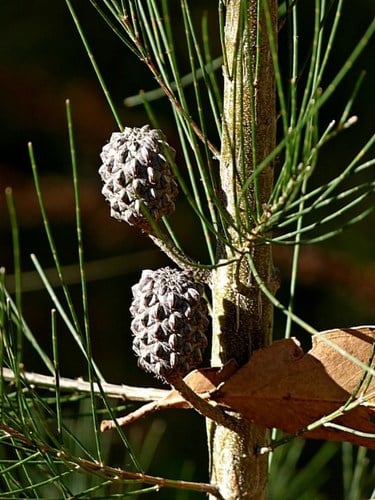
Allocasuarina littoralis
Black she-oak
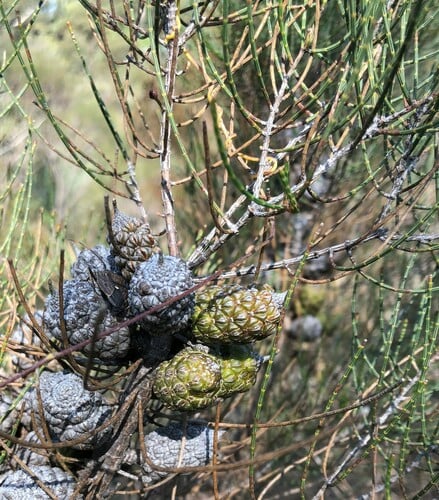
Allocasuarina muelleriana
Slaty she-oak
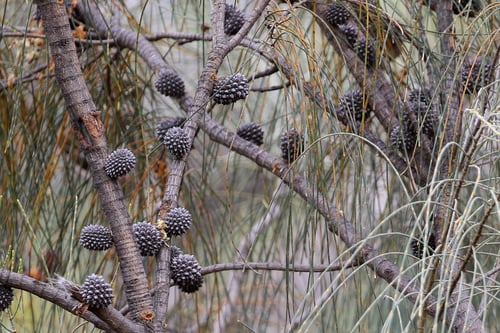
Allocasuarina verticillata
Mountain she oak, Drooping she oak
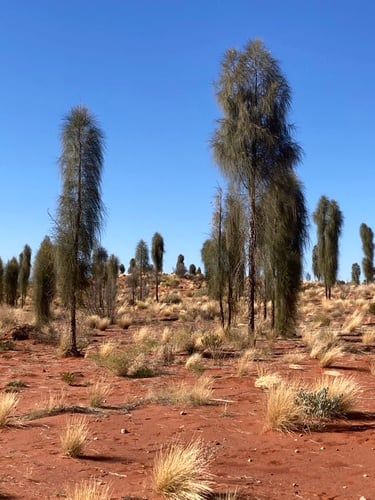
Casuarina decaisneana
Desert Oak
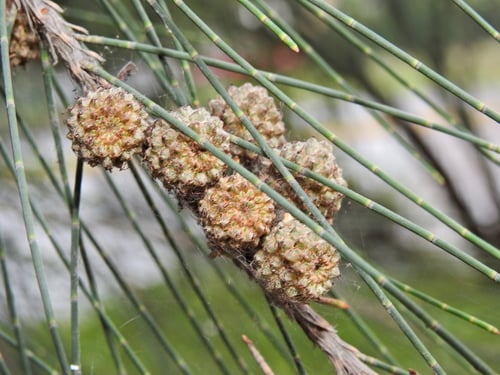
Casuarina equisetifolia
She oak, Shingle Oak, Coastal She Oak
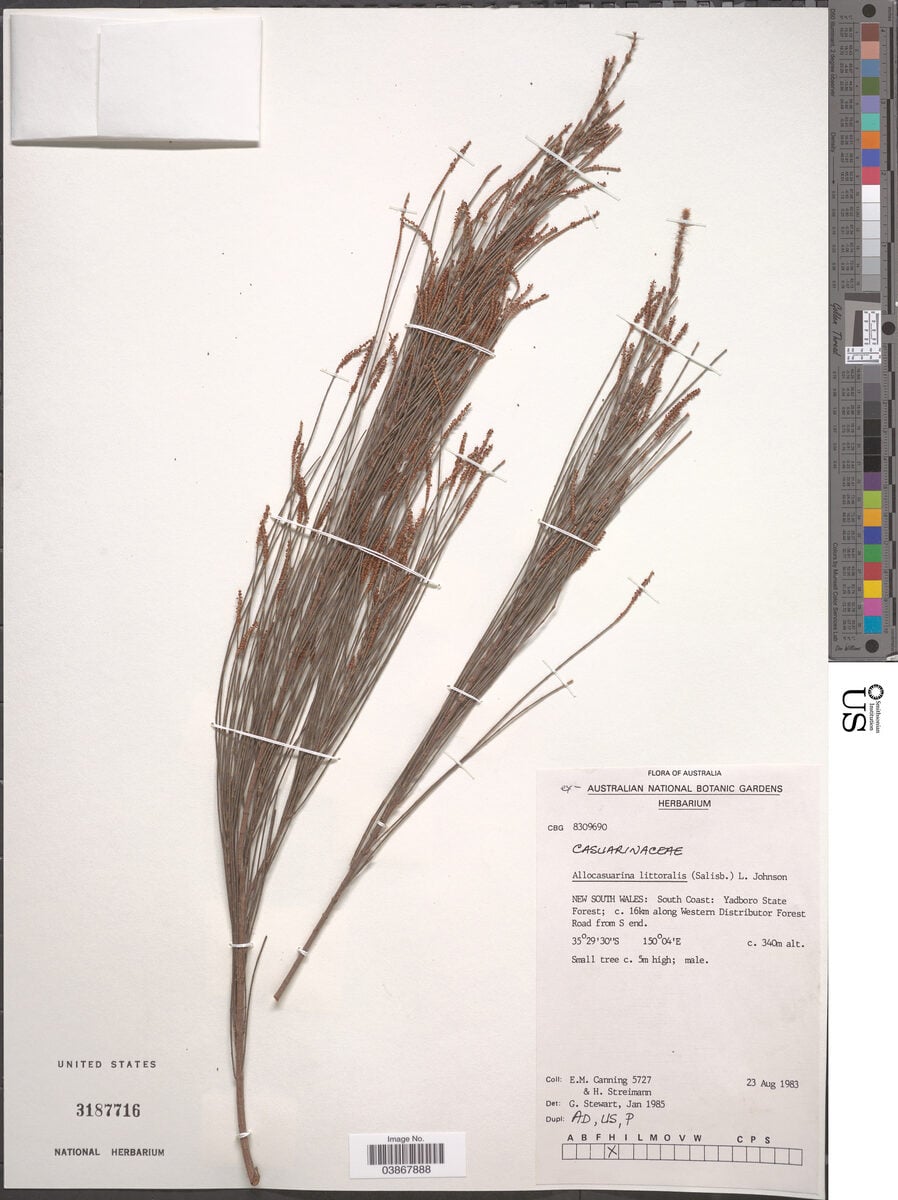
Casuarina littoralis - (Salisb.) L.A.S.Johnson
Black She Oak, Bull Oak, Wayetuck