Livistona chinensis
(Jacq.) R. Br. ex Mart.
Chinese fan palm, Fountain palm
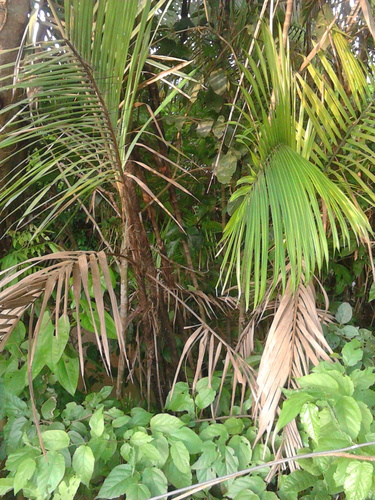
iNaturalist· cc-by
(c) Forest and Kim Starr, some rights reserved (CC BY)
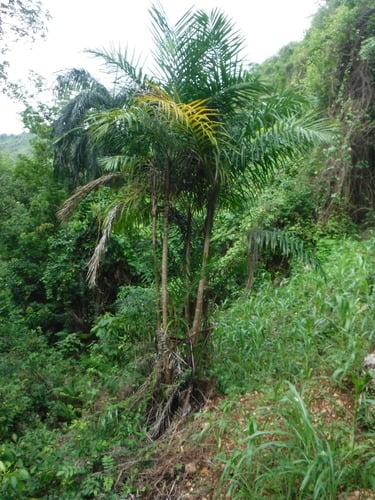
iNaturalist· cc-by-nc
(c) Keita Watanabe, some rights reserved (CC BY-NC)
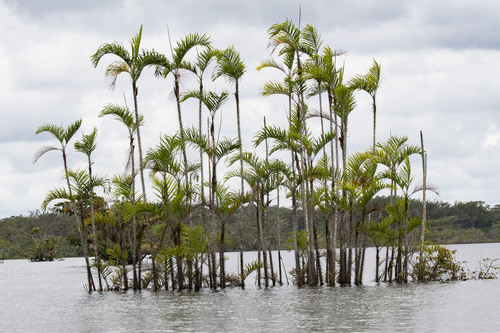
iNaturalist· cc-by-nc
(c) ChuSR, some rights reserved (CC BY-NC), uploaded by ChuSR
Summary
Source: WikipediaLivistona chinensis, the Chinese fan palm or fountain palm, is a species of subtropical palm tree of east Asia. It is native to southern Japan, Taiwan, the Ryukyu Islands, southeastern China and Hainan. In Japan, two notable populations occupy islands near the coast of Miyazaki Prefecture, Aoshima and Tsuki Shima. It is also reportedly naturalized in South Africa, Mauritius, Réunion, the Andaman Islands, Java, New Caledonia, Micronesia, Hawaii, Florida, Bermuda, Puerto Rico and the Dominican Republic.
Description
A solitary palm. The trunk is 15 m tall and 20-30 cm across. It is rough with leaf scars. The leaves have leaflets like fingers on a hand. The leaf stalks are 1.8 m long. There are spines that curve back along the edge. The leaves are almost round in outline. They are 1.2-1.6 m across. They are divided into 50-90 segments. These hang down at the tips. The flowering stalks are 1 m long. They are branched 3 times.
Edible Uses
The young immature flowering shoots are cooked with meat and sold in local markets.
Traditional Uses
The young immature flowering shoots are cooked with meat.
This uses section is brief — help expand it
Distribution
It is a subtropical plant. It grows in coastal forests often on sandy soils. In XTBG Yunnan.
Where It Grows
Asia, Australia, China, Dominican Republic, Fiji, Guam, India, Indonesia, Japan, Nauru, Marquesas, Marshall Islands, Mayotte, Micronesia, Myanmar, North America, Northeastern India, Pacific, Pakistan, Rotuma, SE Asia, Taiwan, USA, Vietnam, West Indies,
Cultivation
Plants can be grown from seeds.
Propagation
Seed - when sown fresh it can germinate in 1 - 2 months.
Other Uses
The leaves are used for making fans. They are also used for manufacturing rain hats and coats, brooms etc. The fibres, extracted from the sheath and the petiole of the leaves, are made into cordage.
Other Information
Flowering shoots are sold in local markets.
Synonyms
Also Known As
Buar-pui, Palem kipas cina, Tayok-htan
References (4)
- Kar, A., et al, 2013, Wild Edible Plant Resources used by the Mizos of Mizoram, India. Kathmandu University Journal of Science, Engineering and Technology. Vol. 9, No. 1, July, 2013, 106-126
- Khodram,S. D., et al, 2019, Local knowledge of edible flowers used in Mizoram. Indian Journal of Traditional Knowledge Vol 18(40 pp 715-723
- Sukarya, D. G., (Ed.) 2013, 3,500 Plant Species of the Botanic Gardens of Indonesia. LIPI p 790
- Vander Velde, N, 2003, The Vascular Plants of Majuro Atoll, Republic of the Marshall Islands. Atoll research Bulletin. No. 503. Smithsonian Institute. p 32